Design Meets Data: A Guide to Building Interactive Power BI Report Navigation


In the world of data visualization, we are constantly seeking ways to convey information and captivate our audience. Our goal is to enhance the aesthetic appeal of our Power BI reports, making them more than just vehicles for data—they become compelling narratives. By leveraging Figma, we aim to infuse our reports with design elements that elevate the overall user experience, transforming complex data into interactive stories that engage and enlighten.

A cornerstone of impactful multi-page reports is effective navigation. Well-designed navigation is a beacon that guides our users through the sea of data, ensuring they can uncover the insights they seek without feeling overwhelmed or lost. This post serves as a guide on how we can use Figma to enhance our Power BI report navigation beyond the use of just Power BI shapes, buttons, and bookmarks to create interactive report navigation that boosts the user experience of our reports.

In this guide, we will explore how to go beyond using the page navigator button option in Power BI and craft a report navigation that is intuitive, interactive, and elevates the visual aspects of our report. We will dive into how we can use Figma’s design capabilities combined with the interactive features of Power BI to create such an experience.
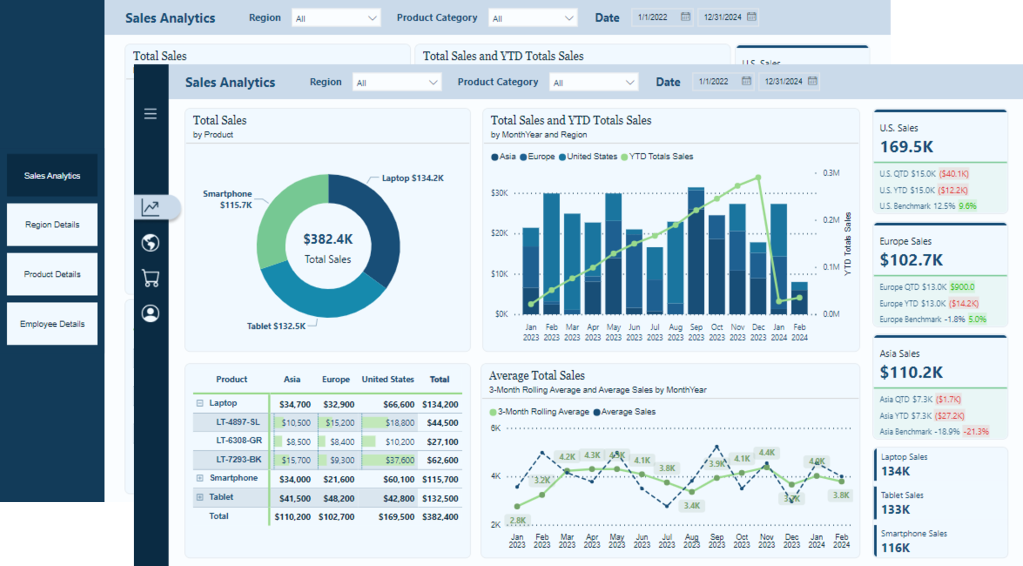
The navigation we will create is a vertical and minimalistic navigation displaying visual icons for each of the report’s pages. This allows our users to focus on the data and the report visuals and not be distracted by the navigation. However, when our users require details on the navigation options, we will provide an interactive experience to expand and collapse the menu.
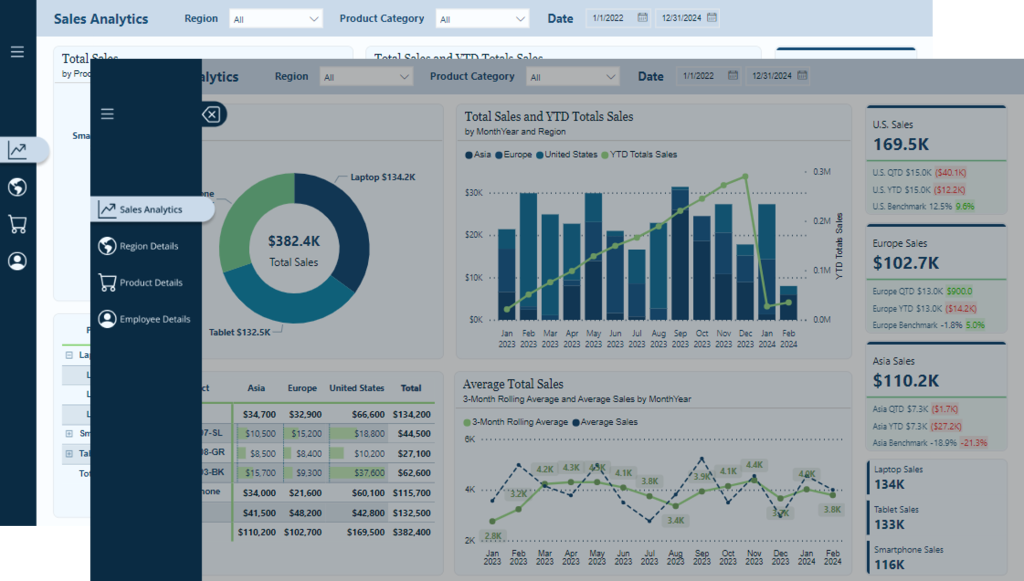
Keep reading to get all the details on leveraging the design functionality offered by Figma and the interactive elements, including buttons and bookmarks in Power BI. By the end, we will have all we need to craft report navigation elements that captivate and guide our audience, making every report an insightful and enjoyable experience.

Get Started with Power BI Templates: For those interested in crafting a similar navigation experience using Power BI built-in tools, visit the follow-up post below. Plus, get started immediately with downloadable Power BI templates!

User-Centric Design: Next level reporting with interactive navigation for an enhanced user experience

Also, check out the latest guide on using Power BI’s page navigator for a streamlined, engaging, and easy-to-maintain navigational experience.

Streamlined report navigation with built-in tools to achieve functional, maintainable, and engaging navigation in Power BI reports.

Diving Into Figma: Designing Our Navigation

Starting the journey of enhancing our Power BI reports with Figma begins with understanding why Figma is a powerful design tool. The beauty of Figma lies in its simplicity and power. It is a web-based tool that allows designers to create fluid and dynamic UI elements without a steep learning curve associated with some other design software. Another great aspect of Figma is the community that provides thousands of free and paid templates, plugins, and UI kits to get our design kickstarted.

Explore thousands of free and paid templates, plugins, and UI kits to kickstart your next big idea.

To get started with Figma, we will need to create an account. Figma offers various account options, including a free version. The free version provides access to the most important aspects of Figma but limits the number of files we can collaborate on with others. Here is a helpful guide on getting started.

Welcome to Figma. Start your learning journey with beginner-friendly resources that will have you creating in no time.

For our Power BI reports, using Figma means designing elements that are aesthetic and functional. Reducing the number of shapes and design elements required in our Power BI reports aids in performance.

Crafting the Report Navigation

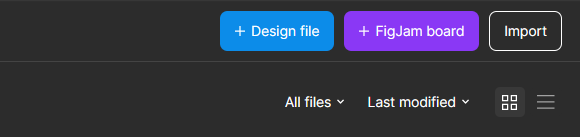
Once logged into Figma, we will start by selecting Drafts from the left side menu, then Design File in the upper right to open a new design file in Figma.
To get started with our new design we will add a frame to our design file and define the shape and size of our design.
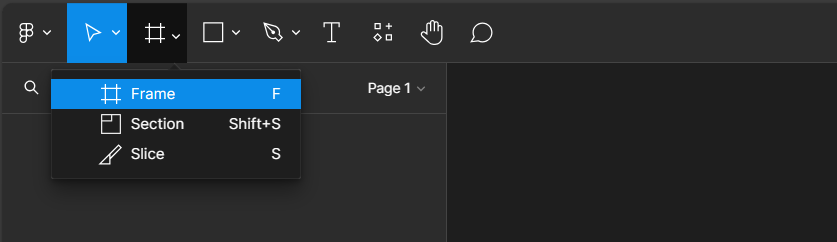
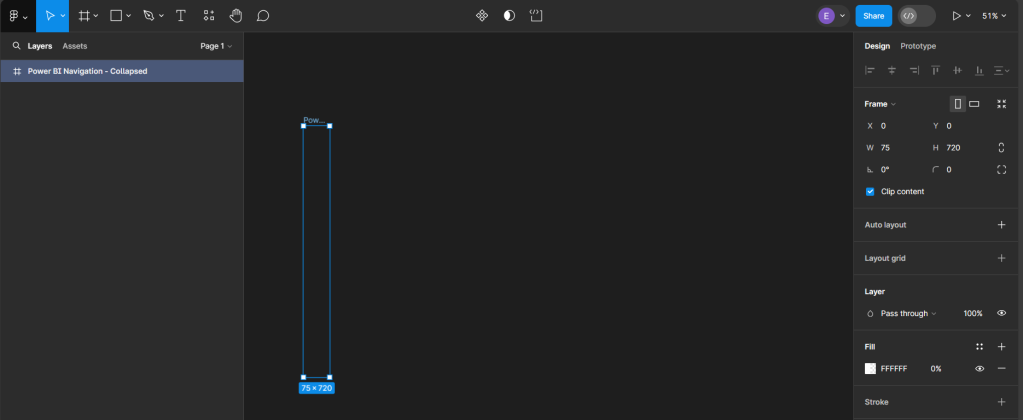
After selecting Frame, a properties panel will open to set the size of the Frame. For a standard Power BI report, the canvas size is typically 1280 x 720. We can use the pre-established size option for TV (under Desktop). We then rename the Frame by double-clicking on the Frame name in the Layers Panel and entering the new name, here we will use Power BI Navigation Collapsed. Then modify the width, since the navigation won’t occupy the entire report, to 75, and set the fill to transparent. This will act as the background or a container for our navigation when collapsed.
Creating Local Variables and Base Elements

Before getting started adding elements to our navigation we will create local variables to store the theme colors of our navigation. On the Design pane, locate local variables and then select open variables.
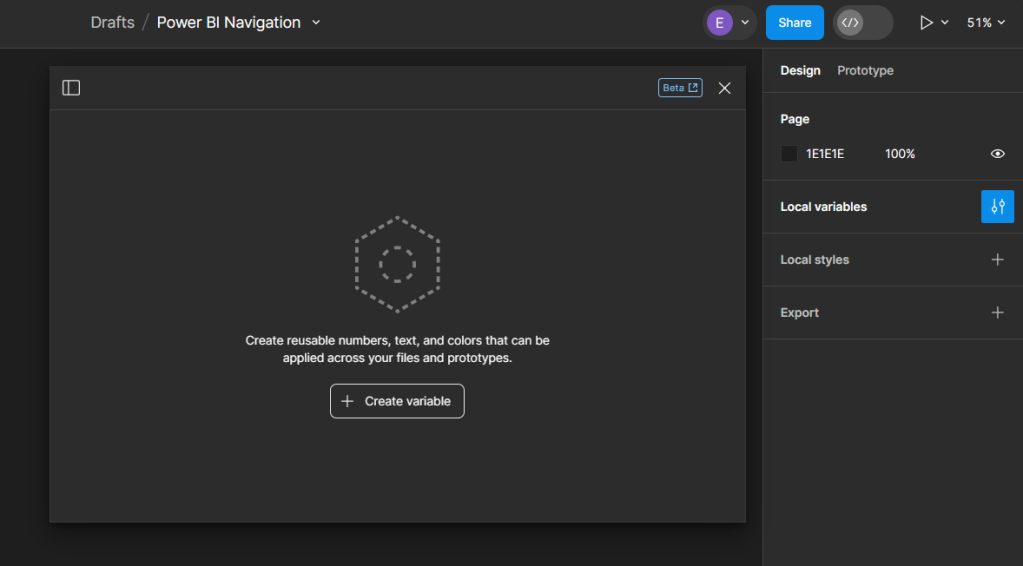
Select Create variable and then Color to get started. For the navigation, we will create two color variables, one corresponding to the background element color and the other the first-level element color of our Power BI theme. If we are using Figma to design wireframes or mock-ups of our Power BI report, we can easily expand the number of variables to include all the colors used within the Power BI theme.

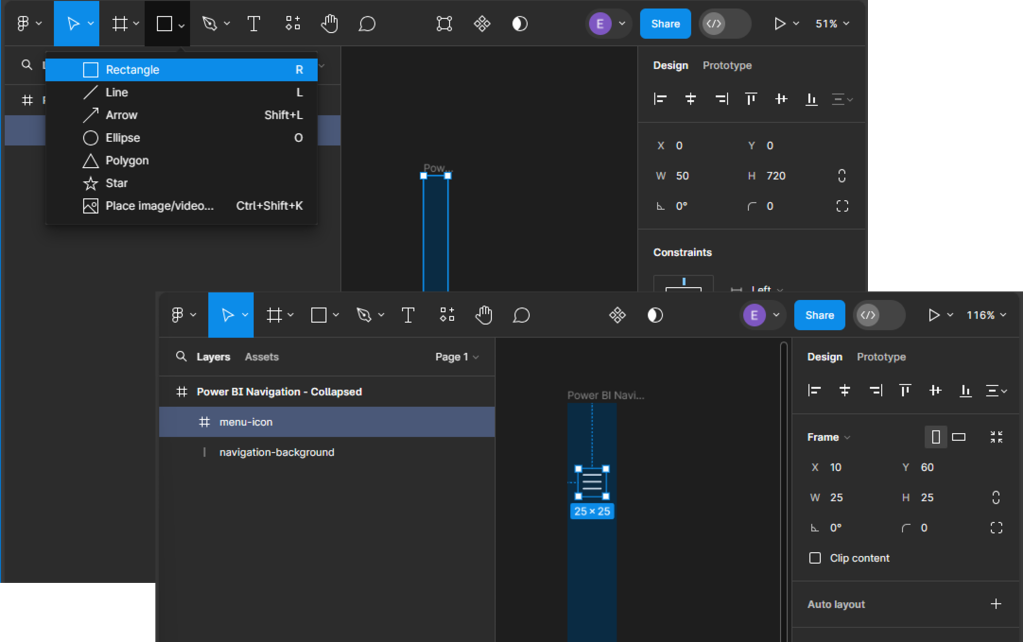
We start building our navigation by adding the base elements. This design includes the dark blue rectangle that will contain our navigation icons and the menu icon that, when clicked, will expand the navigation menu. Under the Shape tools menu select rectangle to add it to our Power BI Navigation - Collapsed frame, then set the width to 45.

Next, we will add the menu icon that will act as a button to expand and collapse the navigation menu. For this navigation, we will use a list or hamburger menu icon with a height and width of 25 that is centered and set towards the top within our navigation background. Then, set the color of the icon to our background-element variable. When searching for icons that fit the report’s styling, the Figma community has a wide range of options to offer.
Adding Page Navigation Icons

Once our base elements are set, we can move on to adding our page icons that will act as the page navigation buttons when the menu is collapsed. In the final report, we will add this navigation menu to contain four pages, so we will add an icon for each page. All icons will be the same size as the menu icon (height and width set to 25), centered horizontally in the navigation background, positioned vertically towards the top, and their color set to our background-element color.
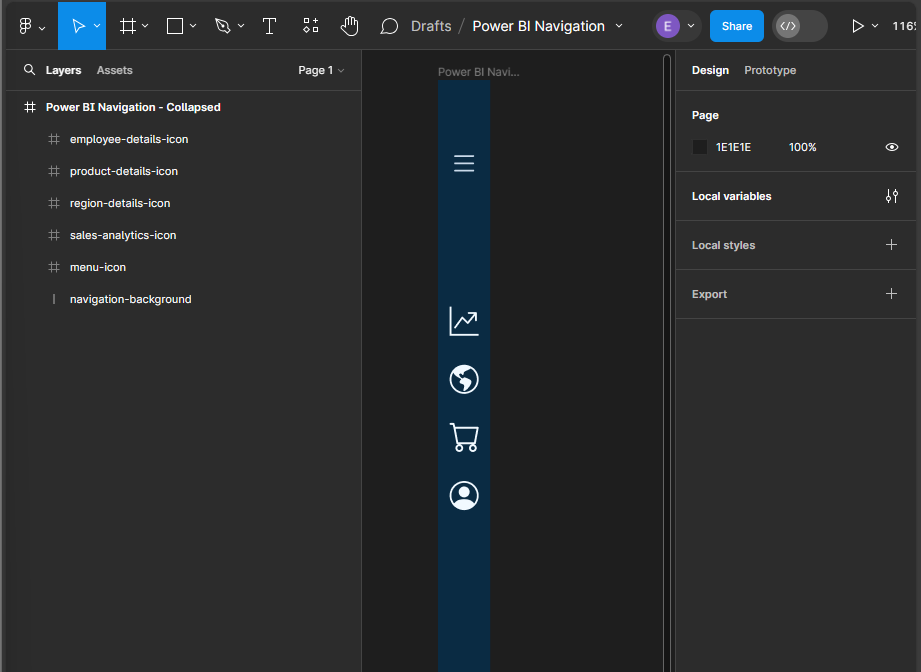
This will serve as our base or template navigation menu for all pages. Next, we will copy this for each page in our report and modify it to indicate the current page.

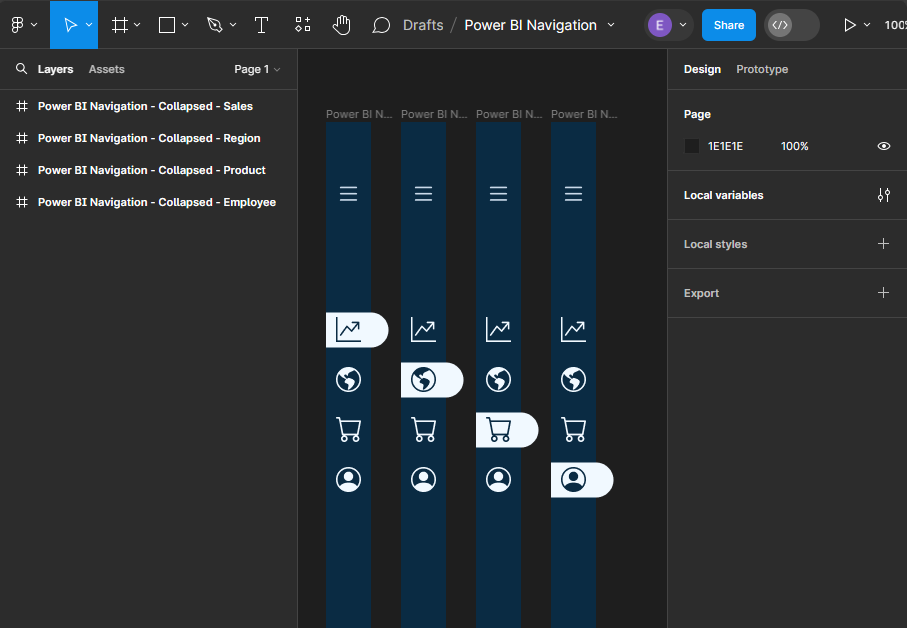
To do this, we first add a line (under the Shape tools) with a width of 45, a stroke color of our background element, a stroke size of 35, and a round end point. Then, position it in the layers pane directly above the navigation so that it appears under the page icons. Once created, align it horizontally with the navigation background, and vertically centered under the current page icon. Update the color of the icon to the first-level-element variable, and then add a drop shadow. Repeat this process for each page icon, creating a navigation menu that can be added to each page of our report.
Creating the Expanded Menu

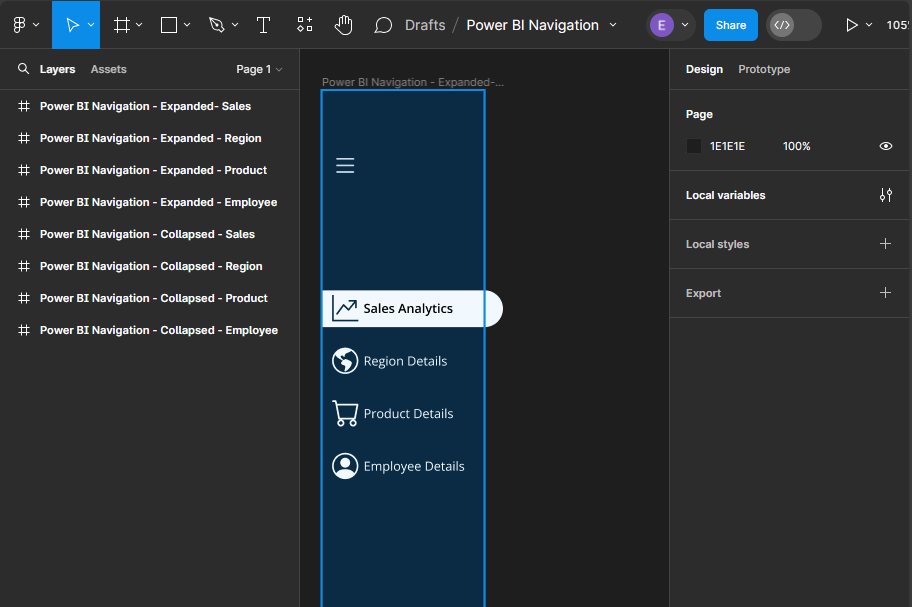
Now that we have completed the collapsed menu design elements, we will use these as the base to create the expanded menu. Creating the expanded menu starts by duplicating each of the collapsed menus. Once duplicated, we will rename each of the Power BI Navigation Frames to replace Collapsed with Expanded and then carry out a few steps for each.

First, we increase the width of the Frame from 75 to 190, the width of the navigation-background rectangle, and the current-page indicator from 45 to 155.

Next, add new Text components for each page icon in the menu. The font color for each text component will match the icon’s color, and the font weight for the selected page text will be set to semi-bold.
In addition to being able to use the menu icon to toggle the navigation between collapsed and expanded, we will also add a specific collapse menu icon to the expanded menu. We first add a new line element to the expanded menu frame, with a width of 15, stroke size 35, and stroke color first-level-element. We position this on the right side of our navigation background and align it vertically centered with the menu icon. Then add a close icon with the same dimensions as all of our other icons and position it centered on this new line component.
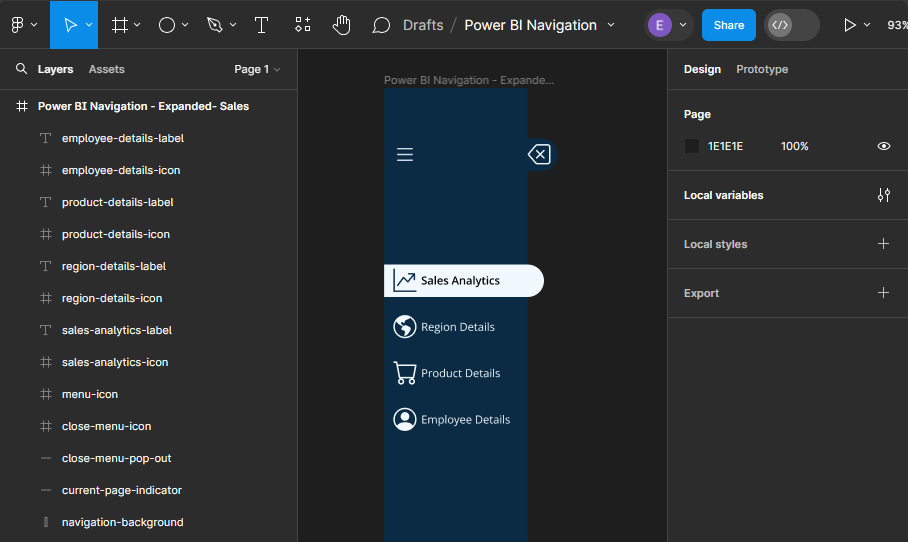
By following these steps, we have taken the first step towards creating a visually appealing, dynamic, and interactive navigation element that will make our Power BI reports more engaging and user-friendly.

Exporting Figma Designs and Importing in Power BI

Once our navigation element is finished in Figma, the next step is bringing it to life within our Power BI Report. This involves exporting the designs from Figma and importing them into Power BI.

Preparing Our Figma Design for Export

Before exporting our design, it is always a good idea to double-check the size of the different components to ensure they are exactly what we want, and so they integrate with our Power BI report seamlessly. Figma allows us to export our designs in various formats, but for Power BI, PNG or SVG files are a common choice.

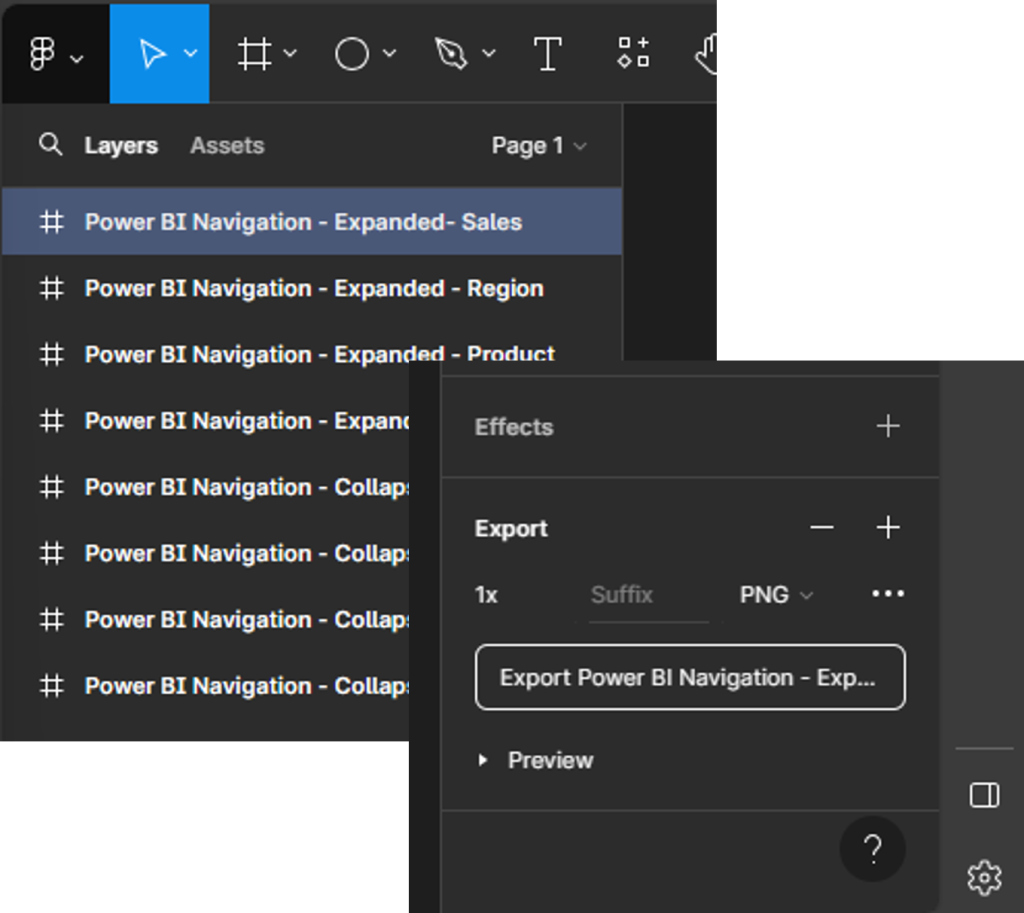
To export our designs, select the Frame from the layers pane (e.g., Power BI Navigation—Expanded—Sales), and then locate export at the bottom of the design pane on the right. Select the desired output file type, then select Export.
Importing and Aligning Figma Designs within Power BI

Once our designs are exported, importing them into Power BI is straightforward. We can add images through the Insert menu, selecting Image and navigating to our exported design files.

Once imported, we adjust a few property settings on the image so it integrates with our report, creating a cohesive look and feel. First, select the image, and in the Format pane under General > Properties, we turn off the Lock aspect ratio option and then set the height to 720 and width to the width of the Figma frame (e.g., 75). Then we set the padding on all sides to zero. This ensures that our navigation is the same height as our report and appears properly.
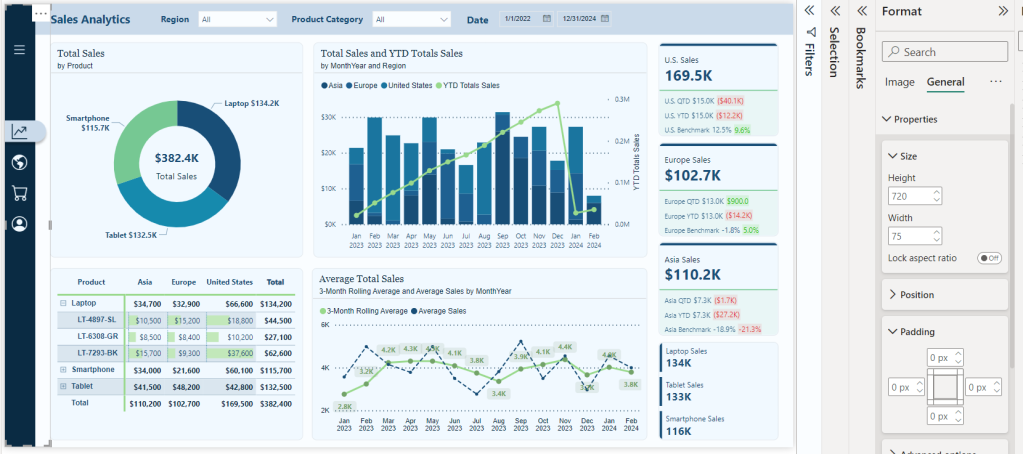
Repeat the above process for the expanded navigation design.

Bringing Our Navigation to Life with Power BI Interactivity

When we merge our design elements with the functionality of interactivity of Power BI, we elevate our Power BI reports into dynamic, user-centric journeys through the data. This fusion is achieved through the strategic use of Power BI’s buttons and bookmarks, paired with the aesthetic finesse of our Figma-designed navigation.

Understanding the Role of Buttons and Bookmarks

Buttons in Power BI serve as the interactive element that users engage with, leading to actions such as page navigation, data filtering, or launching external links. The key to leveraging buttons effectively is to design them in a way that they are intuitive and aligned with the overall design of our report.

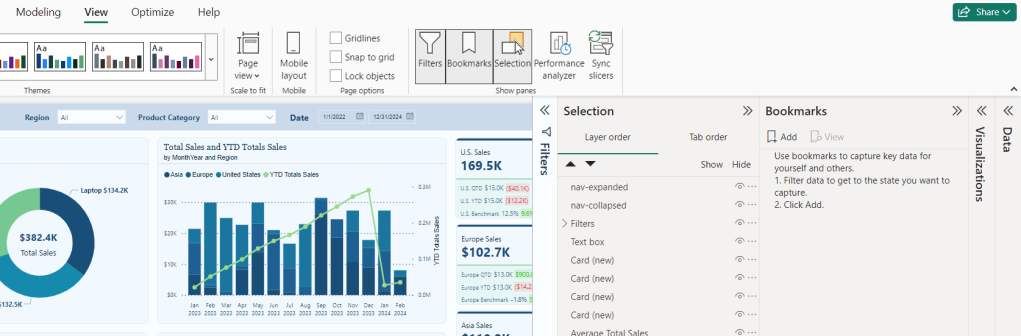
Bookmarks capture and recall specific states of a report, and most importantly for our navigation, this includes the visibility of objects. To create a bookmark first go to the View menu and select bookmarks to show the Bookmarks pane. Then we set our report how we want it to appear, then click Add, or if the bookmark already exists, we can right-click and select Update.

Step-by-Step Guide

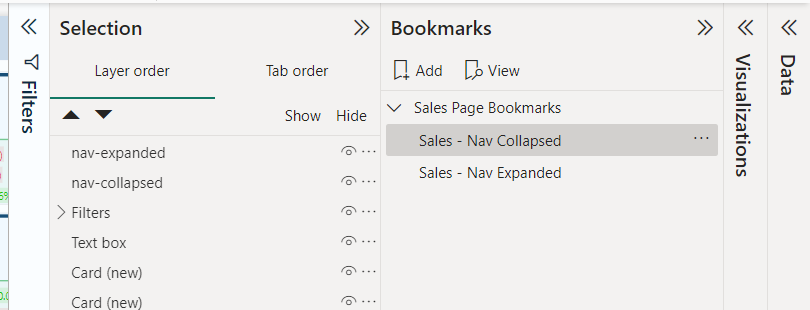
  1. First from the View menu we will turn on the Selection and Bookmarks pane to get our report objects and bookmarks set for our navigation. We will see the image object in our Selection pane, which will be the two navigation images we previously imported. Rename these to give descriptive names, so we can tell them apart. For example nav-collapsed and nav-expanded.
  1. We will add two bookmarks to this page of the report, one corresponding to the collapsed navigation and one for the expanded navigation. To keep our bookmarks organized, we will give them a descriptive name (<page-name>- Nav Collapsed and <page-name>-Nav Expanded) and if needed we can use groups to further organize them.
  1. Now we will add buttons that overlay our navigation design element to add interactivity for our users. We will a blank button to our report with a width of 45 and a height of 35.
    • Then on the Format pane under Style, locate the Fill option for the button toggle it on, and set the following for the Default, On Hover, and On Press states.
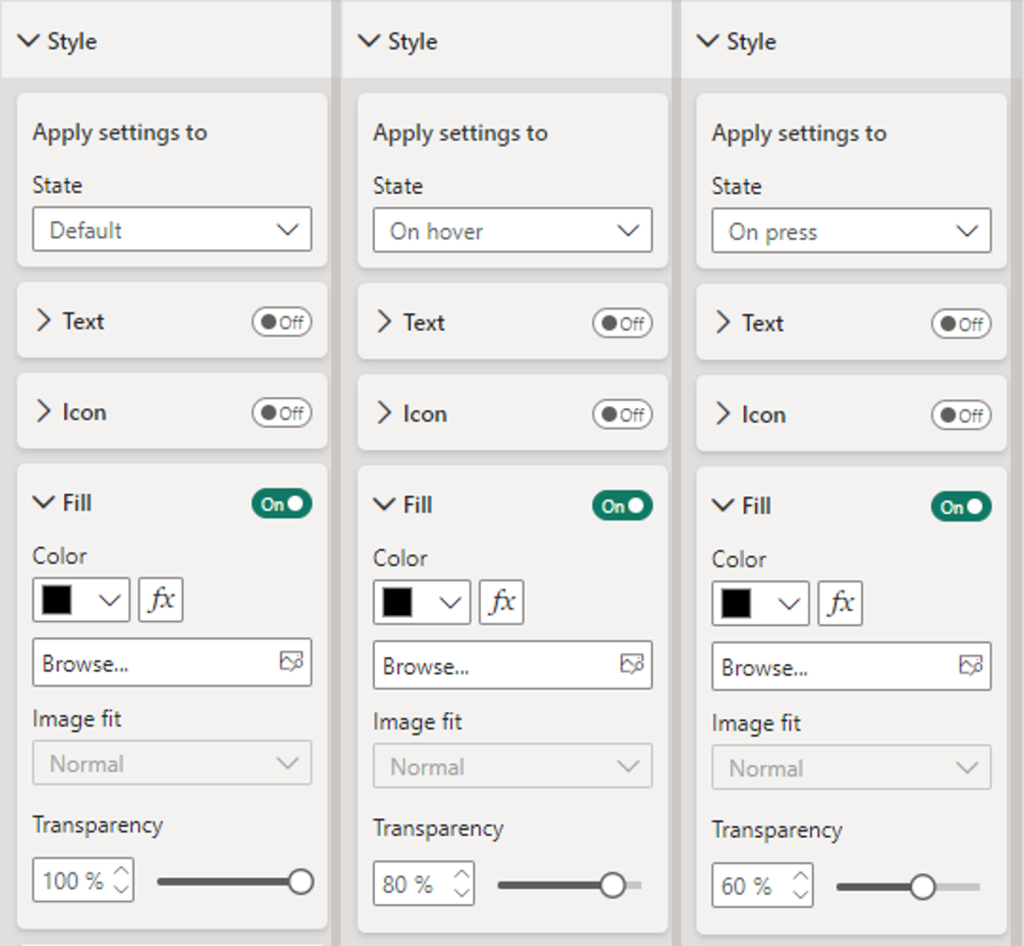
      • Default: Fill: Black, Transparency: 100%
      • On Hover: Fill: Black, Transparency: 80%
      • On Press: Fill: Blank, Transparency: 60%

Duplicate this button for each page icon and position the buttons so that they overly each icon in the navigation menu. In the Selection pane double-click each button to rename the object providing it a description name (e.g. nav-collapsed-menu). Then select all and group them, providing the group a name as well (e.g. nav-collapsed-buttons).
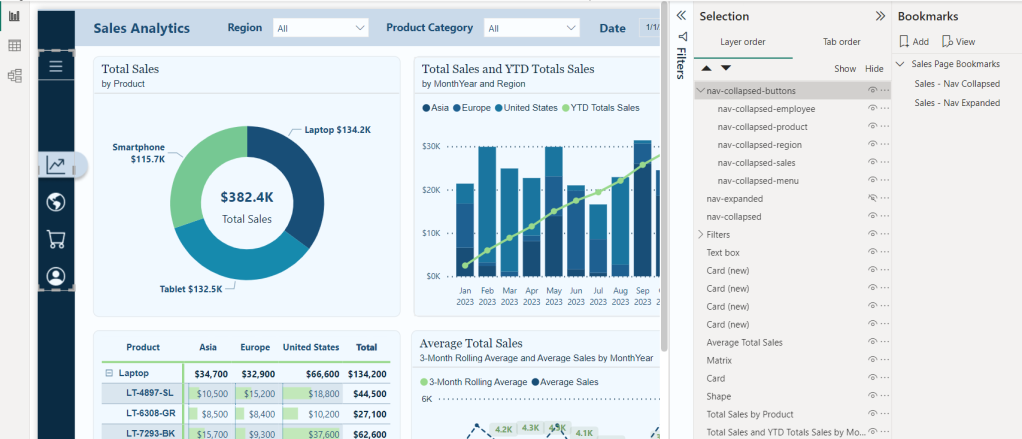
  1. Now that our buttons are created, styled, and positioned, we will set the specific actions required by each.
    • Navigation menu icon
      • Action
        • Type: Bookmark
        • Bookmark: Sales – Nav Expanded
        • Tooltip text: Expand Navigation Menu
    • The current page icon button
      • Action
        • Type: Page navigation
        • Destination: None
        • Tooltip text: Sales Analytics
      • Style
        • Fill: Toggle off (this will remove the darkening effect when hovered over since this page is active)
    • All other page icon buttons
      • Action
        • Type: Page navigation
        • Destination: Select the appropriate page for the icon
        • Tooltip text: Name of the destination page
  1. Next, we copy and paste the nav-collapsed-buttons group to duplicate the buttons so we can modify them for our expanded navigation menu. After pasting the nav-collapsed-buttons group ensure to set the position to the same position as the initial grouping.
    • Rename this group with a descriptive name such as nav-expanded-buttons.
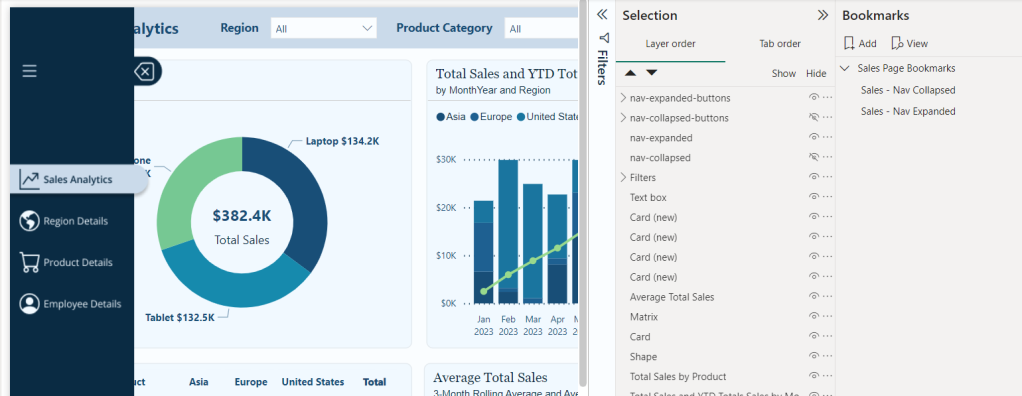
    • Additionally, rename all the buttons objects within the group to keep all our objects well organized and clearly named (e.g. nav-expanded-menu).
    • Adjust the visibility of our object so that the nav-collapsed-buttons group and nav-collapsed image are not visible, and their expanded counterparts are visible.
  1. Set the width for all the page navigation buttons to 155. This will match our navigation background, which we created in Figma. No other properties should have to be set for these buttons.
  2. Update the action of the nav-expanded-menu button and select the Sales - Nav Collapsed bookmark we created previously.
    • Copy and paste this button, then rename the new button as nav-expanded-close.
    • Resize and position this button over the close icon in our expanded navigation.
    • In the Selection pane drag and drop this button into the nav-expanded-buttons grouping.
  3. When the navigation is expanded, we want to prevent interaction with report visuals. To do this, we will add a new blank button to the report and size it to cover the entire report canvas.
    • In the Selection pane, place this button directly following the navigation images so it is below nav-expanded.
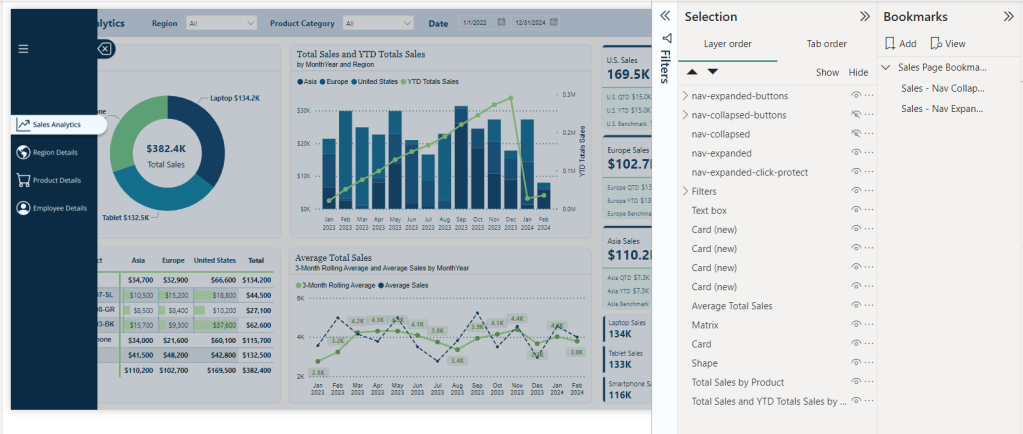
    • In the Format pane for the new button, under the General tab turn on the background and set the color to black with 80% transparency.
    • Turn on the action for this button, set it to a Bookmark type, and set the bookmark to our Sales—Nav Collapsed bookmark. This will ensure that if a user selects outside of the navigation options when the navigation is expanded, they are returned to the collapsed navigation state, where they can interact with the report visuals.
  1. Lastly, we will set our bookmarks, so the correct navigation objects are shown for the expanded and collapsed bookmarks.
    • Right-click each bookmark and uncheck the Data option, so this bookmark will not maintain the current data state. When a user expands or collapses the menu or moves to a different page, we do not want to impact any selected slicers or filters they have selected.
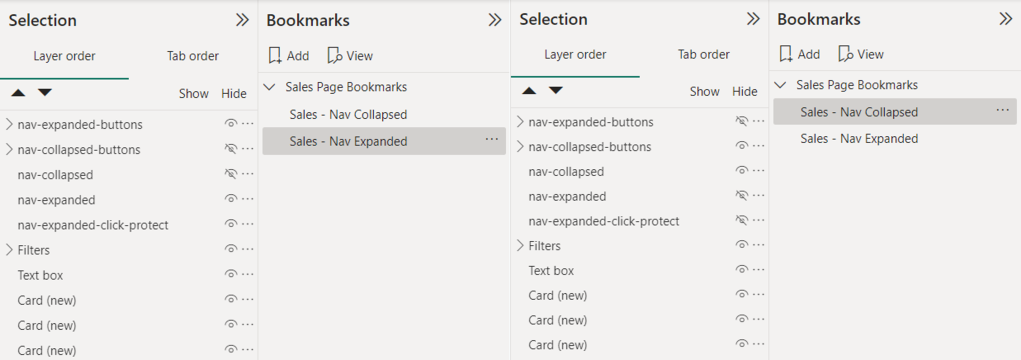
    • Ensure the nav-collapsed-buttons grouping and nav-collapsed images are hidden while their expanded counterparts are visible. Then right-click the expanded bookmark and select update.
    • Select the collapsed bookmark, unhide the collapsed objects, and hide the expanded objects. Right-click the collapsed bookmark and select update.


Now that we have created all the interactivity for our navigation in Power BI for our Sales Analytics page, we can easily copy and move these objects (e.g., the button groupings) to each page in our report. Then, on each page, we will import the 2 Figma navigation designs specific to that page and then size and align them. After this we can add two new bookmarks for that page to store the collapsed and expanded state, using the same process we used in step #9. Finally, update the current page button to toggle off the styling fill and toggle on styling fill for the sales icon buttons (See step #4).

By blending Figma’s design capabilities with Power BI’s interactive features, we can create a navigation experience that elevates the appearance of our report and feels intuitive and engaging. This approach ensures our reports are not just viewed but interacted with, providing deep insights and a more enjoyable user experience.

Bringing It All Together: A Complete Navigation Experience

After creating our navigation visual elements in Figma and integrating them with the interactive powers of Power BI buttons and bookmarks, it’s time to bring it all together and see it in action.
Testing and Refining the Navigation

The key to a successful navigation experience for our users lies in its usability. It is important to conduct user testing sessions to gather feedback on the intuitiveness of the navigation. During these sessions, we can note areas where users hesitate or get lost. Then, using this feedback, we can further refine our navigation, making adjustments to ensure users can effortlessly find the information they need within our reports.

User Experience (UX) Tips for Power BI Reports

Well-designed navigation is just one piece of the UX puzzle. To further enhance our Power BI reports, we should also consider the following.

  • Clarity: ensure our reports are clear and easy to understand at a glance. We should use consistent labeling and avoid cluttering a page with too much information.
  • Consistency: apply the same navigation layout and style throughout our reports, and perhaps even across different reports. This consistency helps users learn how to navigate our reports more quickly.
  • Feedback: Provide visual and textual feedback when users interact with our report elements. For example, we could set the on hover and on pressed options for our buttons or use tooltips to explain what a button does.

Elevating Power BI Reports

By embracing the fusion of Figma’s design capabilities, UX tips, and Power BI’s interaction and analytical power, we can unlock new potential in our reports and user engagement. This journey from design to functionality has enhanced the aesthetic appeal, usability, and functionality of our report. Remember the goal of our reports is to tell the data’s story in an insightful and engaging way. Let’s continue to explore, iterate, and enhance our reports as we work towards achieving this goal while crafting reports that are beyond just tools for analysis but experiences that inform, engage, and fuel data-driven decisions.

If you found this step-by-step guide useful, check out the quick start on creating interactive navigation solely using Power BI’s built-in tools. It provides details on where and how to get downloadable templates to begin implementing this navigational framework for 2-, 3-, 4-, and 5-page reports!

User-Centric Design: Next level reporting with interactive navigation for an enhanced user experience

Also, check out the latest guide on using Power BI’s page navigator for a streamlined, engaging, and easy-to-maintain navigational experience.

Streamlined report navigation with built-in tools to achieve functional, maintainable, and engaging navigation in Power BI reports.


Thank you for reading! Stay curious, and until next time, happy learning.

And, remember, as Albert Einstein once said, “Anyone who has never made a mistake has never tried anything new.” So, don’t be afraid of making mistakes, practice makes perfect. Continuously experiment, explore, and challenge yourself with real-world scenarios.

If this sparked your curiosity, keep that spark alive and check back frequently. Better yet, be sure not to miss a post by subscribing! With each new post comes an opportunity to learn something new.

DAX Table Manipulation Functions: Transforming Your Data Analysis


Exploring DAX: Table Manipulation Functions

Dive into the world of DAX and discover its critical role in transforming raw data into insightful information. With DAX in Power BI, we are equipped with a powerful tool providing advanced data manipulation and analysis features.

Despite its advanced capabilities, DAX remains approachable, particularly its table manipulations functions. These functions are the building blocks of reshaping, merging, and refining data tables, paving the way for insightful analysis and reporting.

Let’s explore DAX table manipulations functions and unlock their potential to enhance our data analysis. Get ready to dive deep into each function to first understand it and then explore practical examples and applications.

For those of you eager to start experimenting there is a Power BI report pre-loaded with the same data used in this post ready for you. So don’t just read, follow along and get hands-on with DAX in Power BI. Get a copy of the sample data file here:

This dynamic repository is the perfect place to enhance your learning journey.

Here is what the post will cover:

  1. ADDCOLUMNS: Adding More Insights to Your Data
  2. Joining Tables with DAX: CROSSJOIN, NATURALINNERJOIN & NATURALLEFTOUTERJOIN
  3. GROUPBY: The Art of Segmentation
  4. SUMMARIZE & SUMMARIZECOLUMNS: Summary Magic
  5. ROLLUP: Climbing the Aggregation Ladder
  6. SELECTCOLUMNS: Handpicking Your Data
  7. UNION, INTERSECT, EXCEPT: Set Operations in DAX
  8. DISTINCT: Identifying Unique Values
  9. TREATAS: Bridging Data Tables

ADDCOLUMNS: Adding More Insights to Your Data

When it comes to enhancing our data tables in Power BI, ADDCOLUMNS is one of our go-to tools. This expression helps us add new columns to an existing table, which can be incredibly handy for including calculated fields or additional information that was not in the original dataset.

The syntax for ADDCOLUMNS is straightforward.

ADDCOLUMNS(table, name, expression[, name, expression]...)

Here, <table> is an existing table or any DAX expression that returns a table of data, <name> is the name given to the column and needs be enclosed in double quotes, and finally <expression> is any DAX expression that returns a scalar value that is evaluated for each row of <table>.

Let’s take a look how we can create a comprehensive date table using ADDCOLUMNS. We will start with the basics by creating the table using CALENDARAUTO() and then enrich this table by adding several time-related columns.

DateTable = 
ADDCOLUMNS (
    CALENDARAUTO(),
    "Year", YEAR([Date]),
    "YearQuarter", FORMAT([Date], "YYYY \QTR-q"),
    "YearQuarterSort", YEAR([Date]) &amp; QUARTER([Date]),
    "Quarter", QUARTER([Date]),
    "MonthName", FORMAT([Date], "MMMM"),
    "MonthShort", FORMAT([Date], "mmm"),
    "MonthNumber", MONTH([Date]),
    "MonthYear", FORMAT([Date], "mmm YYYY"),
    "MonthYearSort", FORMAT([Date], "YYYYMM"),
    "Day", DAY([Date]),
    "Weekday", WEEKDAY([Date]),
    "WeekdayName", FORMAT([Date], "DDDD"),
    "DateKey", FORMAT([Date], "YYYYMMDD")
)

In this example, we transform a simple date table into a multifaceted one. Each additional column provides a different perspective of the date, from the year and quarter to the month name and day of the week. This enriched table becomes a versatile tool for time-based analysis and reporting in Power BI.

With ADDCOLUMNS, our data tables go beyond just storing data, they become dynamic tools that actively contribute to our data analysis, making our reports richer and more informative.


Joining Tables with DAX: CROSSJOIN, NATURALINNERJOIN & NATURALLEFTOUTERJOIN

In Power BI, combining different datasets effectively can unlock deeper insights. DAX offers powerful functions like CROSSJOIN, NATURALINNERJOIN, and NATURALLEFTOUTERJOIN to merge tables in various ways, each serving a unique purpose in data modeling.

CROSSJOIN: Creating Cartesian Products

CROSSJOIN is our go-to function when we need to combine every row of one table with every row of another table, creating what is known as a Cartesian product. The syntax is simple.

CROSSJOIN(table, table[, table]…)

Here<table> is any DAX expression that returns a table of data. The columns names from the <table> arguments must all be different in all tables. When we use CROSSJOIN the number of rows in the resulting table will be equal to the product of the number of rows from all <table> arguments, and the total number of columns is the sum of all the number of columns in all tables.

We can use CROSSJOIN to create a new table containing every possible combination of products and regions within our dataset.

ProductsRegionsCross = 
CROSSJOIN(Products, Regions)

This formula will create a new table where each product is paired with every region, providing a comprehensive view for various analysis task such as product-region performance assessments.

NATURALINNERJOIN & NATURALLEFTOUTERJOIN: Simplifying Joins

When it comes to joining tables based on common columns, NATURALINNERJOIN and NATURALLEFTOUTERJOIN can be helpful. These functions match and merge tables based on column with the same names and data types.

NATURALINNERJOIN creates a new table containing rows that have matching values in both tables, this function performs an inner join of the tables. Here is the syntax.

NATURALINNERJOIN(left_table, right_table)

The <left_table> argument is a table expression defining the table of the left side of the join, and the <right_table> argument defines the table on the right side of the join. The resulting table will include only the rows where the values in the common columns are present in both tables. This table will have the common columns from the left table and other columns from both tables.

For instance, to see products data and sales data for only products that have sales we could create the following table.

NATURALLEFTOUTJOIN, on the other hand, includes all the rows from the first (left) table and the matched rows from the second (right) table. Unmatched rows in the first table will have null values in columns of the second table. This is useful for scenarios where we need to maintain all records from one table while enriching it with data from another. Its syntax is the same as NATURALINNERJOIN.

NATURALLEFTOUTERJOIN(left_table, right_table)

The resulting table will include only rows from the <right_table> where the values in the common columns specified are also present in the <left_table>.

Let’s explore this and how it differs from NATURALINNERJOIN by creating the same table as above but this time using NATURALLEFTOUTERJOIN.

Here we can see the inclusion of our TV line of products, which have no sales. NATURALLEFTOUTERJOIN provides a list of all products, along with the sales data where it is available for each product. While the previous example shows that NATURALINNERJOIN provides only products and sales where the ProductID is matched between these two tables.

Each of these functions serves a distinct purpose: CROSSJOIN for comprehensive combination analysis, NATURALINNERJOIN for intersecting data, and NATURALLEFTOUTERJOIN for extending data with optional matching from another table. Understanding when to use each will significantly enhance our data modeling in Power BI.


GROUPBY: The Art of Segmentation

Segmenting data is a cornerstone of data analysis, and in Power BI, the DAX GROUPBY function is a powerful ally for this task. GROUPBY allows you to group a table by one or more columns and performs calculations on each group. It helps us organize our data into manageable clusters, then glean insights from each cluster. The syntax for GROUPBY is as follows.

GROUPBY (table [, groupBy_columnName[, groupBy_columnName[, …]]] [, name, expression [, name, expression [, …]]])

Let’s break this down. The <table> argument is any DAX expression that returns a table of data. The <groupBy_columnName> argument is the name of an existing column in <table> (or a related table) by which the data is to be grouped and cannot be an expression. The <name> argument is the name given to a new column that is being added to the list returned by GROUPBY enclosed in double quotes. Lastly, <expression> is the expression to be evaluated for each group and must be a supported aggregation iterator function.

For details on aggregation iterator functions visit this in-depth post.

A guide to transforming data into meaningful metrics: Explore essential aggregation functions.

Let’s get into some details and examples.

The general use of GROUPBY is to create a table with a new column(s) which contain aggregated results. When using GROUPBY for grouping and aggregation we must be familiar with the related CURRENTGROUP function. The CURRENTGROUP function returns the set of rows from the table argument of the GROUPBY function that belongs to the current row of the GROUPBY results, and the function can only be used within the GROUPBY expression. This function has not argument and is only supported as the first argument to a supported aggregation function, for a list of supported functions see the reference document below.

Learn more about: CURRENTGROUP

We will start with a basic use of GROUPBY to analyze our sales by product. We can try to create a new table using the following expression.

Sales by Product = 
GROUPBY(
    Sales,
    Products[Product],
    "Total Sales", SUM(Sales[Amount])
    "Average Sales", AVERAGE(Sales[Amount)
)

However, we will see this returns an error stating:

Function 'GROUPBY' scalar expression have to be Aggregation functions over CurrentGroup(). The expression of each Aggregation has to be either a constant or directly reference the column in CurrentGroup().

We can correct this and get our expected results but updating our expression to:

Sales by Product = 
GROUPBY(
    Sales,
    Products[Product],
    "Total Sales", SUMX(CURRENTGROUP(), Sales[Amount]),
    "Average Sales", AVERAGEX(CURRENTGROUP(), Sales[Amount])
)

Although we can use GROUPBY to create the above summary table, for efficient aggregations over physical tables in our data model such as our Sales table we should conder using the functions SUMMARIZECOLUMNS or SUMMARIZE. We will explore these functions later in this post. The true power of GROUPBY is to perform aggregations over intermediate results from DAX table expressions.

We will leverage this use case by creating a new measure that calculates the total sales amount for each product category, but only for the categories where the average sales amount per transaction exceeds a threshold. Here is how we can use GROUPBY and a virtual table to define the Total Sales by High Performing Categories measure.

Total Sales by High Performing Categories = 
VAR ThresholdAverage = 3500
VAR IntermediateTable = GROUPBY(
    Sales,
    Products[Product],
    "Total Sales", SUMX(CURRENTGROUP(), Sales[Amount]),
    "Average Sales", AVERAGEX(CURRENTGROUP(), Sales[Amount])
)
VAR FilteredTable = FILTER(
    IntermediateTable,
    [Average Sales] &gt; ThresholdAverage
)
RETURN
SUMX(FilteredTable, [Total Sales])

In this measure we first define the threshold average as $3,500. Then using GROUPBY we create an intermediate table that groups our sales by product and calculates the total sales and average for each product, this is the same expression we used in the above example. We then create another table by filtering the intermediate table to include only the product groups where the average sales exceed the defined threshold. Then we use SUMX to sum up the total sales from the filtered tabled.

We can see the measure returns a total sales value of $267,000 which from the previous example we can see is the sum of our total sales for our Laptop and Tablet product categories, leaving out the Smartphone category which has an average of $3,379 and is below the threshold. This measure effectively uses GROUPBY to segment and analyze our data in a sophisticated manner, tailoring the calculation to specific business requirements.

Using GROUPBY in measures provides immense flexibility in Power BI, enabling us to perform complex aggregations and calculations that are directly reflected in our report visuals.


SUMMARIZE & SUMMARIZECOLUMNS: Summary Magic

In Power BI, creating summary tables is a common requirement, and DAX offers us two powerful functions for this purpose: SUMMARIZE and SUMMARIZECOLUMNS. These functions are designed to simplify the process of aggregating and summarizing data, making it easier to create our reports and dashboards.

SUMMARIZE: The Classic Aggregator

SUMMARIZE allows us to create a summary table by specifying the columns we want to group by and the aggregations we want to perform. It is particularly useful for creating customized groupings and calculations. Here is its syntax.

SUMMARIZE (table, groupBy_columnName[, groupBy_columnName]…[, name, expression]…)

Here, <table> can be any DAX expression that returns a table of data, <groupBy_columnName> is optional and is the name of an existing column used to create summary groups, <name> is the name given to a summarized column enclosed in double quotes, and <expression> is any DAX expression that returns a single scalar value.

Let’s see how we can more effectively create our Sales by Product summary table. We will create a Sales by Product SUMMARIZE table using the following:

Sales by Product SUMMARIZE = 
SUMMARIZE(
    Sales,
    Products[Product],
    "Total Sales", SUM(Sales[Amount]),
    "Average Sales", AVERAGE(Sales[Amount])
)

A key difference to note is the use of SUM and AVERAGE compared to the use of SUMX and AVERAGEX that were required when we used GROUPBY. Unlike GROUPBY the SUMMARIZE function has an implied CALCULATE providing the required context to aggregate our values.

SUMMARIZECOLUMNS: Enhanced Efficiency and Flexibility

SUMMARIZECOLUMNS offers enhanced efficiency and flexibility, especially in handling complex filter contexts. It may be preferred over SUMMARIZE for its performance benefits and ease of use with measures. The syntax is:

SUMMARIZECOLUMNS(groupBy_columnName[, groupBy_columnName]…, [filter_table]…[, name, expression]…)

The <groupBy_columnName> argument is a column reference to a table within our data model, the <filterTable> is a table expression which is added to the filter context of all columns specified by <groupBy_columnName>, <name> specifies the column name, and the <expression> is any DAX expression that returns a single value.

We are interested in calculating the total and average sales by product and region, but only for the previous year. This is a common scenario in business analysis, where understanding historical performance is key. We can use SUMMARIZECOLUMNS to help us achieve this.

We will create a new Last Year Sales by Product and Region table using the following:

Last Year Sales by Product and Region = 
SUMMARIZECOLUMNS(
    Regions[Region],
    Products[Product],
    Filter(Sales, Year(Sales[SalesDate]) = Year(TODAY())-1),
    "Total Sales", SUM(Sales[Amount]),
    "Average Sales", AVERAGE(Sales[Amount])
)

Here we begin with defining the dimension for group with Regions[Region] and Products[Product], this means our resulting summary will include these two levels of data granularity. The FILTER function is applied to the Sales table to include only sales records from the last year. This is achieved by comparing the year of the SalesDate to the previous year (YEAR(TODAY()) - 1). We then define two new columns in our summary: Total Sales, which sums up the amount for each product-region combination, and Average Sales, which calculates the average sales amount.

This example highlights SUMMARIZECOLUMNS and its strength in handling complex data relationships and filters. By seamlessly integrating time-based filtering and multi-dimensional grouping, it enables the creation of insightful, context-rich summary tables, pivotal for time-sensitive business analysis.

In summary, while SUMMARIZE is great for basic aggregation tasks, SUMMARIZECOLUMNS is the go-to function for more complex scenarios, offing better performance and handling of filter context in Power BI.


ROLLUP: Climbing the Aggregation Ladder

The ROLLUP function in DAX is a robust tool in Power BI for creating layered aggregations, especially useful in multi-level data analysis. It facilitates the generation of subtotals and grand totals within a single query, offering a detailed yet consolidated view of your data. ROLLUP modifies the behavior of the SUMMARIZE function by adding rollup rows to the results on columns defined by the <groupBy_columnName> argument.

Understanding the syntax and functionality of ROLLUP is key to leveraging its full potential. The basic syntax of ROLLUP is as follows:

ROLLUP (groupBy_columnName [, groupBy_columnName [, … ]])

The <groupBy_columnName> argument is a name of an existing column or ROLLUPGROUP function to be used to create summary groups.

To better understand our resulting summary table when using ROLLUP we can incorporate another helpful function: ISSUBTOTAL. We can use ISSUBTOTAL to create another column within our SUMMARIZE expression that returns true if the row contains a subtotal value for the column passed to ISSUBTOTAL as an argument.

Let’s explore an example. Suppose we want to analyze sales data and see subtotals at different levels: by region, then by product within each region, and finally a grand total across all regions and products. Here is how ROLLUP and ISSUBTOTAL can help.

Sales by Region and Production Rollup = 
SUMMARIZE(
    Sales,
    Regions[Region],
    ROLLUP(Products[Product]),
    "Total Sales", SUM(Sales[Amount]),
    "Product SubTotal", ISSUBTOTAL(Products[Product])
)

This example uses SUMMARIZE and groups our Sales data by Region. Then using ROLLUP it generates subtotals first at the product level within each region, followed by region-level subtotals. Total Sales calculates the sum of sales amounts for each group. Product SubTotals, through ISSUBTOTAL indicates whether a row is a subtotal for a product, enhancing the analysis by clearly marking these subtotal rows.

This approach, using ROLLUP with SUMMARIZE is highly effective for multi-layered data analysis. It allows for an intricate breakdown of data, showcasing how individual segments (in the example, products within regions) cumulatively contribute to broader totals. Such a perspective is critical for in-depth data analysis and informed decision-making.


SELECTCOLUMNS: Handpicking Your Data

In Power BI, tailoring our dataset to include just the right columns is often essential for efficient and focused analysis. This is where the SELECTCOLUMNS function in DAX becomes invaluable. SELECTCOLUMNS allows us to create a new table by selecting specific columns from an existing table. The syntax for SELECTCOLUMNS is straightforward:

SELECTCOLUMNS(table, [name], expression, name], …)

The arguments of this function are <table> which is any DAX expression that returns a table, <name> is the name given to the column, and <expression> is any expression that returns a scalar value.

Let’s use SELECTCOLUMNS to create a simplified table from our dataset, focusing on product sales and the corresponding sales date.

Simplified Product Sales = 
SELECTCOLUMNS(
    Sales,
    "Product Name", RELATED(Products[Product]),
    "Sales Amount", Sales[Amount],
    "Date of Sale", Sales[SalesDate]
)

UNION, INTERSECT, EXCEPT: Set Operations in DAX

Set operations in DAX including UNION, INTERSECT, and EXCEPT are fundamental in Power BI for efficiently managing and manipulating data sets. Each operation serves a unique purpose in data analysis, allowing for combining, intersecting, and differentiating data sets.

UNION: Merging Data Sets

UNION is used to combine two or more tables by appending rows from one table to another. The tables must have the same number of columns, and corresponding columns must have compatible data types. Here is its syntax.

UNION(table_expression1, table_expression2[,table_expression]…)

The <table_expression> arguments are any DAX expression that returns a table.

In our data model we have our products table and a new table containing other products, we can use UNION to merge these two product tables.

INTERSECT: Finding Common Elements

INTERSECT returns the common rows between two tables. This function is useful when we need to identify overlapping data. It’s syntax is simple.

INTERSECT(table_expression1, table_expression2)

The <table_expression> arguments are any DAX expression that returns a table. Duplicated rows are retained. The column names in the resulting table will match the column names in <table_expression1>. The table returned by INTERSECT has lineage based on the column in <table_expression1> regardless of the lineage of the columns in the second table.

Let’s use our new All Products table and INTERSECT to examine what products have sales.

Product IDs with Sales INTERSECT = 
INTERSECT(
   SELECTCOLUMNS(
      'All Products', 
      "ProdictID", 
      'All Products'[ProductID]
   ), 
   SELECTCOLUMNS(
      Sales, 
      "ProductID", 
      Sales[ProductID]
   )
)

EXCEPT: Identifying Differences

EXCEPT takes two tables and returns the rows from the first table that are not found in the second table. This is useful for finding discrepancies or exclusions between datasets.

The syntax for EXCEPT will look familiar.

EXCEPT(table_expression1, table_expression2)

Where <table_expression> can be any DAX expression that returns a table.

Let’s look at the list of ProductIDs that do not have sales, by modifying the above example using EXCEPT.

Understanding and utilizing UNION for merging data, INTERSECT for finding common data, and EXCEPT for identifying unique data helps enhance our data manipulation and analysis capabilities in Power BI.


DISTINCT: Identifying Unique Values

Identifying unique values in a data set is a common requirement, and the DISTINCT function in DAX provides a straightforward solution. DISTINCT is used to return table that contains the distinct values from a specified column or table. This function can help remove duplicate values and obtain a list of unique entries for further analysis.

The syntax for DISTINCT is simple.

DISTINCT(column)

Here, <column> is the column from which distinct values are to be returned, or an expression that returns a column. When we are using DISTINCT it is important to be aware that the results of this function are affected by the current filter context. For example, if we use DISTINCT to create a measure of the distinct products from our sales table, the result of this measure would change whenever our Sales table was filtered by date or region for example.

Using DISTINCT on a Column

When applied to a column, DISTINCT generates a one column table of unique values from the specified column. For example, we want to create a measure that returns the column of employees that have a sale. For this we can use DISTINCT to get a list of the distinct employee Ids from our Sales table and pass the list to the COUNTROWS functions to produce the count. Here is the expression.

Count of Employee with Sales = 
COUNTROWS(
   DISTINCT(
      Sales[EmployeeID]
   )
)

Using DISTINCT on a Table

When used on a table, DISTINCT returns a table with unique rows, effectively removing any duplicated rows. We can use this to examine our Sale table to identify if there are any duplicated sales records. We will create two measures, the first to return the count of rows in our Sales table and the second to return the count of rows of our Sales table using DISTINCT.

Our Count of Sales DISTINCT measure produced a count of our Sales table where each row is unique across all columns in the table. With this compared to our count of Sales we can identify our Sales table has a duplicated record.


TREATAS: Bridging Data Tables

A common challenge we may encounter is linking data from different tables that do not have a direct relationship in the data model. TREATAS in DAX is a powerful function designed to address this issue. It applies the values from one table as filters to another unrelated table. This can be especially useful when we are working with complex models where establishing direct relationships may not be feasible or optimal.

The syntax for TREATAS is as follows:

TREATAS(table_expression, column[, column[, column[,…]]]} )

The arguments of TREATAS are the <table_expression> which is an expression that results in a table, and <column> which is one or more existing columns, it cannot be an expression. The table returned by TREATAS contains all the rows in <column(s)> that are also in <table_expression>. When using TREATAS the number of columns specified must match the number of columns in <table_expression> and they must be in the same order. TREATAS is best used when a relationship does not exist between the tables, if there are multiple relationships between the tables, we should consider using USERELATIONSHIP to specify what relationship to use.

Previously, using SUMMARIZECOLUMNS we created a summary table of sales for the previous year. We now wish to visualize the total sales of this table utilizing a measure that allows the user to filter the value by a selected region.

Let’s start by adding a table to visualize our Last Year Sales by Product and Region table, a card visual to visualize the default aggregation of the Total Sales field in this table, and a slicer to allow for selection of a region.

When we select a region in our slicer, an issue becomes clear. The table and Total Sales card visual are not filtered. This is because there is no direct relationship between our Regions table and our Last Year Sales by Product and Region table. Here is how we can create a measure using TREATAS to help solve this issue.

Last Year Sales by Region = 
CALCULATE(
    SUM('Last Year Sales by Product and Region'[Total Sales]), 
    TREATAS(
        VALUES(Regions[Region]),
        'Last Year Sales by Product and Region'[Region]
    )
)

Adding a new card visual to visualize this measure we can see now that the total sales value is filtered by our Region slicer as expected.

By using TREATAS, we can dynamically filter and aggregate data across tables without the need for a physical relationship in the data model. This function is invaluable for creating flexible, context-specific calculations in Power BI.


Wrapping Up: Harnessing the Full Potential of Table Manipulation in DAX

As we wrap up our exploration of table manipulation functions in DAX, it is clear that these tools offer a wealth of possibilities for transforming and understanding our data. The functions we discussed here and many others found in the DAX Reference Guide each serve unique purposes and can be combined in various ways to unlock deeper insights.

Learn more about: Table manipulation functions.

These functions offer flexibility in data manipulation, enabling custom analyses and efficient data modeling. Mastering these functions enhances the power of our reports, making them more insightful and interactive. However, as always, it is important to balance complexity with efficiency to maintain sufficient performance.


Thank you for reading! Stay curious, and until next time, happy learning.

And, remember, as Albert Einstein once said, “Anyone who has never made a mistake has never tried anything new.” So, don’t be afraid of making mistakes, practice makes perfect. Continuously experiment and explore new DAX functions, and challenge yourself with real-world data scenarios.

If this sparked your curiosity, keep that spark alive and check back frequently. Better yet, be sure not to miss a post by subscribing! With each new post comes an opportunity to learn something new.