Power BI Partial RLS Explained: Let Users See the Bigger Picture


This post is part two of a series on Power BI security patterns. Check out part one for a beginner-friendly overview of row-level security in Power BI.

Discover how to personalize your reports and show each user only the data they require in just a few clicks.

This post will take our security design pattern one step further.

While row-level security (RLS) allows us to restrict data based on user roles and identities, there are times when we don’t want everything locked down. Occasionally, users need to see their data in relation to broader metrics, such as company-wide totals or averages.

In the sample report, regional sales teams should see detailed information only about their assigned region and the total sales for other regions.
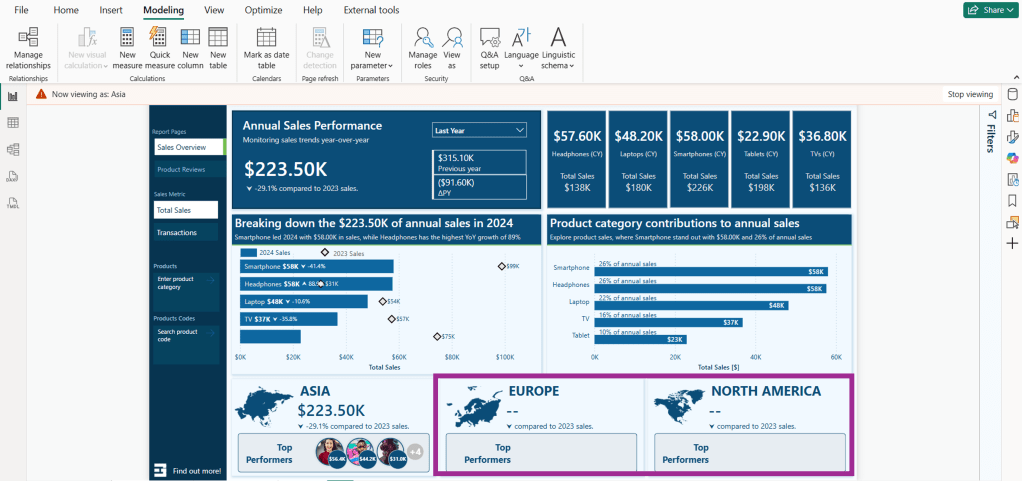
In the previous post, we noted that standard RLS filters out other regional sales, preventing the totals from other regions from being displayed. This is where partial RLS becomes useful and can fulfill this requirement.

In this post, we will walk through:

  • What Partial RLS is and when to use it
  • A real-world scenario that calls for it
  • Key limitations and design tips

What is Partial Row-Level Security

Row-Level Security (RLS) applies filters at the dataset level throughout the entire datamodel for a user. This means that if RLS restricts a user to view only sales data for the North America region, every visual and measure in the report will be automatically limited to data associated with the North America region.

Using RLS is effective for data protection, but it can be a limitation when a report needs to provide a broader context to the user.

With report-level filters and slicers, DAX provides functions like ALL() and REMOVEFILTERS(), which can bypass data filtering. However, DAX expressions cannot bypass RLS.

Partial RLS is a design approach in Power BI that helps mitigate RLS’s limitations when necessary. The concept involves separating secured data from summary data, allowing users to view filtered and unfiltered insights side by side.

To achieve this, we will create a summary table (Annual Sales Summary (Regional)) within our datamodel. This summary table will aggregate the total sales across all regions and will not be affected by RLS filters. It provides overall totals that offer essential context when needed, while the RLS still restricts access to detailed sales information within our sales table.

In our sample report, RLS is applied to the Region table, and the RLS filter propagates to the Sales table.

In the datamodel, filters applied to the Region table do not directly impact the rows in our summary table. This means that users can see the total aggregated sales for all regions while still having RLS filters applied to the detailed sales data.


Use Case: Display Regional Total Sales and Percentage of Company-Wide Sales

We are designing a Power BI report for a global sales team. Each regional sales team member should only be able to:

  • View detailed transaction-level data for their assigned region
  • See key metrics, like total sales for all regions, to provide a broader context

Step 1: Apply RLS rules to the Region table

First, we define our RLS rules in Power BI Desktop, see Power BI Row-Level Security Explained: Protect Data by User Role.

The implemented RLS rules filter the Sales table and limits access to the appropriate region per user.

A challenge arises when we implement RLS while also trying to meet the second requirement. As shown in the image above, the total sales figures for Asia and North America appear blank when viewing the report with the Europe role.

This is because the measure used to calculate the totals uses the following expression.

Total Sales = SUM(Sales[Amount])

When RLS is implemented, users only have access to data specific to their region. For instance, when the Total Sales measure is evaluated, the Sales table is filtered to include only the sales data associated with the Europe sales region. As a result, the Total Sales measure reflects the total sales relevant to the user’s region rather than the entire dataset.

Step 2: Create a summary table

To address this issue and meet our requirements, we will create a calculated summary table in our data model. This table will store pre-aggregated total sales and total transactions by year and region.

Annual Sales Summary (Regional) =       
   SUMMARIZECOLUMNS(
      Sales[SalesDate].[Year],
      Regions[Region],
      "TotalRegionalSales", SUM(Sales[Amount]),   
      "TotalRegionalTransactions", COUNTROWS(Sales),
      "DateKey", FORMAT(DATE(MAX(Sales[SalesDate].[Year]), 12, 31), "YYYYMMDD")
)

This table does not have a direct relationship with the Region table, which is under RLS control, and our RLS roles will not filter it.

Step 3: Build dynamic DAX measures

We can now utilize this table in our measures to establish company-wide or cross-region metrics while ensuring the security of the underlying transactional data.

We first create two new measures within our datamodel to calculate the entire company’s total sales and transaction counts.

Total Sales (nonRLS) =
SUM('Annual Sales Summary (Regional)'[TotalRegionalSales])

Transaction Count (nonRLS) =
SUM('Annual Sales Summary (Regional)'[TotalRegionalTransactions])

We can use these base measures to dynamically display total sales or total transactions for all regions in the data cards at the bottom of the report, utilizing the following expression and visual filters.

Regional Total Sales =
VAR _currentYear = YEAR(MAX(Sales[SalesDate]))
VAR _selectedMetric = SELECTEDVALUE('Sales Metric'[Sales Metric Fields])

RETURN
If(
    _selectedMetric = "'_Measures'[Total Sales]",
    CALCULATE(
        [Total Sales (nonRLS)], 
        'Annual Sales Summary (Regional)'[Year]=_currentYear),
    CALCULATE(
        [Transation Count (nonRLS)], 
        'Annual Sales Summary (Regional)'[Year]=_currentYear)
)

Note: we can also use the fact that RLS filters the region table and expressions such as COUNTROWS() or SELECTEDVALUE() to hide or show the top performers data card.

RLS still applies to the top-row visuals and bar charts, which provide detailed breakdowns of regional sales. However, the summary table enables us to present the total sales for all regions within the data card along the bottom of our report.

Step 4: Combine RLS-filtered and unfiltered measures

The non-RLS base measures can also compare regional total sales or transactions based on the current user (RLS-filtered) as a percentage of the company-wide measure (unfiltered).

% of CompanyWide Sales =
DIVIDE([Total Sales], [Total Sales (nonRLS)])

Considerations and Limitations

While the partial RLS pattern can enhance the usability and insightfulness of our Power BI report, we must consider its capabilities and limitations, as well as the associated technical and design trade-offs.

Partial RLS does not override existing RLS filters; instead, it isolates high-level summary data in a separate table unaffected by these filters. This allows partial RLS to be used for comparisons or to add additional global context without exposing detailed row-level information.

1) When implementing partial RLS, it’s important to remember that datamodel relationships matter. The summary table must be included in the datamodel to ensure that cross-filtering from tables affected by RLS does not impact it. If the summary table is related to a table with RLS filters applied at the datamodel level, it will also be subject to the RLS filters.

2) When combining measures filtered by RLS with unfiltered measures, users may need assistance interpreting the visuals associated with these measures. Visual cues or proper labeling, such as Total Sales Across All Regions versus Your Regional Sales may be necessary to help clarify what users are seeing.

3) Partial RLS can be implemented efficiently when the summary table is small and pre-aggregated without complex DAX filtering. However, keep in mind that if the summary table grows too large or includes too much granularity, it may negatively impact the performance of our reports.

4) Implementing partial RLS can add complexity when creating DAX measures. Since RLS is enforced on our Sales table, any attempts to calculate totals, even when using functions like ALL() or REMOVEFILTER(), will still be subject to our RLS rules. While partial RLS offers additional insights into our data, it does not grant any additional access.

5) We must assess edge cases, such as data gaps or undefined user roles. If a user is assigned a role that is not properly mapped in our datamodel, they may encounter an empty report or access to detailed data. We should always validate our RLS roles to ensure they function as expected.


Wrapping Up

Partial RLS is a design approach used in cases where RLS filtering restricts our ability to give users a broader context for their data. This approach allows us to ensure secure access to detailed, role-specific data while providing users insight into the overall picture and how their data fits into a larger context.

We can provide contextual insights without revealing specific row details by utilizing partial row-level security, enabling us to create more comprehensive and insightful reports.

Row-Level Security (RLS) enables us to filter data at the row level, but it does not allow us to secure entire tables or columns within our datamodel. Make sure to check back for the next post, or better yet, subscribe so you don’t miss it!

In the next post, we will explore Object-Level Security (OLS) in Power BI. OLS is essential because it allows us to secure specific tables and columns from report viewers.

If you’d like to follow along and practice these techniques, Power BI sample reports are available here: EMGuyant GitHub – Power BI Security Patterns.


Thank you for reading! Stay curious, and until next time, happy learning.

And, remember, as Albert Einstein once said, “Anyone who has never made a mistake has never tried anything new.” So, don’t be afraid of making mistakes, practice makes perfect. Continuously experiment, explore, and challenge yourself with real-world scenarios.

If this sparked your curiosity, keep that spark alive and check back frequently. Better yet, be sure not to miss a post by subscribing! With each new post comes an opportunity to learn something new.

Power BI Row-Level Security Explained: Protect Data by User Role


When creating reports for teams across various departments or regions, it’s important to recognize that not everyone needs or wants to see the same data. This is where Row-Level Security (RLS) becomes essential.

We can use RLS to restrict data access for report viewers based on their identity. This eliminates the need to create separate reports for different departments or regions. With RLS, we can use a single report and dataset to generate personalized views for each individual or role.

In this guide, we will walk through:

  • What RLS is and why we should use it
  • Static vs Dynamic RLS
  • Step-by-step examples for each
  • Limitations and Considerations when implementing RLS

By the end of this guide, you will better understand RLS, its applications, and its limitations. Additionally, a PBIX example file will be provided for in-depth, hands-on exploration of this topic.


What is Row-Level Security

Row-level Security (RLS) within Power BI restricts data access for report viewers based on their identity by enabling us to establish rules within our data model to filter data rows.

Consider it as always adding another filter to the appropriate users. These filters are applied at the dataset level, ensuring that users can only see the information they can access, regardless of how they interact with the report

It is important to note that users who have more than viewer permissions to the Power BI workspace have access to the entire semantic model. RLS only restricts data access for users with Viewer permissions.


Why use Row-Level Security

There are several key advantages to using Row-Level Security (RLS) when creating our reports.

Security and Privacy

RLS helps prevent users from seeing data they shouldn’t have access to. This can become especially important when the dataset includes sensitive data.

Efficiency and Scalability

Managing separate reports for different departments or roles can be cumbersome. With RLS, we can create and customize one report for each user role. This approach is easier to maintain, scales better, and reduces the likelihood of inconsistencies and errors.

Improved User Experience

Users no longer need to apply slicers or filters to view only their data of interest. RLS automatically handles this when the report is rendered, resulting in a cleaner and more user-friendly report.


Static Row-Level Security

Static Row-Level Security (RLS) is the most straightforward form of RLS. In this approach, we manually define which users can access specific rows of data, usually by applying filters based on criteria such as Region or Department. This method works well when there is a small group of users and the access rules do not change frequently.

Step-by-Step: Static RLS

Static RLS applies a fixed value in the DAX filter when rendering our report. Configuring static RLS involves several steps.

1. Creating RLS roles in Power BI Desktop
To create RLS roles in Power BI Desktop, navigate to the Modeling tab and select Manage Roles.

Then, we select + New under Roles on the manage security roles dialog box. For this sample report, we create a role for each sales region.

We give each role a descriptive name, select the table to which the filter is applied, and create the filter condition.

After each role is created, any user we assign to the Asia, Europe, or United States role will only see data filtered to that specific region.

This approach is considered Static RLS since we use a static value to define each role.

2. Testing the roles in Power BI Desktop
Within Power BI Desktop, we can test each role to validate it by selecting the View as option on the modeling tab.

After selecting a role, we can see the report rendered as if we are a member of that role.

3. Deploying the report to the Power BI Service
Once we create and validate the roles, we publish the report to the Power BI Service as with any other report.

4. Add members to the role in the Power BI Service
To add a member to the role in the Power BI Service, we must navigate to the workspace where we published the report. We locate the semantic model and select the More options ellipsis (…) and then Security.

Within the Row-Level Security screen, we add users or security groups to each role we created. RLS rules will not apply to users who have access to the report but have not been added to a role.

5. Testing the roles in the Power BI Service
On the Security screen, we select the More options ellipsis (…) next to each role and then Test as role.

Once all roles have been validated, we have successfully implemented static row-level Security in Power BI.


Dynamic Row-Level Security

While static RLS can be great for smaller teams, it doesn’t scale well. Manually assigning roles to individuals quickly becomes unmanageable.

Dynamic RLS solves this issue using a User Access Table or a field that defines each user’s role inside our data model. The report utilizes this table to filter itself based on who is viewing the report.

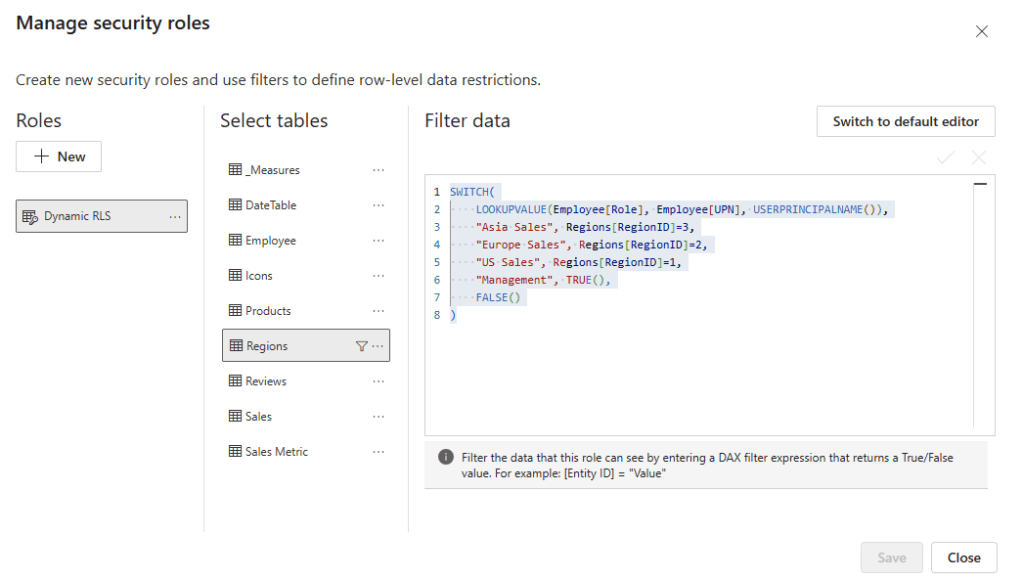
For this example, our data model has an Employee table that contains each employee’s user principal name and role (e.g., Asia Sales, Europe Sales, US Sales, Management, or blank). We utilize this information to implement dynamic RLS by looking up the user’s role based on the user principal name of the viewer currently signed in.

Step-by-Step: Dynamic RLS

1. Set up a dynamic role using DAX
Navigate to the Modeling tab and select Manage Roles. Then, in the Manage Security Roles dialog box, select + New under Roles.

We name the role, select the table to which the filter is applied, and, this time, rather than creating a static filter condition, select Switch to DAX editor to create our dynamic rule.

We filter the Region table based on the current user’s role using the following DAX expression:

SWITCH(
    LOOKUPVALUE(
        Employee[Role], 
        Employee[UPN], 
        USERPRINCIPALNAME()
    ),
    "Asia Sales", Regions[RegionID]=3,
    "Europe Sales", Regions[RegionID]=2,
    "US Sales", Regions[RegionID]=1,
    "Management", TRUE(),
    FALSE()
)

The DAX expression looks up the user’s Role based on the current user’s user principal name (e.g. email).

2. Testing the dynamic filter
After creating the rule, we must test and validate that it functions as expected. We navigate to the Modeling tab and select View as. Then, in the dialog box, we check the Other User option and enter a user’s email. We also check the dynamic filter rule we just created and select OK.

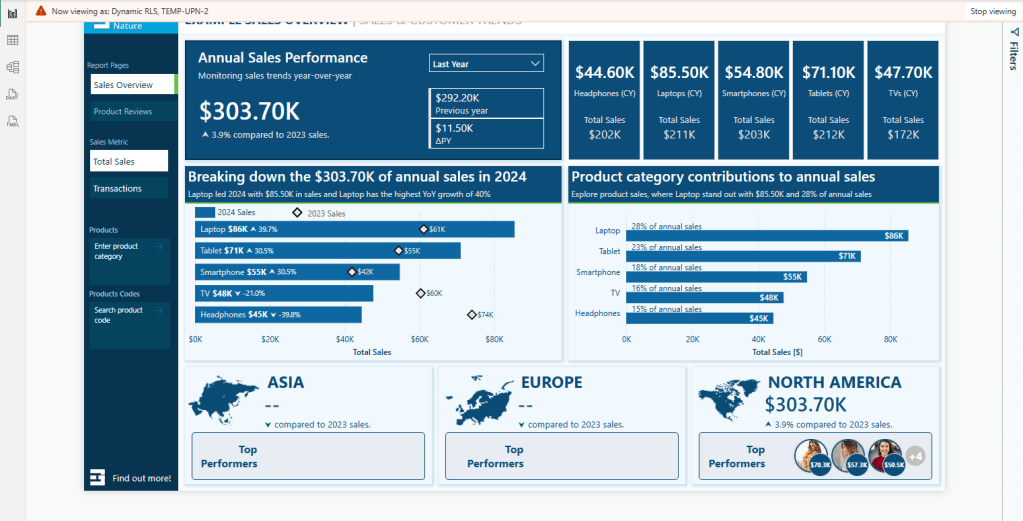
The report will refresh, and we will validate that the TEMP-UPN-2 user, who has the role of US Sales, sees data only for their assigned region.

3. Publish the report and add members to the role
We publish the report to the Power BI Service. Then, to add members to the role in the Power BI Service, we must navigate to the workspace where we published the report. We locate the semantic model and select the More options ellipsis (…) and then Security.

Within the Row-Level Security screen, similar to what we did for static RLS, we can add users or security groups to each role we created.

Since we may implement dynamic row-level Security for better scalability, assigning a security group when adding members can be beneficial. Better yet, this security group can also give users their Viewer access to the report or app.

4. Validate roles in the Power BI Service
On the Security screen, we select the More options ellipsis (…) next to each role and then Test as role.

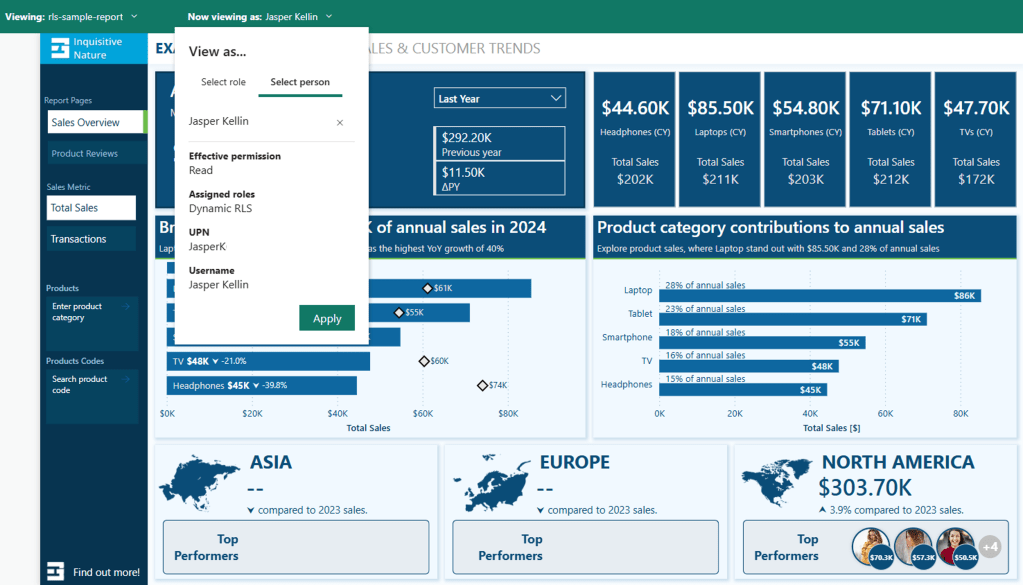
Then, at the top, we select Now viewing as and Select a person to validate that the RLS is functioning as expected. We will view the report as Jasper (TEMP-UPN-2) as we did in Power BI Desktop.

Note: The TEMP-UPN-# provided in the sample file will only function for testing in Power BI Desktop without requiring an actual email address. The UPN field must contain actual user email addresses to validate in the Power BI Service.

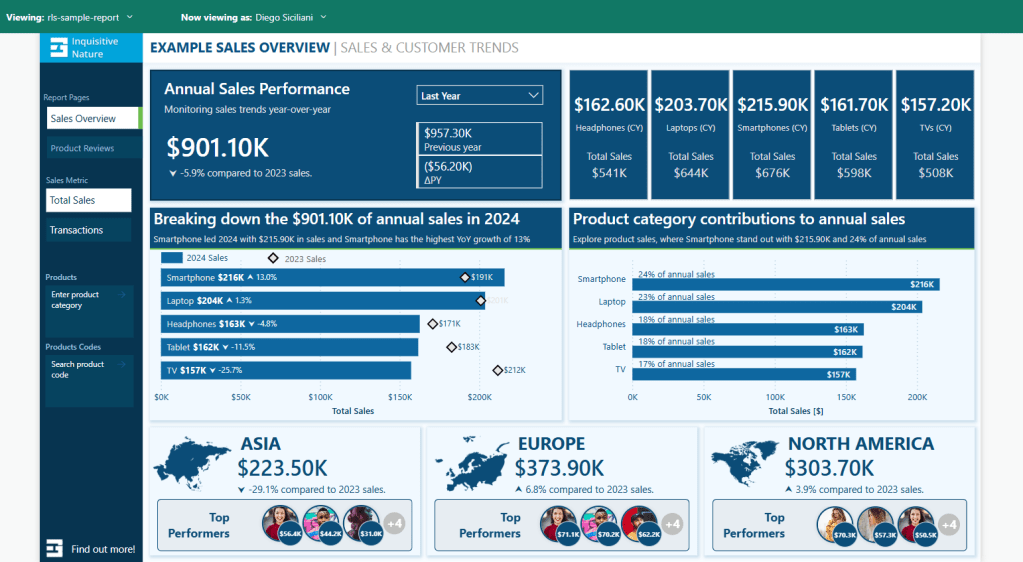
We can also validate the report for Diego (TEMP-UPN-4), who is assigned the Management role and should be able to see data for all sales regions

One last consideration is what happens when a user intentionally or unintentionally has access to view the report but does not have a Role defined in the Employee table.

If we review the DAX expression used for the filter:

SWITCH(
    LOOKUPVALUE(
        Employee[Role], 
        Employee[UPN], 
        USERPRINCIPALNAME()
    ),
    "Asia Sales", Regions[RegionID]=3,
    "Europe Sales", Regions[RegionID]=2,
    "US Sales", Regions[RegionID]=1,
    "Management", TRUE(),
    FALSE()
)

The last value, or the default if no other condition is true, is set to FALSE(). This means that if a user is in the Employee table but either does not have a role or their role doesn’t match one defined in the rule, the report will be empty.

When testing the report, Grady (TEMP-UPN-5) is contained in the Employee table but does not have a role assigned.

Now that everything is working as expected, we have successfully implemented dynamic row-level Security. The benefit is that by using dynamic RLS, we replace four roles with a single rule applied dynamically based on the current user. Additionally, we can add an extra layer and hide data for users who have access to the report but are not assigned a role in the Employee table.


Considerations and Limitations

Before implementing RLS across our reports, it is important to consider and evaluate the impacts of RLS limitations.

A list of limitations can be viewed here:

Learn more about: Row-Level Security with Power BI

It’s also important to understand when Row-Level Security (RLS) is and is not the right tool.

We may consider publishing multiple semantic models if we have only a few simple RLS rules. For example, if we have just two sales regions, we might publish a separate semantic model for each region. Although the semantic models do not enforce RLS, we can use query parameters to filter the source data to the specific sales region. The use of query parameters would still allow us to publish the same model while displaying the relevant data for each region.

Advantages of not using Row-Level Security (RLS) include:

  • Improved Query Performance: With fewer filters applied to the data model, queries can run faster.
  • Smaller Models: While avoiding RLS may increase the number of models, each individual model is generally smaller, which can enhance query performance and data refresh responsiveness.
  • Full Access to Power BI Features: Certain features, like “Publish to the Web”, do not work with RLS.

However, there are also disadvantages to not implementing RLS:

  • Multiple Workspaces Required: Each user audience for reports may require its own workspace.
  • Content Duplication: Reports and dashboards must be created in each workspace, leading to redundancy and increased maintenance efforts.
  • Lack of Consolidated View: Users who belong to multiple report user audiences must open various reports, resulting in no single, consolidated view of their data.

Wrapping Up

Row-Level Security (RLS) is a valuable feature in Power BI that enables us to protect and customize report data according to the identity of the report viewer. With static RLS, we can implement straightforward, fixed access rules, while dynamic RLS offers a more scalable and flexible solution. RLS allows us to provide tailored insights that meet the specific needs of different users.

It’s important to remember that Row-Level Security only filters rows in a table and does not limit access to model objects like tables or columns. If your requirements involve hiding entire tables or specific columns within a table, you should consider using Power BI Object-Level Security (OLS).

RLS can sometimes be overly restrictive when it comes to broader calculations. For example, we could display the total sales for each region to all users or calculate the percentage of total sales across all regions. However, RLS rules filter these total sales values, leading to complications. This is where the concept of partial RLS comes into play, allowing us to secure specific data while still accessing global context for certain calculations.

Stay tuned and subscribe so you won’t miss upcoming posts in this series, focusing on the partial RLS design pattern and object-level security.

If you’d like to follow along and practice these techniques, Power BI sample reports are available here: EMGuyant GitHub – Power BI Security Patterns.


Thank you for reading! Stay curious, and until next time, happy learning.

And, remember, as Albert Einstein once said, “Anyone who has never made a mistake has never tried anything new.” So, don’t be afraid of making mistakes, practice makes perfect. Continuously experiment, explore, and challenge yourself with real-world scenarios.

If this sparked your curiosity, keep that spark alive and check back frequently. Better yet, be sure not to miss a post by subscribing! With each new post comes an opportunity to learn something new.