Make your Power BI reports more impactful—learn how to highlight key data points in a bar chart!
Workout Wednesday is a weekly challenge series designed to help develop Power BI skills through hands-on exercises.
This guide outlines my solution for the Power BI 2025 Week 5 challenge, which focused on adding an All category to a bar chart in Power BI. The challenge emphasized data transformation, visualization, and dynamic formatting to enhance insights.
The Challenge Requirements
The 2025 Week 5 Power BI challenge involved creating a bar chart that displays the unadjusted percent change in the consumer price index from December 2023 to December 2024 across various categories. Here are the challenge requirements:
Add a “total average” row to the data that contains the average of the unadjusted_percent_change values in the original data set.
Plot the items and associated percent increase in a bar chart. Sort the items by descending value of unadjusted_percent_change.
Add data labels to the bar chart to show the exact percent change for each item.
Use a different bar color for eggs to make it stand out. Also, use a different color for your total average to make it look distinct from the other items.
Use a canvas background color or image related to eggs.
The Final Result
Before we start the step-by-step guide, let’s look at the final result.
The original data sources are BLS and USDA, and the data used for this challenge is hosted on Data.World. The background image is a photo by Gaelle Marcel on Unsplash.
Adding a Total Average Row in Power Query
The initial step involved loading and transforming the raw dataset in the Power Query Editor, where a total average row was added. This row calculates the average unadjusted percent change values and acts as a benchmark for comparison.
Here is the Power Query used to complete this step.
let
    Source = Excel.Workbook(File.Contents("C:\temp\PBIWoW2025W5.xlsx"), null, true),
    data = Source{[Item="Sheet1",Kind="Sheet"]}[Data],
    setHeaders = Table.PromoteHeaders(data, [PromoteAllScalars=true]),

    // Adjust "Unadjusted Percent Change" by converting values to percentages
    adjustPercentages = Table.TransformColumns(setHeaders, {{"Unadjusted Percent Change", each _*0.01}}),

    // Calculate the total average and create a new row
    totalAverage = List.Average(adjustPercentages[Unadjusted Percent Change]),
    averageRow = #table(
        Table.ColumnNames(setHeaders),
        {{"Total average", totalAverage}}
    ),

    //Append Total Average to the initial dataset
    finalTable = Table.Combine({adjustPercentages, averageRow}),

    setDataTypes = Table.TransformColumnTypes(finalTable,{{"Item", type text}, {"Unadjusted Percent Change", Percentage.Type}})
in
    setDataTypes
Once the data is loaded, Power Query converts the percent values so they display correctly when the data type is set to Percentage.Type.
It then calculates the average of the unadjusted percent change data using the List.Average() function, which computes the average of all the values in the unadjusted percent change column. Once calculated, we create a single-row table using #table() to ensure the structure matches the initial dataset. In this table, Total Average is set for the Item column, and the calculated average is in the Unadjusted Percent Change column.
Lastly, the Power Query appends this row to our initial dataset using Table.Combine() and sets the column data types.
Creating the Bar Chart and Sorting the Data
With the Total Average data now included in the dataset, the next step was creating the Power BI bar chart to visualize the data.
The visual is a clustered bar chart, where Item is set for the y-axis and Unadjusted Percent Change is set for the x-axis.
The axis is sorted in descending order by Unadjusted Percent Change and data labels are enabled.
Additional formatting steps included disabling the titles for the x- and y-axes, darkening the vertical gridlines, and removing the visual background.
At this point, the bar chart displays all categories, including the Total Average row, but the colors are uniform. The next step is to apply conditional formatting using DAX to highlight key insights to improve clarity.
Applying Conditional Formatting Using DAX
The bar colors differentiate key categories to make the visualization more insightful.
Values above the average should be highlighted to stand out*.
The average value should have a distinct color to serve as a benchmark.
Values below the average should have a uniform color.
* This only applies to the Eggs category in the current data set. Although this doesn’t strictly meet the requirement of explicitly making the Eggs category stand out, it remains dynamic. It will highlight any value in the future that would be above the average.
The measure looks up the total average value and retrieves the Unadjusted Percent Change value of the category within the current evaluation context.
Then, using the SWITCH() function, the color code is set based on whether the current _value is less than, equal to, or greater than the total average.
Applying the DAX Measure to the Bar Chart
Select the visual on the report canvas.
In the Format pane, locate the Bars sections.
Click the fx (Conditional Formatting) button next to the Bar Color property.
In the Format style drop-down, select Field value, and in the What field should we base this on? select the newly created Bar Color measure.
To also have the data label match the bar color, locate the data labels section in the Format pane and the Values section. Follow the same steps to set the color of the data label value.
The visual is now structured to highlight key categories based on their relationship to the Total Average value.
BONUS: Creating Dynamic Titles with DAX
To improve the visualization, a dynamic subtitle can be added. This subtitle automatically updates based on the dataset, providing insights at a glance.
I start by creating the DAX measure:
Subtitle =
VAR _topPercentChange =
    TOPN(1, pbiwow2025w5, pbiwow2025w5[Unadjusted Percent Change], DESC)
VAR _topItem =
    MAXX(_topPercentChange, pbiwow2025w5[Item])
VAR _topValue =
    MAXX(_topPercentChange, pbiwow2025w5[Unadjusted Percent Change])
VAR _average =
    COALESCE(
        LOOKUPVALUE(
            pbiwow2025w5[Unadjusted Percent Change],
            pbiwow2025w5[Item],
            "Total average"
        ),
        0
    )
VAR _belowAverage =
    ROUNDUP(
        MAXX(
            FILTER(pbiwow2025w5, pbiwow2025w5[Unadjusted Percent Change] < _average),
            pbiwow2025w5[Unadjusted Percent Change]
        ),
        2
    )

RETURN
_topItem & " prices have increased by "
& FORMAT(_topValue, "0.0%") & ", exceeding the average of "
& FORMAT(_average, "0.00%") & ", while other categories remain under "
& FORMAT(_belowAverage, "0%") & "."
The measure identifies the category with the highest percentage change, extracting both the item name and the percent change value. It then retrieves the total average value to incorporate into the title. Next, it finds the highest percent change value for all the items that fall below the average and rounds the value up.
Finally, the RETURN statement constructs a text summary that displays the category with the highest price change, its percentage change, a comparison to the total average, and a summarized value for all items below the average.
Applying the Dynamic Subtitle
Select the visual on the report canvas.
In the Format pane, locate the Title section.
Under the Subtitle section, select the fx button next to the Text property.
In the Format style drop-down, select Field value, and in the What field should we base this on? select the newly created Subtitle measure.
This subtitle provides quick insights for our viewers.
Now that you have seen my approach, how would you tackle this challenge? Would you use a different Power Query transformation method, a different visualization style, or an alternative approach to dynamic formatting?
If you’re looking to grow your Power BI skills further, be sure to check out the Workout Wednesday Challenges and give them a try!
Thank you for reading! Stay curious, and until next time, happy learning.
And, remember, as Albert Einstein once said, “Anyone who has never made a mistake has never tried anything new.” So, don’t be afraid of making mistakes, practice makes perfect. Continuously experiment, explore, and challenge yourself with real-world scenarios.
If this sparked your curiosity, keep that spark alive and check back frequently. Better yet, be sure not to miss a post by subscribing! With each new post comes an opportunity to learn something new.
Streamlined report navigation with built-in tools to achieve functional, maintainable, and engaging navigation in Power BI reports.
Before we begin developing the navigational element of our reports, we must decide what tools to use. The Design Meets Data series started with two previous posts in which we explored two approaches: using Figma to design and customize our navigation and using Power BI’s built-in shapes, bookmarks, and buttons to create a similar experience with native tools.
User-Centric Design: Next level reporting with interactive navigation for an enhanced user experience
This post will explore using Power BI’s Page Navigator to simplify our navigation setup. Each approach has its own level of flexibility and ease of maintenance, so it’s important to choose the right method based on the project’s requirements.
The Power BI Page Navigator
Power BI’s Page Navigator lets us create a dynamic and interactive navigation menu in our reports. It is an out-of-the-box solution that simplifies the navigation experience.
Since the Page Navigator is a native feature, it requires minimal setup and automatically adjusts when new pages are added to the report. However, some adjustments may still be needed, such as resizing or formatting changes to accommodate report updates.
To add a Page Navigator to our report, we go to the Insert tab in Power BI Desktop, then select Navigator > Page navigator under the Buttons dropdown.
Customization Options
Power BI provides various options to customize the appearance of our Page Navigator, such as changing the font, colors, shapes, borders, and even what pages are listed. This allows us to create a navigational element that fits seamlessly within our report’s aesthetic.
Although the design flexibility is not as extensive as in our previous example using Figma, the Page Navigator option strikes a balance between ease of use and visual appeal.
Building the Navigation Pane
Now that we have covered the basics of the Page Navigator, we can begin building the navigation pane for our report. The navigation pane will be located on the left-hand side of our report and will serve as both the page navigation and container for our page slicers.
Below, is the final product. Follow the detailed step-by-step guide provided to create your own navigation pane
Building the navigation pane
We begin building the navigational pane on the left-hand side of our report canvas. First, we add a rectangle to the report canvas and style it to meet our needs. The navigation pane has a height equal to the report canvas and a width of 140. We set the fill color to dark blue, which is our Theme 1, 50% darker.
Next, we add a rectangle at the top of the navigation pane to provide an accent and space for displaying an organizational logo within our report. This rectangle has a height of 40 and a width of 140, and its fill color is set to the accent color of our report theme.
With the basic structure of our navigation pane in place, we then move on to adding the Page Navigator.
Formatting the Page Navigator
We begin by selecting the Insert tab on the main ribbon. Then, under the Button dropdown, select Navigator > Page navigator.
Once the Page Navigator is added to the report canvas, go to the Format pane and select Vertical from the Orientation dropdown under the Grid layout property.
Under the Pages property, we find options to control what pages are displayed within our report navigation. In the Options group, we can set general options such as Show hidden pages, Show tooltip pages, and Show all by default. Additionally, in the Show group, we can explicitly set which pages are shown in the navigation by using the toggles next to each report page.
Once our navigation displays the required pages, we adjust the width of the navigator object to 130 and the height to 105. Note that the height should be adjusted based on the number of pages in the navigation. In this example, we use a basic calculation to calculate the height by multiplying the number of pages by 35 ( 3 pages x 35 = 105).
Lastly, we set the horizontal position of the navigator object to 10 and the vertical position to 100.
Styling the Page Navigator
Once we finish the basic formatting, we customize the navigator to match the look of our report. Our aim with the styling is to make it easier to identify the current page.
We do this by adjusting the Style properties of the Page Navigator and using the Apply settings to State dropdown.
Below are the key differences between our page navigator’s Default, Hover, Press, and Selected states.
Default Text > Font: Segoe UI Text > Font Color: light blue, Theme color 1, 60% lighter Text > Horizontal alignment: left Text > Padding: left 5 px Fill > Color: dark blue (#06435F) Border: off Shadow: off Glow: off Accent bar: off
Hover Text > Font: Segoe UI Semibold Text > Font Color: white Text >Horizontal alignment: left Text> Padding: left 5 px Fill > Color: dark blue, Theme color 1, 25% darker Border: off Shadow: off Glow: off Accent bar: off
Press Text > Font: Segoe UI Semibold Text > Font Color: dark blue, Theme color 1, 50% darker Text >Horizontal alignment: left Text> Padding: left 5 px Fill > Color: white Border: off Shadow: off Glow: off Accent bar: off
Selected Text > Font: Segoe UI Semibold Text > Font Color: dark blue, Theme color 1, 50% darker Text >Horizontal alignment: left Text> Padding: left 5 px Fill > Color: white Border: off Shadow: off Glow: off Accent bar > Position: right Accent bar > Color: accent green (#6CBE4B) Accent bar > Width: 6px
After configuring all the styling options, our report page will have an engaging and interactive navigation panel.
Comparing the Approaches
When building a navigational component within our reports, we have a wide variety of options and approaches to choose from. Each report has unique requirements, so it’s important to compare and contrast these different approaches based on performance, ease of maintenance, and design flexibility.
Performance Comparison
Figma: Our Figma-based designs require importing images into Power BI. This can improve the load time of our reports because the report does not have to render each shape and component independently.
Power BI Native Shapes and Buttons: This option has the advantage of only requiring our development work to occur in Power BI. However, each shape and component added to build our navigation pane has to be loaded each time our report page is viewed.
Page Navigator: This offers a fully integrated approach with minimal overhead. However, we lose full control over design and aesthetics.
Ease of Maintenance
Figma: Our Figma-based approach is the most complex to maintain. Every design update requires going back to Figma, redesigning, re-exporting from Figma, and re-importing and integrating into our Power BI report.
Power BI Native Shapes and Buttons: This approach has the advantage of only using Power BI to maintain our navigational element but still requires manual updates when adding or removing pages from our report.
Page Navigator: This is the easiest option to maintain because the page navigator updates with any page additions or changes. However, the size of the object may still need to be adjusted.
Design Flexibility
Figma: Offers the highest level of design customization. We can create any design we can think up, however, this comes with added complexity and time requirements.
Power BI Native Shapes and Buttons: Provides us more flexibility than the page navigator, allowing us to customize our design and layout. However, we may still encounter design limitations depending on the options provided by Power BI.
Page Navigator: The most straightforward to implement but offers limited customization options, which restricts design flexibility. It prioritizes ease of maintenance over complex designs.
Final Thoughts
Deciding on the proper navigation for our Power BI reports depends on balancing design flexibility, ease of maintenance, and performance. Leveraging Figma allows for fully custom designs but comes with more complex maintenance. Power BI offers various native tools to help design navigational elements, although building a custom navigational pane will still require manual updates. Power BI’s Page Navigator stands out for its simplicity, dynamic updating, and minimal maintenance effort. However, the cost of the simplicity is limited customization and design flexibility.
The Design Meets Data series explored three approaches to building a Power BI report navigational pane.
User-Centric Design: Next level reporting with interactive navigation for an enhanced user experience
There are seemingly endless other approaches to creating this critical part of our Power reports. How do you approach your report’s navigation?
Thank you for reading! Stay curious, and until next time, happy learning.
And, remember, as Albert Einstein once said, “Anyone who has never made a mistake has never tried anything new.” So, don’t be afraid of making mistakes, practice makes perfect. Continuously experiment, explore, and challenge yourself with real-world scenarios.
If this sparked your curiosity, keep that spark alive and check back frequently. Better yet, be sure not to miss a post by subscribing! With each new post comes an opportunity to learn something new.
Enhancing Consistency and Efficiency with Customizable Power Query Workflows
When extracting and transforming data in Power BI, we often repeat the same steps across different projects. This repetition raises the question: can these steps be generalized and reusable in future projects?
This post will explore a solution that breaks down these steps into flexible and reusable parameters and functions, eliminating the need to recreate these common steps across our projects. The solution leverages parameters, functions, and queries to standardize various parts of our data preparation process when CSV files in a SharePoint document library are the data source.
Don’t just read; get hands-on and view all the details in the template report available here:
This repository provides a Power BI template and sample CSV files for automating and standardizing CSV data transformation from SharePoint using Power Query functions.
Power Query Parameters
Parameters help keep our data preparation process as dynamic as possible. They provide a level of flexibility to our Power Query functions and allow us to modify their behavior without altering the underlying function definition. This flexibility enables this solution to adapt to different requirements and increases the reusability of our work.
In our solution, 7 parameters manage how data is loaded, cleaned, and transformed.
SharePoint Site Url (Text): specifies the SharePoint site URL where the CSV files are stored.
https://yourcompany.sharepoint.com/sites/yoursite
SharePoint Folder Path (Text): defines the folder path within the SharePoint site where the CSV files are located.
textColumns (Text): a comma-separated list of column names that require text transformations.
Column Name 1, Column Name 2, Column Name 3
textFormatCase (Text): a text value that specifies how text columns should be formatted. Options include Proper, Lower, and Upper case.
columnDataTypes (Text): a semicolon-separated list of column names paired with their corresponding data type description, used to dynamically set the data types of each column.
Column Name 1,date;
Column Name 2,whole number;
Column Name 3,text;
Column Name 4,text;
Column Name 5,text;
Column Name 6,whole number;
Column Name 7,decimal number
errorHandlingOption (Text): sets how errors are handled within the dataset and provides the options of RemoveErrors, ReplaceErrors, or None.
viewErrorSummary (TRUE/FALSE): toggles between displaying a summary of rows that contain errors and returning the cleaned dataset.
Once we create our parameters and set their values, we can reference them throughout our functions and queries. This enables us to adjust the entire data transformation process by updating the parameter values.
Supporting Utility Functions
To enhance the reusability of our Power Query solution, we first break down complex data transformations into smaller, modular functions. Each utility function handles a specific task, improving its maintainability and allowing us to apply them individually or collectively across different datasets.
fxParameterToList
(parameterName as text) as list =>
   List.Transform(Text.Split(parameterName, ","), each Text.Trim(_))
Many of our parameters in this solution are comma-separated strings that we must convert to list objects before using them in a list-based transformation within Power Query. Since many of our parameters and functions require this, creating a function allows us to repeat this operation easily.
The function has a single input parameter (parameterName), a comma-separated string of values. It then splits this input by commas, trims surrounding spaces, and converts the result into a list. This is used when calling and passing parameter values to other utility functions such as fxTransformTextFormat and fxTransformTextTrim.
fxTransformTextTrim
The fxTransformTextTrim function trims any leading and trailing spaces from text values in the specified columns. Trimming can be essential when cleaning user-entered data or other text extracted from external sources.
(inputTable as table, columnsToTrim as list) as table =>
    Table.TransformColumns(inputTable, List.Transform(columnsToTrim, each {_, Text.Trim, type text}))
This function has two input parameters:
inputTable: a table containing the data to be trimmed
columnsToTrim: a list of text columns that require trimming
The fxTransformTextTrim function applies Text.Trim to each column specified in columnsToTrim, ensuring our text data is clean and consistent.
fxTransformTextFormat
The fxTransformTextFormat function standardizes the case formatting of our text data depending on the caseType input parameter. Depending on our requirements, the function can convert text data to Proper Case, Lower Case, or Upper Case.
(inputTable as table, columnsToTransform as list, caseType as text) as table =>
    let
        // Determine the transformation function based on caseType input
        CaseFunction = if caseType = "Proper" then Text.Proper
                       else if caseType = "Lower" then Text.Lower
                       else if caseType = "Upper" then Text.Upper
                       else error "Unsupported case type: Use 'Proper', 'Lower', or 'Upper'",

        // Apply the selected case transformation to each column in the list
        TransformTextCase = Table.TransformColumns(inputTable, List.Transform(columnsToTransform, each {_, CaseFunction, type text}))
    in
        TransformTextCase
This function has three input parameters:
inputTable: a table containing the data to be transformed
columnsToTransform: a list of columns that require text formatting
caseType: a text value specifying the desired text format (Proper, Lower, or Upper)
Using the caseType parameter, the function identifies the transformation type and then applies the transformation to the specified columns.
fxTransformRemoveDuplicates
The fxTransformRemoveDuplicates is a straightforward function that removes duplicated rows within our dataset.
(inputTable as table) as table =>
Table.Distinct(inputTable)
This function has a single parameter:
inputTable: a data table to remove duplicate rows from
The function uses Table.Distinct to identify and remove duplicated rows and returns a table with each row being unique.
fxTransformSetDataTypes
The fxTransformSetDataTypes function maps a textual description of the data type to the Power Query data type. The function allows dynamically setting column data types based on our columnDataTypes Power Query parameter.
(columnType as text) as type =>
    let
        lowerColumnType = Text.Lower(columnType),
        columnTypeResult =
            if lowerColumnType = "decimal number" then type number
            else if lowerColumnType = "fixed decimal number" then type number
            else if lowerColumnType = "whole number" then Int64.Type
            else if lowerColumnType = "percentage" then type number
            else if lowerColumnType = "date/time" then type datetime
            else if lowerColumnType = "date" then type date
            else if lowerColumnType = "time" then type time
            else if lowerColumnType = "date/time/timezone" then type datetimezone
            else if lowerColumnType = "duration" then type duration
            else if lowerColumnType = "text" then type text
            else if lowerColumnType = "true/false" then type logical
            else if lowerColumnType = "binary" then type binary
            else type text // Default to text if the type is unrecognized
    in
        columnTypeResult
The function has a single input parameter:
columnType: a text value of the data type to set for a column
This function helps us leverage common textual descriptions to set Power Query data types across our dataset columns.
fxErrorHandling
The fxErrorHandling function allows us to manage how our dataset handles errors based on our requirements. We can use the function’s input parameter to remove rows containing errors, replace error values with null, or retain the errors within the dataset.
(inputTable as table, errorHandlingOption as text) as table =>
let
    ErrorRows = Table.SelectRowsWithErrors(inputTable),

    // Determine the action based on the error handling option provided
    ErrorHandlingResult =
    if errorHandlingOption = "RemoveErrors" then
        // Remove rows with any errors
        Table.RemoveRowsWithErrors(inputTable)
    else if errorHandlingOption = "ReplaceErrors" then
        // Replace errors with a specified value (default is "Error" if replaceValue is not provided)
        let
            ReplaceErrorsStep =
                let
                    // Get a list of column names
                    columnNames = Table.ColumnNames(inputTable),
                    // Create a list of replacement rules where each column is mapped to null in case of error
                    errorReplacementList = List.Transform(columnNames, each {_, null})
                in
                    Table.ReplaceErrorValues(inputTable, errorReplacementList)
        in
            ReplaceErrorsStep
    else
        // If the parameter is not set correctly, return the data as is
        inputTable,

    Output = if viewErrorSummary then ErrorRows else ErrorHandlingResult
in
    Output
The function has two input parameters:
inputTable: a data table to be evaluated for errors
errorHandlingOption: specifies how the errors within inputTable should be handled (RemoveErrors, ReplaceErrors, None)
The function also utilizes the viewErrorSummary Power Query parameter. This parameter can be set to TRUE/FALSE and determines whether to return an error summary or the cleaned dataset.
This function identifies rows with errors. Depending on the errorHandlingOption, it will remove the rows containing errors, replace the error values with null, or return inputTable without handling the errors.
If viewErrorSummary is set to TRUE, the function returns only the rows that contain errors, allowing us to inspect the errors further within our dataset.
Core Function – TranformCSV
The fxTransformCSV function is the start of our standardized data processing solution, designed to handle our CSV files in a modular and reusable way.
It takes the raw contents of our CSV files, applies a defined set of transformations, and then outputs a clean data table ready for our analysis. This function leverages the utility functions discussed in the previous section.
(FileContent as binary) =>
let
    //STEP 01: Importing CSV files
    ImportCSV = Csv.Document(FileContent,[Delimiter=",", Encoding=1252, QuoteStyle=QuoteStyle.None]),
    PromoteHeaders = Table.PromoteHeaders(ImportCSV, [PromoteAllScalars=true]),

    //STEP 02: Cleaning blank rows/columns
    //Clean blank rows
    RemoveBlankRows = Table.SelectRows(PromoteHeaders, each not List.IsEmpty(List.RemoveMatchingItems(Record.FieldValues(_), {"", null}))),
    //Clean blank columns
    RemoveBlankColumns = Table.SelectColumns(RemoveBlankRows, List.Select(Table.ColumnNames(RemoveBlankRows), each not List.IsEmpty(List.RemoveMatchingItems(Table.Column(RemoveBlankRows, _), {""," ", null})))),

    //STEP 03: Replace empty strings with  null
    ReplaceValue = Table.ReplaceValue(RemoveBlankColumns,"",null,Replacer.ReplaceValue,Table.ColumnNames(RemoveBlankColumns)),

    //STEP 04: Remove duplicates
    RemoveDuplicates = fxTransformRemoveDuplicates(ReplaceValue),

    //STEP 05: Text transformations
    // Convert the textColumns parameter into a list
    TextColumnsToTransform = fxParameterToList(textColumns),
    // Apply the TrimTextColumns function
    TrimTextColumns = fxTransfromTextTrim(RemoveDuplicates, TextColumnsToTransform),
    // Apply the TransformTextCase function for Proper Case (can also be "Lower" or "Upper")
    FormatTextColumns = fxTransformTextFormat(TrimTextColumns, TextColumnsToTransform, textFormatCase)

in
    FormatTextColumns
Breaking Down fxTransformCSV
STEP 01: Importing the CSV files
The function begins by reading the contents of the CSV files and then promotes the first row to headers.
The next step, which begins our transformation steps, removes any empty rows or columns. By eliminating these blank rows or columns early in our process, we avoid potential issues downstream and reduce clutter in the dataset.
    //STEP 02: Cleaning blank rows/columns
    //Clean blank rows
    RemoveBlankRows = Table.SelectRows(PromoteHeaders, each not List.IsEmpty(List.RemoveMatchingItems(Record.FieldValues(_), {"", null}))),
    //Clean blank columns
    RemoveBlankColumns = Table.SelectColumns(RemoveBlankRows, List.Select(Table.ColumnNames(RemoveBlankRows), each not List.IsEmpty(List.RemoveMatchingItems(Table.Column(RemoveBlankRows, _), {""," ", null})))),
STEP 03: Replace empty strings with null
Empty strings can cause common issues in our analysis. This step replaces empty string values in the dataset with null, making the data more consistent, better understood, and easier to work with.
    //STEP 03: Replace empty strings with  null
    ReplaceValue = Table.ReplaceValue(RemoveBlankColumns,"",null,Replacer.ReplaceValue,Table.ColumnNames(RemoveBlankColumns)),
STEP 04: Remove duplicates
Using the fxTransformRemoveDuplicates utility function, this step removes duplicated rows from the dataset.
The text transformations start with trimming our text values to ensure there are no leading or trailing spaces, using the fxTransformTextTrim utility function.
Then, the text values get standardized using the fxTransformTextFormat utility function to make our data more readable and consistent.
//STEP 05: Text transformations
    // Convert the textColumns parameter into a list
    TextColumnsToTransform = fxParameterToList(textColumns),
    // Apply the TrimTextColumns function
    TrimTextColumns = fxTransfromTextTrim(RemoveDuplicates, TextColumnsToTransform),
    // Apply the TransformTextCase function for Proper Case (can also be "Lower" or "Upper")
    FormatTextColumns = fxTransformTextFormat(TrimTextColumns, TextColumnsToTransform, textFormatCase)
Core Function – LoadCSVData
The LoadCSVData function is the layer connecting the different elements of our Power Query solution. It loads multiple CSV files from our SharePoint source, applies the fxTransformCSV function to each file, and handles final data preparations.
This function is adaptable by leveraging Power Query parameters, allowing us to easily modify the data preparation process to meet our project’s requirements (e.g. switching to different SharePoint sites or folders).
() as table =>
let

    //STEP 01: Load files from SharePoint
    SharePointSite = SharePoint.Files(#"SharePoint Site Url", [ApiVersion = 15]),
    SharePointFolder = Table.SelectRows(SharePointSite, each ([Folder Path] = #"SharePoint Folder Path")),

    //STEP 02: Invoke the fxTransformCSV function for each file
    TransformCSVResult = Table.AddColumn(SharePointFolder, "TransformCSV", each fxTransformCSV([Content])),

    //STEP 03: Renaming and removing columns
    // Rename the "Name" column for clarity
    PrefixSouceName = Table.RenameColumns(TransformCSVResult,{{"Name", "source.Name"}}),
    // Remove other columns to focus on the transformed data
    RemoveColumns = Table.SelectColumns(PrefixSouceName,{"source.Name", "TransformCSV"}),

    //STEP 04: Expand the transformed CSV data
    ExpandTransformCSV = Table.ExpandTableColumn(RemoveColumns, "TransformCSV", Table.ColumnNames(TransformCSVResult{0}[TransformCSV])),

    //STEP 05: Set data types
    ColumnTypePairs = Text.Split(columnDataTypes, ";"),
    // Trim spaces and split each pair into a list of {column name, data type}
    ColumnTypeList = List.Transform(ColumnTypePairs, each
        let
            PairParts = List.Transform(Text.Split(_, ","), Text.Trim),
            ColumnName = List.First(PairParts),
            ColumnType = fxTransformSetDataTypes(List.Last(PairParts))
        in
            {ColumnName, ColumnType}
    ),
    // Dynamically set the column data types
    SetDataTypes = Table.TransformColumnTypes(ExpandTransformCSV, ColumnTypeList),

    //STEP 06: Error handling
    ErrorHandlingOutput = fxErrorHandling(SetDataTypes, errorHandlingOption)
in
    ErrorHandlingOutput
Breaking down fxLoadCSVData
STEP 01: Load files from SharePoint
The function begins by connecting to the specified SharePoint site using the SharePoint Site Url parameter. Then, it filters the files to those located within the specified SharePoint Folder Path. Using both parameters allows us to target the specific CSV files required for our analysis.
//STEP 01: Load files from SharePoint
SharePointSite = SharePoint.Files(#"SharePoint Site Url", [ApiVersion = 15]),
SharePointFolder = Table.SelectRows(SharePointSite, each ([Folder Path] = #"SharePoint Folder Path"))
STEP 02: Invoke the fxTransformCSV function for each file
For each file in our SharePoint source, we add a new column and invoke our custom fxTransformCSV function. This step ensures each file is processed consistently.
//STEP 02: Invoke the fxTransformCSV function for each file
TransformCSVResult = Table.AddColumn(SharePointFolder, "TransformCSV", each fxTransformCSV([Content]))
STEP 03: Renaming and removing columns
To improve the clarity of our columns, we renamed the Name column to source.Name, indicating that it represents the original file name. This clearly indicates what this column is while providing information on the file the row of data is associated with.
The function then removes unnecessary columns, and we keep only source.Name and TransformCSV columns.
//STEP 03: Renaming and removing columns
// Rename the "Name" column for clarity
PrefixSouceName = Table.RenameColumns(TransformCSVResult,{{"Name", "source.Name"}}),
// Remove other columns to focus on the transformed data
RemoveColumns = Table.SelectColumns(PrefixSouceName,{"source.Name", "TransformCSV"})
STEP 04: Expand the transformed CSV data
We expand the TransformCSV column into individual files, which compiles all the transformed CSV data into a single table.
//STEP 04: Expand the transformed CSV data
ExpandTransformCSV = Table.ExpandTableColumn(RemoveColumns, "TransformCSV", Table.ColumnNames(TransformCSVResult{0}[TransformCSV]))
STEP 05: Set data types
In this step, the function dynamically sets the data types for each column based on the columnDataTypes Power Query parameter. The TransformSetDataTypes function maps each column to its specified data type.
//STEP 05: Set data types
ColumnTypePairs = Text.Split(columnDataTypes, ";"),
// Trim spaces and split each pair into a list of {column name, data type}
ColumnTypeList = List.Transform(ColumnTypePairs, each
    let
        PairParts = List.Transform(Text.Split(_, ","), Text.Trim),
        ColumnName = List.First(PairParts),
        ColumnType = fxTransformSetDataTypes(List.Last(PairParts))
    in
       {ColumnName, ColumnType}
),
// Dynamically set the column data types
SetDataTypes = Table.TransformColumnTypes(ExpandTransformCSV, ColumnTypeList)
STEP 06: Error handling
The function concludes by handling errors in the dataset according to the errorHandlingOption parameter. If the viewErrorSummary is set to true, the function returns a summary of rows that contain errors, otherwise it returns the cleaned dataset.
We have explored and started constructing a flexible approach to standardize and ensure our data preparation steps are applied consistently within and across our Power BI projects.
The final query loaded to our Power BI data model is rpt_SharePointCSVData. This query utilizes the fxLoadCSVData function to bring each step together and deliver a clean and consistent data set to our Power BI report.
let
    Source = fxLoadCSVData()
in
    Source
This simple query calls the fxLoadCSVData function, which loads and processes the CSV files according to previously defined transformations and parameters. The result is a clean, ready-to-use dataset.
This solution is designed to be adaptable and can be applied to different Power BI projects that require loading CSV files from a SharePoint source.
A Power BI template and sample data files are available at the link below to view an example of how this solution can be applied. This file can be used as a starting point for our Power BI projects, or you can copy and paste specific folders or elements of it into an existing project.
This repository provides a Power BI template and sample CSV files for automating and standardizing CSV data transformation from SharePoint using Power Query functions.
To successfully apply this solution:
Start with the Parameters: define the parameters relevant to the project.
Open the template file and, when prompted, populate each parameter with the required information.
For example, the parameters can be set using the sample files to the following.
SharePoint Site Url:
https://yourcompany.sharepoint.com/sites/yoursite

SharePoint Folder Path:
https://yourcompany.sharepoint.com/sites/yoursite/yourfolder/

textFormatCase:
Proper

textColumns:
Event Name, Location, Organizer Name

columnDataTypes:
Event Date,date;Event ID,whole number;Event Name,text;Location,text;Organizer Name,text;Number of Attendees,whole number;Feedback Score,decimal number

errorHandlingOption:
ReplaceErrors

viewErrorSummary:
FALSE
Then, under the Load dropdown, select Edit to explore this solution in the Power Query Editor.
Once the data is loaded, you can modify the textFormatCase, error handling option, and viewErrorSummary parameters in the Power Query Editor to view the results when you select different options.
Customize the Utility Functions: if different projects have unique requirements, consider modifying or extending the utility functions.
Leverage the modular structure: This solution’s modular design makes adding or removing steps easy based on the project’s specific needs.
Extend with new functions: as our data processing needs evolve, we can extend this solution by adding new functions or adding more flexibility to our existing ones.
Wrapping Up
This post explores a solution that leverages Power Query parameters, functions, and queries to streamline our data preparation process. Combining custom functions with parameters provides us with a framework that can be adapted to meet the demands of different projects.
The design approach used in this solution aims to enhance the maintainability and reusability of each of its components. As we continue to work with and expand this solution, we will build a library of reusable functions to increase our efficiency in future projects.
Thank you for reading! Stay curious, and until next time, happy learning.
And, remember, as Albert Einstein once said, “Anyone who has never made a mistake has never tried anything new.” So, don’t be afraid of making mistakes, practice makes perfect. Continuously experiment, explore, and challenge yourself with real-world scenarios.
If this sparked your curiosity, keep that spark alive and check back frequently. Better yet, be sure not to miss a post by subscribing! With each new post comes an opportunity to learn something new.
Ever wondered how to tackle Power BI data challenges? Find out how I transformed this challenge into an opportunity to learn and then into an achievement.
Over the last two years I have ended each of my posts with two main messages, (1) stay curious and happy learning, and (2) continuously experiment, explore and challenge yourself. However, at times it can be hard to identify open ended opportunities to fulfill these.
One opportunity available is participating in various data challenges. I recently participated in and was a top 5 finalist in the FP20 Analytics ZoomCharts Challenge 15. This data challenge was a HR data analysis project with a provided dataset to explore and a chance to expand your report development skills.
What I enjoyed about the challenge is along with the dataset, it provided a series of questions to help guide the analysis and provide direction and a focus for the report.
Here is the resulting report submitted to the challenge and discussed in this post. View, interact, and get the PBIX file at the link below.
The report was built with the HR Analysis dataset and includes ZoomCharts custom Drill Down PRO visuals for Power BI.
About the Challenge
The FP20 Analytics challenge was in collaboration with ZoomCharts and provided an opportunity to explore custom Power BI ZoomCharts drill down visuals.
The requirements included developing a Power BI report with a default canvas size, a maximum of 2 pages, and include at least two ZoomCharts Drill Down Visuals.
The goal of the challenge was to identify trends within the dataset and develop a report that provides viewers the answers to the following questions.
How diverse is the workforce in terms of gender, ethnicity, and age?
Is there a correlation between pay levels, departments, and job titles?
How about the geographic distribution of the workforce?
What is the employee retention rate trend yearly?
What is the employee retention rate in terms of gender, ethnicity, and age?
Which business unit had the highest and lowest employee retention rate?
Which business unit and department paid the most and least bonuses annually?
What is the annual historical bonus trend? Can we show new hires some statistics?
How about the pay equity based on gender, ethnicity, and age?
What is the employee turnover rate (e.g., monthly, quarterly, annually) since 2017?
There are countless ways to develop a Power BI report to address these requirements. You can see all the FP20 Analytics ZoomCharts Challenge 15 report submissions here.
This post will provide an overview and some insight into my approach and the resulting report.
Understanding the Data
With any analysis project, before diving into creating the report, I started by exploring and getting an understanding of the underlying data. The challenge provided a single table dataset, so I loaded the data into Power BI to use the Power Query editor’s column distribution, column profile, and column quality to help get an understanding of the data.
Using these tools, I was able to identify missing values, data errors, data types, and get a better sense of the distribution of the data. This initial familiarity will help inform the analysis and help identify what data could be used to answer the requirement questions, identify data gaps, and help ask the right questions to create an effective report.
The dataset contained 16 columns and provided the following data on each employee.
Employee/Organizational characteristics
Employee ID, full name, job title, department, business unit, hire date, exit date
Demographic information
Age, gender, ethnicity
Salary information
Annual salary and bonus percentage
Location information
City, country, latitude, longitude
The dataset was already clean. No columns contained any errors that had to be addressed, and the only column that had empty/null values was exit date, which is expected. One thing I noted at this stage is that the Employee ID column did not provide a unique identifier for an employee.
Additionally, I used a temporary page in the Power BI report containing basic charts to visualize distributions and experiment with different types of visuals to see which ones best represent the data and help reach the report objectives. Another driver of using this approach was start experimenting with and understanding the different ZoomCharts and their customizations.
Identifying Key Data Attributes
Once I had a basic understanding of the dataset, it is always tempting to jump right into data manipulation and visualization. However, I find it helpful at this stage to pause and review the questions the report should answer.
During this review I was able to further define these goals, with my new understanding of the data, which guided the selection of relevant data within the dataset.
I then broke the questions down into 3 main areas of focus and began to think about what data attributes within the dataset can be used, and possibility more importantly, think about what is missing or how I can enrich the dataset to create a more effective report.
Workforce Diversity (Question #1 and #3)
To analyze the workforce diversity, the dataset provided a set of demographic information fields that aligned with these questions.
The next set of questions I focused on revolved around the salary and bonus structure of the organization. I identified I could use the demographic fields along with the salary information to provide insights.
Employee Retention & Turnover (Questions #4, #5, #6, and #10)
The dataset did not directly include the retention and turnover rates and required enriching the dataset to calculate these values. To do this I used the hire date and exit date. Once calculated I am able to add an organization context to the analysis by using the business unit, department, and job title attributes.
Dataset Enrichment
After identifying key data attributes that can be used to answer the objectives of the report, it becomes clear that there are opportunities for enriching the dataset to aid in making a more effective visualization (e.g. age bins) and address data gaps or require calculations (e.g. employee retention and turnover).
For this report I achieved this through the use of both calculated columns and measures.
Creating Calculated Columns
Calculated columns are a great tool to add new data based on existing information in the dataset. For this report I created 7 calculated columns which were required because I wanted to use the calculated result in axes of report visuals or as a filter condition in a DAX query.
Age Bin: categorized the employee’s age based on their age decade (20s, 30s, 40s, 50s, or 60s). Here I used a calculated column rather than the built-in data group option to provide more flexibility and control over the bins.
Tenure (Years): while exploring salary across departments and demographic categories, I also wanted to include context for how long the employee has been with the organization as this might influence their salary and/or bonus.
Total Compensation: the dataset provided annual salary and bonus percent. The bonus percent was helpful when examining this attribute specifically, however when analyzing the organization pay structure across groups, I found the overall page (salary + bonus) to be more insight and provide the entire picture of the employee’s compensation.
Employee Status: the dataset included current and past employees. To ease analysis and provide the users the ability to filter on the employee’s status I included a calculated column to label the employee as active or inactive.
Abbreviation: the report required providing insight broken down by business unit, country, and department all of which could have long names and clutter the report. For each of these columns I included a calculated column providing a 3-letter abbreviation to be used in the report visuals.
Defining Measures
In addition to calculated columns, the report included various calculated measures. These dynamic calculations are versatile and aid the interactive nature of the Power BI report.
For this report I categorized my measure into the following main categories.
Explicit Summaries: these measures are not strictly required. However, I prefer the use of explicit aggregation measures over implicit auto-aggregation measures on the visuals due to the increased flexibility and reusability.
Average Total Compensation
Average Bonus ($)
Average Bonus (%)
Highest Average Bonus % (Dept) Summary
Lowest Average Bonus % (Dept) Summary
Maximum Bonus %
Minimum Bonus %
Average Annual Salary
Maximum Annual Salary
Median Annual Salary
Minimum Annual Salary
Active Employee Count
Total count
Each ethnicity count
Male/Female count
Inactive Employee Count
Report Labels: these measures were used to add additional context and information to the user when interacting with drill down visuals. On the drill down visuals when a user selects a data category or data point the visual drills down and shows the next level of the data hierarchy. What is lost, is what top level category was selected, so these labels are used to provide that information.
Selected Age Bin
Selected Business Unit Retention
Selected Business Unit Turnover
Selected Dept Retention
Selected Dept Turnover
Retention & Turnover: 4 of the report objectives revolved around employee retention and turnover rates. The dataset only provided employee hire dates and exits which are used to calculate these values.
Cumulative Total Employee Count (used in retention rate)
Employee Separations (used in retention rate)
Employee Retention
Brazil Retention Rate
China Retention Rate
United Sates Retention Rate
Employee Turnover Rate
Brazil Turnover Rate
China Turnover Rate
United States Turnover Rate
Report Development
After understanding the dataset, identifying key data attributes, and enriching the dataset I moved onto the report development.
Report Framework
From the requirements I knew the report would be 2 pages. The first focused on Workforce Diversity and Salary & Bonus Structure. The second focused on Employee Retention & Turnover.
I started the report with a two-page template that included all the functionality of an expandable navigational element. For details on how I created this, and where to find downloadable templates see my post below.
This navigation is a compact vertical navigation that can be expanded to provide the user page titles and was highlighted as a strong point of the report in the Learn from the Best HR Reports: ZoomCharts TOP Picks.
User-Centric Design: Next level reporting with interactive navigation for an enhanced user experience
Then I selected the icons used in the navigation and updated the report page titles on each page and within the expanded navigation.
Once the template was updated for the specifics of this report, I applied a custom theme to get the aesthetic just right. For more on creating custom themes and where to find downloadable themes, including the one used in this report (twilight-moorland-plum), see the following post.
Dive into the details of blending design and data with custom Power BI themes.
After updating the navigation template and implementing the report theme, I was set with a solid foundation to begin adding report visuals.
Demographic & Compensation Analysis
The first page of the report focused on two main objectives, the demographic distribution of the workforce and an in-depth analysis of the organizational compensation structure.
Demographic Distribution
The first objective was to provide the user insights into the diversity of the workforce in terms of gender, ethnicity, and age. This was a perfect fit for the Drill Down Combo PRO (filter) by ZoomCharts visual. The visual displays the percentage of the workforce broken down by gender and displayed by employee age. Each age bin then can be drilled into to reveal additional insights into the age bins ethnicity make up.
In addition to the core visual, I included a card visual displaying the Selected Age Bin measure to provide context to the data when viewing an age bins ethnicity make up.
The Map visual shows the ethnicity of the workforce as a percentage of the total workforce for each geographic location.
This visual in the report had noted limitation. Mainly the initial view of the map did not show all the data available. The inclusion of the country break provided an effective means to filter to a specific country however, it crowded the visual. Additionally, the colors in the report for the ethnicity groups of Asian and Black used the same colors used throughout the report for Male and Female which can be a source of confusion. See the Feedback and Improvements sections to see the updates to more effectively visual this data.
The first component of the compensation structure analysis was to examine the median total compensation (salary + bonus) by departments, business units and job title. The second was to provide insights into compensation equity among the demographic groups of age, ethnicity, and gender.
I used the Drill Down Combo PRO (Filter) visual to analyze the median total compensation for each organizational department broken down by gender. Each department can be drilled into to extract insights about the business unit and further drilled into each job title. I also included the average tenure in years of the employees within each category to better understand the compensation structure of the organization.
This report section contained another Drill Down Combo PRO (Filter) visual to provide insights on the median total compensation by ethnicity and gender. These two visuals when used in tandem and leveraging cross-filtering can provide a nearly complete picture of the compensation structure between departments and equity across demographic groups.
When the two Median Total Compensation visuals are used along with the demographic and geographic distributions visuals a full understanding and in-depth insights can be extracted. The user can interact and cross-filter all of these visuals to tailor the insights to meet their specific needs.
The second component of the compensation structure analysis was to provide an analysis of departmental bonuses and historical bonus trends.
To provide detailed insights into the bonus trends I utilized a set of box and whisker plots to display granular details and card visuals to provide high-level aggregations. I will note that box and whisker plots may not be suitable in every scenario. However, for an audience that is familiar and comfortable interpreting these plots they are a great tool and were well suited for this analysis.
Workforce Retention & Turnover
The second page of the report focused on the analysis of employee retention and turnover. For this report the retention rate was calculated as the percentage of employees that remained with the organization during a specific evaluation period (e.g. annually) and the turnover rate is the rate at which employees left the organization expressed as a percentage of the total number of employees.
For this analysis, I thought it was key to provide the user and quick and easy way to flip between these metrics depending on their specific requirement. I did this by implementing a button experience at the top of the report, so the user can easily find and reference what metric they are viewing.
Another key aspect to enhance the clarity of the report is the visuals remain the same regardless of the metric being viewed. This eases the transition between the different views of the data.
Across the top of the report page is a set of Drill Down Combo Bar PRO (Filter) visuals to analyze the selected metric by department and business unit on the left and age, gender, and ethnicity in the right-side grouping.
Each of these visuals also use the threshold visual property to display the average across all categories. This provides a clear visual indicator of how a specific category is performing compared to the overall average (e.g. retention for the R&D Business Unit is slightly worse (87%) than the organizational average of 92%).
All of these visuals can be used to cross-filter each other to get highly detailed and granular insights when required.
In addition to examining the retention and turnover rate among organizational and demographic groups there was an objective to provide insight to the temporal trends of these metrics. The Drill Down Timeline PRO (Filter) visual was perfect for this.
This visual provides a long-term view of the retention and turnover rate trend while providing the user an intuitive and interactive way to zoom into specific time periods of interest.
Additional Features
Outside to of the main objectives of the report outlined by the 10 specified questions there were additional insights, features, and functionalities built into the report to enhance usability and the user experience.
On the Demographic & Compensation Analysis page this included a summary statistics button to display a high-level overlay of demographic and salary summaries.
On both pages of the report there was also a clear slicer button to clear all selected slicer values. However, this clear slicer button did not reset the report to an initial state or reset data filters due to user interactions with the visuals. See the Feedback and Improvements section for details and the implemented fix.
Lastly, each page had a guided tutorial experience to inform new users about the report page and all the different features and functionalities the report and the visuals offered.
There are various other nuanced and detailed features of this reports and too much to all cover here. But please check out and interact with the report here:
The report was built with the HR Analysis dataset and includes ZoomCharts custom Drill Down PRO visuals for Power BI.
Feedback and Improvements
My submitted report was discussed in the Learn from the Best HR Reports: ZoomCharts TOP Pick webinar which provided excellent feedback on areas to improve the report.
You can view the webinar discussion below.
The first improvement was to address the sizing of the map. Initially, when the report loads the map visual is too small to view all of the data it provides.
To address and correct this the Employee Count by country visual was removed. This visual provided helpful summary information and an effective way to filter the map by country, however, the benefits of displaying all the data on the map outweigh the benefits of this visual.
Also mentioned in the discussion of the map is the limitation in colors. Initially the ethnicity groups Black and Asian used the same colors used to visualized gender and a source of potential confusion.
To address this, I extended the color palette to include two additional colors to better distinguish these groups. These groupings are also visible on the Workforce Retention & Turnover page. These visuals were also updated to ensure consistency across the report.
The next area of feedback was around the clear slicer button. As shown in the webinar it only clears the selected slicer values and uses Power BI’s built-in Clear all slicers button.
The functionality of the clear filter button on both pages was updated to reset the report context to a base state with no filters applied to the page. The size of the button was also increased to make it easier to identify for the user.
Another point of feedback was regarding the navigation icon tooltips. I did not make an adjustment to the report to address this. As shown in the webinar if you hover over the active page icon there is not a visible tool tip. I left the report this way because the current page icon indicator on the navigational element and the report page has a title providing this information to the user.
However, on each page if you hover over an icon to a different page, there should be a tool tip that displays and addresses the main objective of this feedback. This functionality is correct on the Demographic & Compensation Analysis page but required correcting on the Workforce Retention & Turnover page to be consistent.
Lastly, there was feedback on the use of the Box and Whisker plot within the report. I agree the use of this visual is heavily dependent on the end user’s comfortability with interpreting these visuals and is not suitable in all cases. However, for this report I think they provide a helpful visualization of the bonus data and remained in the report.
Wrapping Up
Getting started with participating in these type of data challenges can be an intimidating task. With Power BI and report development there is always more to learn and areas to improve so there is not some static skill level or point to begin with these challenges. The best method to move forward is to just start and show yourself patience as you learn more and grow your skills.
For me, the main take aways from participating in this challenge and why I plan to participate in more moving forward are:
When learning a new skill repetition and continued use is essential, and with report development the more reports you create the better and more experienced you will be. This challenge provided an excellent opportunity to use a unique dataset to create a report from scratch.
Others are using the same data and creating the own report to share. Viewing these different reports to see how others solved the same data challenge can be extremely helpful in growing your skills and expanding the way you approached the challenge.
Participating in the ZoomCharts Challenge provided tailored feedback on the report submission. Providing helpful insight on how others viewed my report and highlighting areas for improvement.
Access to custom visuals. Through this challenge I was able to learn and work with ZoomCharts custom visuals. I really enjoyed learning these and adding that experience to my skillset. Find out more about these extremely useful visuals here.
Thank you for reading! Stay curious, and until next time, happy learning.
And, remember, as Albert Einstein once said, “Anyone who has never made a mistake has never tried anything new.” So, don’t be afraid of making mistakes, practice makes perfect. Continuously experiment, explore, and challenge yourself with real-world scenarios.
If this sparked your curiosity, keep that spark alive and check back frequently. Better yet, be sure not to miss a post by subscribing! With each new post comes an opportunity to learn something new.
Dive into the details of blending design and data with custom Power BI themes.
At the intersection of design and data, crafting Power BI themes emerges as a crucial skill for effective and impactful reports that provide a clear and consistent experience. Through thoughtful design choices in color, font, and layout, we can elevate our report development strategy.
Let’s dive into the details of Power BI theme creation and unlock the potential to make our reports informative, impactful, and remembered. Keep reading to explore the blend of design and data, where every detail in our report is under our control.
Throughout this post we will be creating a Power BI theme file and a Power BI report to test our theme, both the file and report are available at the end of the post. Here is what we will explore.
Have you ever stared at one of your Power BI reports and thought, “This could look so much better”? Well, you are not alone. Power BI themes and templates help us turn bland data visualizations into eye-catching reports that keep everyone engaged.
Themes in Power BI focus on the colors, fonts, and visual styles that give our reports a consistent look. Imagine having a signature style that runs through all your reports – that is what themes can help us do. They ensure that every chart, visual, or table aligns with our brand or a project’s aesthetic, making our report both informational and visually appealing.
No matter your Power BI role or skill level furthering our understanding of Power BI themes can significantly impact the quality of reports we create. So, let’s dive in and explore how we can create our own Power BI custom theme. Ready to transform our reports from meh to magnificent?
The Anatomy of a Power BI Theme
Let’s dive into some details and take a peek under the hood of a Power BI theme. If you have ever opened a JSON and immediately closed, again, you are not alone. But once you get the hang of it, it becomes more and more like reading a recipe of the visual aspects of our Power BI report.
Remember, as complex as the Power BI theme file may seem at its core it is structured text used to define properties like colors, fonts, and visual styles in a way Power BI can understand and apply across our reports.
Key Elements to Customize
Theme Colors: These colors are the heart of our theme. The theme colors determine the colors that represent data in our report visuals. When customizing our theme through Power BI Desktop or setting colors of a visual element we will see Color 1 – Color 8 listed, however the list of theme colors in our theme file can have as many colors as we require for automatically assigning colors in our visualizations.
In the theme color section is also where we find our sentiment and divergent colors as well. Sentiment colors are those used in visuals such as the KPI visual to indicate positive, negative, or neutral results. While the divergent colors are used in conditional formatting to show where a data point falls in a range and we define the colors for the maximum, middle, minimum, and null values.
Structural Colors: While theme colors focus on the data visualizations, structural colors deal with the non-data components of our report, such as the background, label colors, and axis gridline colors. These colors help to enhance the overall aesthetic of our reports.
Structural colors can be found in the Advanced subsection of the Name and Colors tab in the Customize theme dialog box.
We can find all the details on what each color class formats in the table at the link below.
Learn more about: What each structural color formats in our Power BI reports
Text Classes: Next, we can specify the font styles for different types of text within our report including defining the font size, color, and font family for things such as titles, headers, and labels.
Within our Power BI theme there are 4 primary classes out of a total of 12 that need to be set. Each of the four primary classes can be found under the Text section of the Customize theme dialog box. The 4 primary classes are the general class which covers most text within each of our visuals, the title class to format the main title and axis titles, the cards and KPIs class to format the callout values in card and KPIs visuals, and the tab headers class to format the tab headers in the key influencers visual.
The other text classes are secondary classes and derive their properties from the primary class they are associated with. For example, a secondary class may select a lighter shade of the font color, or a percentage larger or smaller font size based on the primary class properties.
For details on what each class formats view the table at the link below.
Visual Styles: To define and fine-tune the appearance of various visuals with detailed and granular control we can add or update the visual styles section of our Power BI theme JSON file.
The Power BI Customize theme dialog box offers a start into setting and modify visual styles. On the Visuals tab we will see options to set background, border, header and tooltip colors. It also provides options to set the colors or our report wallpaper and page background on the Page tab, and set the appearance of the filter pane on the Filter pane tab.
The visuals styles offer us the ability to get granular and ensure every visual matches the aesthetics of our report. However, with this comes a lot of details to work through, we will explore just some of the basics later in this post when customizing the Power BI Theme file.
By focusing on these components, the blueprint for crafting a Power BI theme begins to come together. Helping us create reports that resonate with our brand and elevates user experience by creating a clear and consistent Power BI appearance. As we get more comfortable with the nuances and details of what goes into a Power BI theme, we become better equipped to create a theme that brings our reports to life.
Step-by-Step Guide to Creating Our First Power BI Theme
Creating a custom Power BI theme might initially seem like an unattainable task and we may not even know where to start. The good news is that starting from scratch is not necessary. Let’s make the creation of our theme as smooth as possible by leveraging some handy tools and resources to get us started.
Starting Point: Customize Theme in Power BI Desktop
Starting to create our first Power BI theme does not mean we have to start from scratch. In fact, diving headfirst into a blank JSON file might not be the best way to start. Power BI offers a more user-friendly entry point through the Customize theme dialog box. As we saw in the previous section this user-friendly interface lets us adjust and set many of the core elements of our theme.
The beauty of starting here is not only its simplicity, but also the fact that Power BI allows us to save our adjustments as a JSON file. This file can serve as a great starting point for further customization, giving us a solid foundation to customize and build upon.
First, we will start by selecting a built-in theme that is close to what we want our end result to look like. If none of the built-in themes are close, don’t overlook the resources available right from the Theme dropdown menu in Power BI Desktop. Near the bottom we can find a link to the Theme gallery.
This is also where we find the Customize current theme option to get started crafting our Power BI Theme.
Selecting the Customize current theme will open the Customize theme dialog box where we are able to make adjustments to the current theme, and then we can save the theme as a JSON file for further customizations.
For those looking to tailor their theme further, there are numerous online theme generators that might be helpful. These can range from free basic tools to paid for advanced tools.
Crafting Our Theme
We will be creating a light color theme with the core theme colors ranging from blue to green, similar to the one applied to the report seen in the post below.
From Sketch to Screen: Bringing your Power BI report navigation to life for an enhanced user experience.
Theme Name and Colors
First, from the View ribbon we start by selecting the Theme drop down. From here we will start with the built-in Accessible Tidal theme. Once we select the built-in theme to apply it to the report, we navigate back to the Theme dropdown and select Customize current theme near the bottom.
Then we start our customizations on the Name and color tab of the Customize theme dialog box. We set our theme colors, with colors 1-4 ranging from a dark blue to a light blue (#064789, #4478A9, #89A9CA, #CADAEA) and colors 5-8 ranging from a light green to dark green (#D5EBD6, #A9DC8F, #7DCE47, #51BF00). Next, we set the sentiment colors and divergent colors using blue and green as the end points and gray for the midpoint.
Then we hit apply and see how the selected theme colors are reflected in our report. On the left and the bar chart across the top we can see the 8 theme colors. The waterfall chart shows the sentiment colors with green representing an increase and the blue a decrease. Lastly, the divergent colors are utilized in the bottom right bar chart where the bar’s color is based on there percent difference from the average monthly sales values.
After setting the theme, sentiment, and divergent colors we can go back to the Customize theme dialog box and navigate to the Name and colors Advanced section to set our 1st-4th level element colors and our background element colors.
These color elements may not be as straightforward or as easy to identify compared to our core theme colors. Let’s explore some examples of each element.
Here are some of our report elements that are set by the first-, second-, third-, and fourth-level elements color of our customized theme.
And then here are some of our report elements that are set by the background and secondary background colors of our customized theme.
After we have set all of our theme and structural colors, we save our customizations and check in on our Power BI theme JSON file. To save our theme navigate to the Theme dropdown in Power BI and select Save current theme near the bottom. In this file we can see our theme colors listed in the dataColors array, followed by the color elements we set in the advanced section, and then our divergent and sentiment colors.
We can also see a remanent of the built-in theme we selected to start building our custom Power BI theme: tableAccent. We can see this color in our matrix visual, and it is used to set the grid border color.
Let’s use this to complete our first customization of our Power BI theme by editing the theme JSON file and loading the updated theme in Power BI Desktop. To do this, we first update the tableAccent property of the JSON file to the following and save the changes.
"tableAccent": "#51BF00"
Then back in our Power BI report, within the Theme dropdown we select Browse for themes and select our updated Power BI theme JSON file. Power BI will validate our theme file, and once applied we see a dialog box informing us the file was successfully added. And just like that we updated our Power BI custom theme by editing the JSON file.
Now that our theme colors are set, let’s move onto setting our text classes.
Theme Text Classes
In the Customize Theme dialog box we will now shift our focus to the Text tab to set the font styles for various text elements. Within Power BI Desktop we can set the general text, title text, card and KPIs, and tab headers.
Let’s add some more elements to our previous report so we can explore and see more of our theme components in action. Here are some examples of what the different text classes format.
For the theme we are building here is how we will set our text classes:
General – Font family: Segoe UI, Font size: 10, Font color: a dark blue (#053567)
Title – Font family: Segoe UI Semibold, Font size: 12, Font color: a dark blue (#053567)
Cards and KPIs – Font family: Segoe UI, Font size: 26, Font color: our theme color #1 (#064789)
Tab headers – Font family: Segoe UI Semibold: Font size 12, Font color: a dark blue (#053567)
Here is the updated report with our text classes defined in our Power BI theme.
Now we can save the report theme to update the Power BI theme JSON file and check in on the new text classes sections that has been added to it. To save our theme navigate to the Theme dropdown in Power BI and select Save current theme near the bottom.
Let’s continue working through the Customize Theme dialog box and move to the Visuals tab. The Visuals tab allows us to customize the appearance of charts, graphs, and other data visualization components. On this tab we can set the background, border, header, and tooltip property of our visualizations.
Our visual background will be set to a light blue (#F6FAFE).
Then we will move to the next section to turn on and set our visual boarder color to the same dark blue color we used for our text classes (#053567) with a radius of 5.
Next, the header of our visualizations. We will use the same background color as we did in the Background section. For the border and icon color, we will set them to the same color we used in the Border section.
Lastly, we finish up with formatting our Tooltips by setting the label text color and value text color to the same dark blue we have been using for our text elements and the same light blue for the background that we used for the other Visual sections.
Then let’s hit apply and check our report page we are creating to see the different aspects of our theme.
We can also see these updates reflected in the addition of the "visualStyles" property to our Power BI theme file. Before we take a look at the details of our "visualStyles", lets first examine an example of the section.
The visualName and cardName sections are used to specify a visual and card name. Currently, the styleName is always an asterisk ("*").
The propertyName is a formatting option (e.g. color), and the propertyValue is the value used for that formatting option.
For the visualName and cardName we can use an asterisk in quotes ("*") when we want the specified setting to apply to all visuals that have the specific property. When we use "*" for both the visual and card name we can think of this as setting a global setting similar to how our text classes font family and font size is applied across all visuals.
Below is our updated Power BI JSON theme file where we can see the "*" used for the visual and card name, meaning these settings are applied to all our visuals that have the property.
To wrap up our starting point of our customized theme we will move onto the Page and Filter pane tabs of the Customize theme dialog box.
On the page tab we set the wallpaper color to a light blue gray (#F1F4F7) and the page background a slightly lighter shade (#F6FAFE).
On the Filter pane tab, we set the background color to the same color used for the page background, the font and icon color a dark blue similar to our other font and icon colors (#0A2B43), and the same for checkbox and apply color (#053567). The available color background color is set to the same color used for a visual background (#F1F9FF), and the font and icon is set to the same dark blue used in the Filter pane section (#0A2B43). The applied filter card background is set to a gray color (#E5E9ED), and the font and icon color set to the same dark blue (#0A2B43) used in the other filter pane sections.
This resulting theme servers as a great starting point for further customizations and we can edit it directly to add more detailed and granular control of our theme. We will begin to make these granular updates in the next section.
By using the Customize theme dialog box, we streamline the initial steps of theme creation, making it an accessible and less intimidating process. This hands-on approach not only simplifies the creation of our custom theme but also provides a visual and interactive way to see our theme come to life in real-time.
With this foundation set, we are now ready to explore the full potential of our theme by venturing into editing our theme JSON file for more advanced customizations.
Advanced Customization
Once we get the hang of creating, updating, and applying custom themes in Power BI, we might encounter scenarios that require a deeper dive into customizations.
Customize Report Theme JSON File
When we are editing our theme JSON file, we can add the properties we want to add additional formatting to. That is, in our theme file we only have to specify the formatting options that we want to change, any setting that is not specified will revert to the default settings of our theme.
After making our edits we can import our file and Power BI will validate that it can successfully be applied, if there are properties that cannot be validated Power BI will show us a message that the theme file is not valid. The schema used to check our file is updated and available to download here. This report schema can also help us identify properties that we have available to style within our theme file.
To start the journey into advanced customization through editing the JSON file we will focus on our table and matrix visuals, slicers, and the new card visual.
Here is what our default table and matrix visuals look like when our theme is applied.
We will start by updating the formatting of our table visual by adding the tableEx property to our theme file. We will then apply a dark blue fill to our column headers with a light-colored font, set the primary and secondary background colors, and set the totals formatting to match the headers.
Here is the JSON element added to the visualStyles section of our theme file.
Now if we look at background (backcolor) of our columnHeaders we can see that it is hard set to the color value #053567. And depending on our requirements this may work, but it might be preferred (or beneficial) to define this color value in a more dynamic way. The color property can also be defined using expr and reference a theme color (e.g. theme colors 1-8).
Let’s see how this works by updating the backcolor property using a color 25% darker than Color #1 we defined previously in our theme.
The benefit of defining the header background color this way is if we change our primary theme colors our table column header background will update automatically to a darker shade of our Color #1 in our theme. We can do the same with the font color.
Next, we turn our focus to the matrix visual by adding the pivotTable section to our theme file and we will style it similar to our table visual. Here is the pivotTable section added to our theme file.
And then the final results for our table and matrix visual.
Next, we will make some updates to our default slicers. By default, our slicer inherits the same background color and outline as all are other visuals. Since we have the slicers sectioned off in a header we are going to format them slightly differently. We will remove the background and visual boarder for these elements.
Here are our initial slicers for product, region, and year/quarter.
We can add a slicer property to our theme file and then specify we want to set the background transparency to 100% and set the show property of the border to false.
After updating our theme file with these updates and applying them to our report we can see the updated formatting of our slicers.
Now we will shift our focus to the Card (new) visual, specifically we will format the reference label portion of this visualization. By default, the background and divider are gray, we will bring these colors more in line with our theme by setting the background color to a lighter green and the divider to Color #8 of our theme colors. To format this visual we add a cardVisual section to our theme file with the referenceLabel style name specify the backgroundColor and divider properties that we want to format. Here is the cardVisual section added to our theme file.
And then here are the changes to the visualization.
Formatting our table, matrix, slicer, and card (new) visualizations is just the start of the options available to us once we are familiar with customizing our theme file. Piece by piece we can add to this file to continue to fine-tune our theme.
Checkout the final theme file and report at the end to see all the customization made including formatting our visual titles, subtitles, dividers and much more.
Implementing Custom Themes in Power BI Reports
After pouring over the details and meticulously updating our custom theme for our Power BI reports, it is time to bring it to life. Implementing our custom theme helps transform our report from the standard look to something uniquely ours.
How to Apply Our Custom Theme to a Report
First, we must have our report open in Power BI Desktop. Then we can go the View tab, and we will find the Theme dropdown menu. In the Theme menu we scroll to the bottom and select Browse for themes. In the file explorer navigate to our custom theme JSON file and select it. Once selected, Power BI automatically applies the theme to the entire report, giving it an instant new look based on the colors, fonts, and styles we have defined.
Adjusting visuals individually: while our theme sets a global standard for our report, we still have the option to customize individual visuals if it is required. This can be done using the Format pane to make the required adjustments that override the theme setting for that specific element.
Experiment with Colors and Styles: if something does not look quite right, or we find ourselves making the same adjustments to individual visuals over and over, we cannot be afraid to go back to the drawing board. Adjusting our theme file and reapplying it to our report is a quick process that can lead to significant improvements.
Gather Feedback: once our theme is implemented, gather feedback from end-users. They might offer valuable insights into how our theme performs in real-world scenarios and suggest further improvement.
Implementing a custom theme in Power BI improves the aesthetics of our reports while also enhancing the way information is presented and consumed. With our custom theme applied, our reports will not only align with our visual identity but also offer a more engaging and coherent experience for our users.
Creating a Template Report to Test Our Theme
After mastering custom themes in Power BI, taking the next step to create a template report can significantly streamline our workflow. A template report serves as a sandbox for testing our theme and any updates we make.
Having a template report will enable us to see how our theme performs across a variety of visuals and report elements before rolling it out to our actual reports.
How to Create a Template Report: A Step-by-Step Approach
Selecting Visuals and Layouts: We start by creating a new report in Power BI Desktop. In the report include a wide range of visuals that are commonly used. This diversity ensures that our theme is thoroughly tested across different data representations.
Incorporating Various Data Visualization Types for Comprehensive Testing: To truly test our theme, beyond the commonly used visuals, also mix in and experiment with other visuals that Power BI offers. Apply conditional formatting where applicable to see how our theme handles dynamically changing visuals elements.
Tips for Efficient Template Report Design:
Use sample data that reflects the complexity and diversity of real datasets. This ensures that our theme is tested in conditions that closely mimic actual reporting scenarios.
Label our visuals clearly to identify them easily when reviewing how the theme applies to different elements. This can help us spot inconsistencies or areas for improvement in our theme.
Iterate and refine. As we apply our theme to the template report, we might find areas where adjustments are necessary. Use this as an opportunity to refine our theme before deploying it widely.
Creating a template report is an invaluable step in theme development. It offers a controlled environment to experiment with design choices and see firsthand how they translate into actual reports. By taking the time to craft and utilize a template report, we ensure that our custom theme meets our aesthetic expectations while enhancing the readability and effectiveness of our Power BI reports.
Leveraging Power BI Themes and Templates
Let’s build a report to view and test our themes. The first page we add is meant to mimic the spacing and visualization balance of a report page, while also including elements that utilize the theme colors, sentiment colors, and divergent colors.
On this page we can see the main colors of our theme on the Product and Region bar charts, the sentiment colors on the waterfall chart, and the divergent colors on the Totals Sales by MonthYear bar chart on the bottom right. Additionally, we can see the detailed updates we made to the matrix visual and slicers.
The other pages of the report focus on displaying the theme colors and their variations, and specific elements or visualization groups available to us in Power BI. Take a look at each page in the gallery below.
Eager to dive into the details?
The final report and JSON theme created throughout this post can found on my GitHub at the link below.
This dynamic repository is the perfect place to enhance your learning journey.
Wrapping Up
As we begin to learn and understand more about Power BI themes and how to efficiently leverage them, we start to unlock a new level of data visualization and report development.
We have navigated the intricacies of creating a custom theme, from understanding the fundamental components to implementing advanced customization techniques. Along the way, we also discovered the value of a template report in testing and refining our Power BI themes. Having a go to report to test our theme development helps us ensuring they not only meet our aesthetic standards but also enhance the readability and accessibility of our reports.
As we complete this exploration of Power BI themes, it becomes clear that the journey does not end here, in fact it is only just the starting point. The field of data visualization is dynamic, with new trends, tools, and best practices emerging regularly. Meaning, the ongoing refinement of our Power BI themes is not just a static task to mark as complete, it is an opportunity to continuously enhance the effectiveness and impact of our Power BI reports.
Armed with our new understanding of Power BI themes, it is time to go explore more, experiment with updates, and continue to transform our reports into even more powerful tools.
Thank you for reading! Stay curious, and until next time, happy learning.
And, remember, as Albert Einstein once said, “Anyone who has never made a mistake has never tried anything new.” So, don’t be afraid of making mistakes, practice makes perfect. Continuously experiment, explore, and challenge yourself with real-world scenarios.
If this sparked your curiosity, keep that spark alive and check back frequently. Better yet, be sure not to miss a post by subscribing! With each new post comes an opportunity to learn something new.








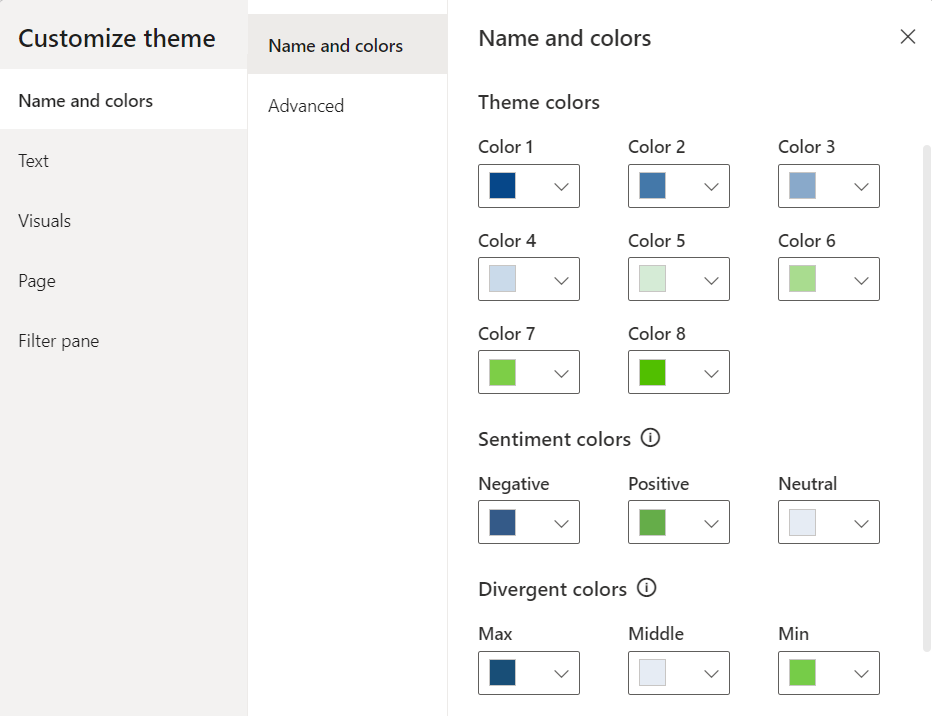


 Ethan Guyant