FP20 Analytics ZoomCharts Challenge 15: My Journey to the Top 5


Over the last two years I have ended each of my posts with two main messages, (1) stay curious and happy learning, and (2) continuously experiment, explore and challenge yourself. However, at times it can be hard to identify open ended opportunities to fulfill these.

One opportunity available is participating in various data challenges. I recently participated in and was a top 5 finalist in the FP20 Analytics ZoomCharts Challenge 15. This data challenge was a HR data analysis project with a provided dataset to explore and a chance to expand your report development skills.

What I enjoyed about the challenge is along with the dataset, it provided a series of questions to help guide the analysis and provide direction and a focus for the report.

Here is the resulting report submitted to the challenge and discussed in this post. View, interact, and get the PBIX file at the link below.

The report was built with the HR Analysis dataset and includes ZoomCharts custom Drill Down PRO visuals for Power BI. 


About the Challenge

The FP20 Analytics challenge was in collaboration with ZoomCharts and provided an opportunity to explore custom Power BI ZoomCharts drill down visuals.

The requirements included developing a Power BI report with a default canvas size, a maximum of 2 pages, and include at least two ZoomCharts Drill Down Visuals.

The goal of the challenge was to identify trends within the dataset and develop a report that provides viewers the answers to the following questions.

  1. How diverse is the workforce in terms of gender, ethnicity, and age?
  2. Is there a correlation between pay levels, departments, and job titles?
  3. How about the geographic distribution of the workforce?
  4. What is the employee retention rate trend yearly?
  5. What is the employee retention rate in terms of gender, ethnicity, and age?
  6. Which business unit had the highest and lowest employee retention rate?
  7. Which business unit and department paid the most and least bonuses annually?
  8. What is the annual historical bonus trend? Can we show new hires some statistics?
  9. How about the pay equity based on gender, ethnicity, and age?
  10. What is the employee turnover rate (e.g., monthly, quarterly, annually) since 2017?

There are countless ways to develop a Power BI report to address these requirements. You can see all the FP20 Analytics ZoomCharts Challenge 15 report submissions here.

This post will provide an overview and some insight into my approach and the resulting report.


Understanding the Data

With any analysis project, before diving into creating the report, I started by exploring and getting an understanding of the underlying data. The challenge provided a single table dataset, so I loaded the data into Power BI to use the Power Query editor’s column distribution, column profile, and column quality to help get an understanding of the data.

Using these tools, I was able to identify missing values, data errors, data types, and get a better sense of the distribution of the data. This initial familiarity will help inform the analysis and help identify what data could be used to answer the requirement questions, identify data gaps, and help ask the right questions to create an effective report.

The dataset contained 16 columns and provided the following data on each employee.

  • Employee/Organizational characteristics
    • Employee ID, full name, job title, department, business unit, hire date, exit date
  • Demographic information
    • Age, gender, ethnicity
  • Salary information
    • Annual salary and bonus percentage
  • Location information
    • City, country, latitude, longitude

The dataset was already clean. No columns contained any errors that had to be addressed, and the only column that had empty/null values was exit date, which is expected. One thing I noted at this stage is that the Employee ID column did not provide a unique identifier for an employee.

Additionally, I used a temporary page in the Power BI report containing basic charts to visualize distributions and experiment with different types of visuals to see which ones best represent the data and help reach the report objectives. Another driver of using this approach was start experimenting with and understanding the different ZoomCharts and their customizations.


Identifying Key Data Attributes

Once I had a basic understanding of the dataset, it is always tempting to jump right into data manipulation and visualization. However, I find it helpful at this stage to pause and review the questions the report should answer.

During this review I was able to further define these goals, with my new understanding of the data, which guided the selection of relevant data within the dataset.

I then broke the questions down into 3 main areas of focus and began to think about what data attributes within the dataset can be used, and possibility more importantly, think about what is missing or how I can enrich the dataset to create a more effective report.

Workforce Diversity (Question #1 and #3)

To analyze the workforce diversity, the dataset provided a set of demographic information fields that aligned with these questions.

Salary & Bonus Structure (Questions #2, #7, #8, #9)

The next set of questions I focused on revolved around the salary and bonus structure of the organization. I identified I could use the demographic fields along with the salary information to provide insights.

Employee Retention & Turnover (Questions #4, #5, #6, and #10)

The dataset did not directly include the retention and turnover rates and required enriching the dataset to calculate these values. To do this I used the hire date and exit date. Once calculated I am able to add an organization context to the analysis by using the business unit, department, and job title attributes.


Dataset Enrichment

After identifying key data attributes that can be used to answer the objectives of the report, it becomes clear that there are opportunities for enriching the dataset to aid in making a more effective visualization (e.g. age bins) and address data gaps or require calculations (e.g. employee retention and turnover).

For this report I achieved this through the use of both calculated columns and measures.

Creating Calculated Columns

Calculated columns are a great tool to add new data based on existing information in the dataset. For this report I created 7 calculated columns which were required because I wanted to use the calculated result in axes of report visuals or as a filter condition in a DAX query.

  • Age Bin: categorized the employee’s age based on their age decade (20s, 30s, 40s, 50s, or 60s). Here I used a calculated column rather than the built-in data group option to provide more flexibility and control over the bins.
  • Tenure (Years): while exploring salary across departments and demographic categories, I also wanted to include context for how long the employee has been with the organization as this might influence their salary and/or bonus.
  • Total Compensation: the dataset provided annual salary and bonus percent. The bonus percent was helpful when examining this attribute specifically, however when analyzing the organization pay structure across groups, I found the overall page (salary + bonus) to be more insight and provide the entire picture of the employee’s compensation.
  • Employee Status: the dataset included current and past employees. To ease analysis and provide the users the ability to filter on the employee’s status I included a calculated column to label the employee as active or inactive.
  • Abbreviation: the report required providing insight broken down by business unit, country, and department all of which could have long names and clutter the report. For each of these columns I included a calculated column providing a 3-letter abbreviation to be used in the report visuals.

Defining Measures

In addition to calculated columns, the report included various calculated measures. These dynamic calculations are versatile and aid the interactive nature of the Power BI report.

For this report I categorized my measure into the following main categories.

  • Explicit Summaries: these measures are not strictly required. However, I prefer the use of explicit aggregation measures over implicit auto-aggregation measures on the visuals due to the increased flexibility and reusability.
    • Average Total Compensation
    • Average Bonus ($)
    • Average Bonus (%)
    • Highest Average Bonus % (Dept) Summary
    • Lowest Average Bonus % (Dept) Summary
    • Maximum Bonus %
    • Minimum Bonus %
    • Average Annual Salary
    • Maximum Annual Salary
    • Median Annual Salary
    • Minimum Annual Salary
    • Active Employee Count
      • Total count
      • Each ethnicity count
      • Male/Female count
    • Inactive Employee Count
  • Report Labels: these measures were used to add additional context and information to the user when interacting with drill down visuals. On the drill down visuals when a user selects a data category or data point the visual drills down and shows the next level of the data hierarchy. What is lost, is what top level category was selected, so these labels are used to provide that information.
    • Selected Age Bin
    • Selected Business Unit Retention
    • Selected Business Unit Turnover
    • Selected Dept Retention
    • Selected Dept Turnover
  • Retention & Turnover: 4 of the report objectives revolved around employee retention and turnover rates. The dataset only provided employee hire dates and exits which are used to calculate these values.
    • Cumulative Total Employee Count (used in retention rate)
    • Employee Separations (used in retention rate)
    • Employee Retention
    • Brazil Retention Rate
    • China Retention Rate
    • United Sates Retention Rate
    • Employee Turnover Rate
    • Brazil Turnover Rate
    • China Turnover Rate
    • United States Turnover Rate

Report Development

After understanding the dataset, identifying key data attributes, and enriching the dataset I moved onto the report development.

Report Framework

From the requirements I knew the report would be 2 pages. The first focused on Workforce Diversity and Salary & Bonus Structure. The second focused on Employee Retention & Turnover.

I started the report with a two-page template that included all the functionality of an expandable navigational element. For details on how I created this, and where to find downloadable templates see my post below.

This navigation is a compact vertical navigation that can be expanded to provide the user page titles and was highlighted as a strong point of the report in the Learn from the Best HR Reports: ZoomCharts TOP Picks.

User-Centric Design: Next level reporting with interactive navigation for an enhanced user experience

Then I selected the icons used in the navigation and updated the report page titles on each page and within the expanded navigation.

Once the template was updated for the specifics of this report, I applied a custom theme to get the aesthetic just right. For more on creating custom themes and where to find downloadable themes, including the one used in this report (twilight-moorland-plum), see the following post.

Dive into the details of blending design and data with custom Power BI themes.

After updating the navigation template and implementing the report theme, I was set with a solid foundation to begin adding report visuals.

Demographic & Compensation Analysis

The first page of the report focused on two main objectives, the demographic distribution of the workforce and an in-depth analysis of the organizational compensation structure.

Demographic Distribution

The first objective was to provide the user insights into the diversity of the workforce in terms of gender, ethnicity, and age. This was a perfect fit for the Drill Down Combo PRO (filter) by ZoomCharts visual. The visual displays the percentage of the workforce broken down by gender and displayed by employee age. Each age bin then can be drilled into to reveal additional insights into the age bins ethnicity make up.

In addition to the core visual, I included a card visual displaying the Selected Age Bin measure to provide context to the data when viewing an age bins ethnicity make up.

Geographic Distribution

The other component of this analysis was objective #3 focused on the geographic distribution of the workforce. In my submitted report this comprised of two elements the first and primary visual is the Drill Down Map PRO (Filter) by ZoomCharts visual. The second is a Drill Down Combo Bar PRO (Filter) by ZoomCharts visual.

The Map visual shows the ethnicity of the workforce as a percentage of the total workforce for each geographic location.

This visual in the report had noted limitation. Mainly the initial view of the map did not show all the data available. The inclusion of the country break provided an effective means to filter to a specific country however, it crowded the visual. Additionally, the colors in the report for the ethnicity groups of Asian and Black used the same colors used throughout the report for Male and Female which can be a source of confusion. See the Feedback and Improvements sections to see the updates to more effectively visual this data.

Organization Compensation Structure – Compensation Equity

The first component of the compensation structure analysis was to examine the median total compensation (salary + bonus) by departments, business units and job title. The second was to provide insights into compensation equity among the demographic groups of age, ethnicity, and gender.

I used the Drill Down Combo PRO (Filter) visual to analyze the median total compensation for each organizational department broken down by gender. Each department can be drilled into to extract insights about the business unit and further drilled into each job title. I also included the average tenure in years of the employees within each category to better understand the compensation structure of the organization.

This report section contained another Drill Down Combo PRO (Filter) visual to provide insights on the median total compensation by ethnicity and gender. These two visuals when used in tandem and leveraging cross-filtering can provide a nearly complete picture of the compensation structure between departments and equity across demographic groups.

When the two Median Total Compensation visuals are used along with the demographic and geographic distributions visuals a full understanding and in-depth insights can be extracted. The user can interact and cross-filter all of these visuals to tailor the insights to meet their specific needs.

Organization Compensation Structure – Departmental & Historic Bonus Analysis

The second component of the compensation structure analysis was to provide an analysis of departmental bonuses and historical bonus trends.

To provide detailed insights into the bonus trends I utilized a set of box and whisker plots to display granular details and card visuals to provide high-level aggregations. I will note that box and whisker plots may not be suitable in every scenario. However, for an audience that is familiar and comfortable interpreting these plots they are a great tool and were well suited for this analysis.

Workforce Retention & Turnover

The second page of the report focused on the analysis of employee retention and turnover. For this report the retention rate was calculated as the percentage of employees that remained with the organization during a specific evaluation period (e.g. annually) and the turnover rate is the rate at which employees left the organization expressed as a percentage of the total number of employees.

For this analysis, I thought it was key to provide the user and quick and easy way to flip between these metrics depending on their specific requirement. I did this by implementing a button experience at the top of the report, so the user can easily find and reference what metric they are viewing.

Another key aspect to enhance the clarity of the report is the visuals remain the same regardless of the metric being viewed. This eases the transition between the different views of the data.

Across the top of the report page is a set of Drill Down Combo Bar PRO (Filter) visuals to analyze the selected metric by department and business unit on the left and age, gender, and ethnicity in the right-side grouping.

Each of these visuals also use the threshold visual property to display the average across all categories. This provides a clear visual indicator of how a specific category is performing compared to the overall average (e.g. retention for the R&D Business Unit is slightly worse (87%) than the organizational average of 92%).

All of these visuals can be used to cross-filter each other to get highly detailed and granular insights when required.

In addition to examining the retention and turnover rate among organizational and demographic groups there was an objective to provide insight to the temporal trends of these metrics. The Drill Down Timeline PRO (Filter) visual was perfect for this.

This visual provides a long-term view of the retention and turnover rate trend while providing the user an intuitive and interactive way to zoom into specific time periods of interest.

Additional Features

Outside to of the main objectives of the report outlined by the 10 specified questions there were additional insights, features, and functionalities built into the report to enhance usability and the user experience.

On the Demographic & Compensation Analysis page this included a summary statistics button to display a high-level overlay of demographic and salary summaries.

On both pages of the report there was also a clear slicer button to clear all selected slicer values. However, this clear slicer button did not reset the report to an initial state or reset data filters due to user interactions with the visuals. See the Feedback and Improvements section for details and the implemented fix.

Lastly, each page had a guided tutorial experience to inform new users about the report page and all the different features and functionalities the report and the visuals offered.

There are various other nuanced and detailed features of this reports and too much to all cover here. But please check out and interact with the report here:

The report was built with the HR Analysis dataset and includes ZoomCharts custom Drill Down PRO visuals for Power BI. 


Feedback and Improvements

My submitted report was discussed in the Learn from the Best HR Reports: ZoomCharts TOP Pick webinar which provided excellent feedback on areas to improve the report.

You can view the webinar discussion below.

The first improvement was to address the sizing of the map. Initially, when the report loads the map visual is too small to view all of the data it provides.

To address and correct this the Employee Count by country visual was removed. This visual provided helpful summary information and an effective way to filter the map by country, however, the benefits of displaying all the data on the map outweigh the benefits of this visual.

Also mentioned in the discussion of the map is the limitation in colors. Initially the ethnicity groups Black and Asian used the same colors used to visualized gender and a source of potential confusion.

To address this, I extended the color palette to include two additional colors to better distinguish these groups. These groupings are also visible on the Workforce Retention & Turnover page. These visuals were also updated to ensure consistency across the report.

The next area of feedback was around the clear slicer button. As shown in the webinar it only clears the selected slicer values and uses Power BI’s built-in Clear all slicers button.

The functionality of the clear filter button on both pages was updated to reset the report context to a base state with no filters applied to the page. The size of the button was also increased to make it easier to identify for the user.

Another point of feedback was regarding the navigation icon tooltips. I did not make an adjustment to the report to address this. As shown in the webinar if you hover over the active page icon there is not a visible tool tip. I left the report this way because the current page icon indicator on the navigational element and the report page has a title providing this information to the user.

However, on each page if you hover over an icon to a different page, there should be a tool tip that displays and addresses the main objective of this feedback. This functionality is correct on the Demographic & Compensation Analysis page but required correcting on the Workforce Retention & Turnover page to be consistent.

Lastly, there was feedback on the use of the Box and Whisker plot within the report. I agree the use of this visual is heavily dependent on the end user’s comfortability with interpreting these visuals and is not suitable in all cases. However, for this report I think they provide a helpful visualization of the bonus data and remained in the report.


Wrapping Up

Getting started with participating in these type of data challenges can be an intimidating task. With Power BI and report development there is always more to learn and areas to improve so there is not some static skill level or point to begin with these challenges. The best method to move forward is to just start and show yourself patience as you learn more and grow your skills.

For me, the main take aways from participating in this challenge and why I plan to participate in more moving forward are:

  1. When learning a new skill repetition and continued use is essential, and with report development the more reports you create the better and more experienced you will be. This challenge provided an excellent opportunity to use a unique dataset to create a report from scratch.
  2. Others are using the same data and creating the own report to share. Viewing these different reports to see how others solved the same data challenge can be extremely helpful in growing your skills and expanding the way you approached the challenge.
  3. Participating in the ZoomCharts Challenge provided tailored feedback on the report submission. Providing helpful insight on how others viewed my report and highlighting areas for improvement.
  4. Access to custom visuals. Through this challenge I was able to learn and work with ZoomCharts custom visuals. I really enjoyed learning these and adding that experience to my skillset. Find out more about these extremely useful visuals here.

Thank you for reading! Stay curious, and until next time, happy learning.

And, remember, as Albert Einstein once said, “Anyone who has never made a mistake has never tried anything new.” So, don’t be afraid of making mistakes, practice makes perfect. Continuously experiment, explore, and challenge yourself with real-world scenarios.

If this sparked your curiosity, keep that spark alive and check back frequently. Better yet, be sure not to miss a post by subscribing! With each new post comes an opportunity to learn something new.

Dive into DAX: Decoding Data with Power BI Logical Functions


The missing piece to decoding our data and unlocking its full potential is often the strategic application of DAX Logical Functions. These functions are pivotal in dissecting complex datasets, applying business logic, and enabling a nuanced approach to data analysis that goes beyond surface-level insights. Better understanding DAX Logical Functions allows us to create more sophisticated data models that respond with agility to analytical queries, turning abstract numbers into actionable insights.

In this post we will explore this group of functions and how we can leverage them within Power BI. We will dive in and see how we can transform our data analysis from a mere task into an insightful journey, ensuring that every decision is informed, every strategy is data-driven, and every report illuminates a path to action.


The Logical Side of DAX: Unveiling Power BI’s Brain

Diving into the logical side of DAX is where everything begins to become clear. Logical functions are the logical brain behind Power BI’s ability to make decisions. Just like we process information to decide between right and wrong, DAX logical functions sift through our data to determine truth values: true or false.

Functions such as IF, AND, OR, NOT, and TRUE/FALSE, are the building blocks for creating dynamic reports. These functions allow us to set up conditions that our data must meet, enabling a level of interaction and decision-making that is both powerful and nuanced. Whether we are determining if sales targets were hit or filtering data based on specific criteria, logical functions are our go-to tools for making sense of the numbers.

For details on these functions and many others visit the DAX Function Reference documentation.

Learn more about: DAX Logical Functions

The logical functions in DAX can go far beyond the basics. The real power happens when we start combining these functions to reflect complex business logic. Each function plays its role and when used in combination correctly we can implement complex logic scenarios.

For those eager to start experimenting there is a Power BI report pre-loaded with the same data used in this post ready for you! So don’t just read, follow along and get hands-on with DAX in Power BI. Get a copy of the sample data report here:

This dynamic repository is the perfect place to enhance your learning journey.


Understanding DAX Logical Functions: A Beginner’s Guide

When starting our journey with DAX logical functions we will begin to understand the unique role of each function within our DAX expressions. Among these functions, the IF function stands out as the decision-making cornerstone.

The IF function tests a condition, returning one result if the condition is TRUE, and another if FALSE. Here is its syntax.

IF(logical_test, value_if_true, value_if_false)

The logical_test parameter is any value or expression that can be evaluated to TRUE or FALSE, and then the value_if_true is the value that is returned if logical_test is TRUE, and the value_if_false is optional and is the value returned when logical_test is FALSE. When value_if_false is omitted, BLANK is returned when the logical_test is FALSE.

Let’s say we want to identify which sales have an amount that exceeds $5,000. To do this we can add a new calculated column to our Sales table with the following expression.

Sales Target Categorization = 
IF(
  Sales[Amount] > 5000, 
  "Above Target", 
  "Below Target"
)

This expression will evaluate each sale in our Sales table, labeling each sale as either “Above Target” or “Below Target” based on the Sales[Amount].

The beauty of starting our journey with IF lies in its simplicity and versatility. While we continue to explore logical functions, it won’t be long before we encounter TRUE/FALSE.

As we saw with the IF function these values help guide our DAX expressions, they are also their own DAX function. These two functions are the DAX way of saying yes (TRUE) or no (FALSE), often used within other logical functions or conditions to express a clear binary choice.

These functions are as straightforward as they sound and do not require any parameters. When used with other functions or conditional expressions we typically use these to explicitly return TRUE or FALSE values.

For example, we can create another calculated column to check if a sale is a high value sale with an amount greater than $9,000.

High Value Sale = 
IF(
  Sales[Amount] > 9000, 
  TRUE, 
  FALSE
)

This simple expression checks if the sales amount exceeds $9,000, marking each record as TRUE if so, or FALSE otherwise.

Together IF and TRUE/FALSE form the foundation of logical expressions in DAX, setting the stage for more complex decision-making analysis. Think of these functions as essential for our logical analysis, but just the beginning of what is possible.


The Gateway to DAX Logic: Exploring IF with AND, OR, and NOT

The IF function is much more than just making simple true or false distinctions; it helps us unlock the nuanced layers of our data, guiding us through the paths our analysis can take. By effectively leveraging this function we can craft detailed narratives from our datasets.

We are tasked with setting sales targets for each region. The goal is to base these targets on a percent change seen in the previous year. Depending on whether a region experienced a growth or decline, the sales target for the current year is set accordingly.

Region Specific Sales Target = 
IF(
    HASONEVALUE(Regions[Region]),
    IF(
        [Percent Change(CY-1/CY-2)] < 0, 
        [Total Sales (CY-1)]*1.1, 
        [Total Sales (CY-1)]*1.2
    ),
    BLANK()
)

In this measure we make use of three other measures within our model. We calculate the total sales for the previous year (Total Sales (CY-1)), and the year before that (Total Sales (CY-2)). We then determine the percentage change between these two values.

If there is a decline (negative percent change), we set the current year’s sales target to be 10% higher than the previous year’s sales, indicating a more conservative goal. Conversely, if there was growth (positive percent change), we set the current year target 20% higher to keep the momentum going.

As we dive deeper, combining IF with functions like AND, OR, and NOT we begin to see the true flexibility of these functions in DAX. These logical operators allow us to construct more intricate conditions, tailoring our analysis to very specific scenarios.

The operator functions are used to combine multiple conditions:

  • AND returns TRUE if all conditions are true
  • OR returns TRUE if any condition is true
  • NOT returns TRUE if the condition is false

Let’s craft a measure to determine which employees are eligible for a quarterly bonus. The criterion for eligibility is twofold: the employee must have made at least one sale in the current quarter, and their average sale amount during this period must exceed the overall average sale amount.

To implement this, we first need to calculate the average sales and compare each employee’s average sale against this benchmark. Additionally, we check if the employee has sales recorded in the current quarter to qualify for the bonus.

Employee Bonus Eligibility = 
VAR CurrentQuarterStart = DATE(YEAR(TODAY()), QUARTER(TODAY()) * 3 - 2, 1)
VAR CurrentQuarterEnd = EOMONTH(DATE(YEAR(TODAY()), QUARTER(TODAY()) * 3, 1), 0)
VAR OverallAverageSale = CALCULATE(AVERAGE(Sales[Amount]), ALL(Sales))
VAR EmployeeAverageSale = CALCULATE(AVERAGE(Sales[Amount]), FILTER(Sales, Sales[SalesDate] >= CurrentQuarterStart && Sales[SalesDate] = CurrentQuarterStart && Sales[SalesDate]  0

RETURN
IF(
    AND(HasSalesCurrentQuarter, EmployeeAverageSale > OverallAverageSale),
    "Eligible for Bonus",
    "Not Eligible for Bonus"
)

In this measure we define the start and end dates of the current quarter, then we calculate the overall average sale across all data for comparison. We then determine each employee’s average sale amount and check if the employee has made any sales in the current quarter to qualify for evaluation.

If an employee has active sales and their average sale amount during the period is above the overall average, they are deemed “Eligible for Bonus”. Otherwise, they are “Not Eligible for Bonus”.

This example begins to explore how we can use IF in conjunction with AND to streamline business logic into actionable insights. These logical functions provide a robust framework for asking detailed questions about our data and receiving precise answers, allowing us to uncover the insights hidden within the numbers.


Beyond the Basics: Advanced Logical Functions in DAX

As we venture beyond the foundational logical functions we step into a world where DAX’s versatility shines, especially when dealing with complex data models in Power BI. More advanced logical functions such as SWITCH and COALESCE bring a level of clarity and efficiency that is hard to match with just basic IF statements.

SWITCH Function: Simplifying Complex Logic

The SWITCH function is a more powerful version of the IF function and is ideal for scenarios where we need to compare a single expression against multiple potential values and return one of multiple possible result expressions. This function helps us provide clarity by avoiding multiple nested IF statements. Here is its syntax.

SWITCH(expression, value, result[, value, result]...[, else])

The expression parameter is a DAX expression that returns a single scalar value and is evaluated multiple times depending on the context. The value parameter is a constant value that is matched with the results of expression, the result is any scalar expression to be evaluated if the result of expression matches the corresponding value. Finally, the else parameter is an expression to be evaluated if the result of expression does not match any value arguments.

Let’s explore. We have a scenario where we want to apply different discount rates to products based on their categories (Smartphone, Laptop, Tablet). We could achieve this by using the following expression for a new calculated column, which uses nested IFs.

Product Discount Rate (IF) = 
IF(
    Products[Product]="Smartphone", 0.10,
    IF(Products[Product]="Laptop", 0.15,
        IF(Products[Product]="Tablet", 0.20,
            0.05
        )
    )
)

Although this would achieve our goal, the use of nested if statements can make the logic of the calculated column hard to read, understand, and most importantly hard to troubleshoot.

Now, let’s see how we can improve the readability and clarity by implementing SWITCH to replace the nested IF statements.

Product Discount Rate = 
SWITCH(
    Products[Product],
    "Smartphone", 0.10,
    "Laptop", 0.15,
    "Tablet", 0.20,
    0.05
)

The expression simplifies the mapping of each Product to its corresponding discount rate and provides a default rate for categories that are not explicitly listed.

COALESCE Function: Handling Blank or Null Values

The COALESCE function offers a straightforward way to deal with BLANK values within our data, returning the first non-blank value in a list of expressions. If all expressions evaluate to BLANK, then a BLANK value is returned. Its syntax is also straightforward.

COALESCE(expression, expression[, expression]...)

Here, expression can be any DAX expression that returns a scalar value. These expressions are evaluated in the order they are passed to the COALESCE function.

When reporting on our sales data, encountering blanks can sometimes communicate the wrong message. Using COALESCE we can address this by providing a more informative value when there are no associated sales.

Product Sales = COALESCE([Total Sales], "No Sales")

With this new measure if our Total Sales measure returns a blank, for example due to filters applied in the report, COALESCE ensures this is communicated with a value of “No Sales”. This approach can be beneficial for maintaining meaningful communication in our reports. It ensures that our viewers understand the lack of sales being reported, rather than interpreting a blank space as missing or erroneous data.

These logical functions enrich our DAX toolkit, enabling more elegant solutions to complex problems. By efficiently managing multiple conditions and safeguarding against potential errors, SWITCH and COALESCE not only optimize our Power BI models but also enhance our ability to extract meaningful insights from our data.

With these functions, our journey into DAX’s logical capabilities becomes even more exciting, revealing the depth and breadth of analysis we can achieve. Let’s continue to unlock the potential within our data, leveraging these tools to craft insightful, dynamic reports.


Logical Comparisons and Conditions: Crafting Complex DAX Logic

Delving deeper into DAX, we encounter scenarios that demand a blend of logical comparisons and conditions. This complexity arises from weaving together multiple criteria to craft intricate logic that precisely targets our analytical goals.

We touched on logical operators briefly in a previous section, the AND, OR, and NOT functions are crucial for building complex logical structures. Let’s continue to dive deeper into these with some more hands-on and practical examples.

Multi-Condition Sales Analysis

We want to identify and count the number Sales transactions that meet specific criteria: sales above a threshold and within a particular region. To achieve this, we create a new measure using the AND operator to count the rows in our sales table that meet our criteria.

High Value Sales in US (Count) = 
COUNTROWS(
    FILTER(
        Sales,
        AND(
            Sales[Amount] > 5500,
            RELATED(Regions[Region]) = "United States"
        )
    )
)

This measure filters our Sales table to sales that have an amount greater than our threshold of $5,500 and have a sales region of United States.

Excluding Specific Conditions

We need to calculate total year-to-date sales while excluding sales from a particular region or below a certain amount. We can leverage the NOT function to achieve this.

Sales Excluding Asia and Low Values = 
CALCULATE(
    SUM(Sales[Amount]),
    AND(
        NOT(Sales[RegionID] = 3), // RegionID=3 (Asia)
        Sales[Amount] > 5500
    ),
    Sales[IsCurrentYear]=TRUE()
)

This measure calculates the sum of the sales amount that are not within our Asia sales region and are above $5,500. Using NOT we exclude sales from the Asia region and we us the AND function to also impose the minimum sales amount threshold.

Special Incentive Qualifying Sales

Our goal is to identify sales transactions eligible for a special incentive based on multiple criteria: sales amount, region, employee involvement, and a temporal aspect of the sales data. Here is how we can achieve this.

Special Incentive Qualifying Sales = 
CALCULATE(
    SUM(Sales[Amount]),
    OR(
        Sales[Amount] > 7500,
        Sales[RegionID] = 2
    ),
    NOT(
        Sales[EmployeeID] = 4
    ),
    Sales[IsCurrentYear] = TRUE()
)

The OR function is used to include sales transactions that either exceed $7,500 or are made in Europe (RegionID = 2) and the NOT function excludes transaction made by an employee (EmployeeID = 4), who is a manager and exempt from the incentive program. The final condition is that the sale occurred in the current year.

The new measure combines logical tests to filter our sales data, identifying the specific transactions that qualify for a special incentive under detailed conditions.

By leveraging DAX’s logical functions to construct complex conditional logic, we can precisely target specific segments of our data, uncover nuanced insights, and tailor our analysis to meet specific business needs. These examples showcase just the beginning of what is possible when we combine logical functions in creative ways, highlighting DAX’s robustness and flexibly in tackling intricate data challenges.


Wrapping Up: From Logic to Action

Our journey through the world of DAX logical functions underscores their transformative power within our data analysis. By harnessing IF, SWITCH, AND, OR, and more, we’ve seen how data can be sculpted into actionable insights, guiding strategic decisions with precision. To explore other DAX Logical Functions or get more details visit the DAX Function Reference.

Learn more about: DAX Logical Functions

Logical reasoning in data analysis is fundamental. It allows us to uncover hidden patterns and respond to business needs effectively, demonstrating that the true value of data lies in its interpretation and application. DAX logical functions are the keys to unlocking this potential, offering clarity and direction in our sea of numbers.

As we continue to delve deeper into DAX and Power BI, let the insights derived from logical functions inspire action and drive decision-making. To explore other functions groups that elevate our data analysis check out the Dive into DAX series, with each post comes the opportunity to enhance your data analytics and Power BI reports.

Explore the intricate landscape of DAX in Power BI, revealing the potential to enhance your data analytics with every post. 


Thank you for reading! Stay curious, and until next time, happy learning.

And, remember, as Albert Einstein once said, “Anyone who has never made a mistake has never tried anything new.” So, don’t be afraid of making mistakes, practice makes perfect. Continuously experiment and explore new DAX functions, and challenge yourself with real-world data scenarios.

If this sparked your curiosity, keep that spark alive and check back frequently. Better yet, be sure not to miss a post by subscribing! With each new post comes an opportunity to learn something new.

Dive into DAX: Elevated Insights with Information Functions


In data analytics effectively navigating, understanding, and interpreting our data can be the difference between data-driven insights and being lost in a sea of data. In this post we will focus on a subset of DAX functions that help us explore our data – the Information Functions.

These functions are our key to unlocking deeper insights, ensuring data integrity, and enhancing the interactivity of our reports. Let’s embark on a journey to not only elevate our understanding of Power BI and DAX but also to harness the full potential of our data.

The Role of Information Functions in DAX

Information functions play a crucial role in DAX. They are like the detective of our Power BI data analysis, helping us identify data types, understand relationships, handling errors, and much more. Whether we are checking for blank values, understanding the data type, or handling various data scenarios, information functions are our go-to tools.

Diving deep into information functions goes beyond today’s problems and help prepare for tomorrow’s challenges. Mastering these functions enables us to clean and transform our data efficiently, making our analytics more reliable and our insights more accurate. It empowers us to build robust models that stand the test of time and data volatility.

In our exploration through the world of DAX Information Functions, we will explore how these functions work, why they are important, and how we can use them to unlock the full potential of our data. Ready to dive in?

For those of you eager to start experimenting there is a Power BI report pre-loaded with the same data used in this post ready for you. So don’t just read, follow along and get hands-on with DAX in Power BI. Get a copy of the sample data file here:

This dynamic repository is the perfect place to enhance your learning journey.


The Heartbeat of Our Data: Understanding ISBLANK and ISEMPTY

In data analysis knowing when our data is missing, or blank is key. The ISBLANK and ISEMPTY functions in DAX help us identify missing or incomplete data.

ISBLANK is our go-to tool to identify voids within our data. We can use this function to locate and handle this missing data either to report on it or to manage it, so it does not unintentionally impact our analysis. The syntax is straightforward.

ISBLANK(value)

Here, value is the value or expression we want to check.

Let’s use this function to create a new calculated column to check if our sales amount is blank. This calculated column can then be used to flag and identify these records with missing data, and ensure they are accounted for in our analysis.

MissingSalesAmount = ISBLANK(Sales[Amount])

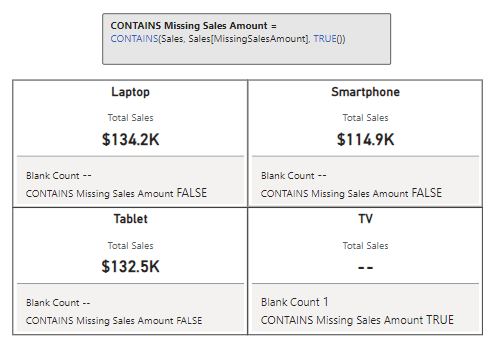
We can now use this calculated column to provide a bit more context to card visuals showing our total sales for each of our products.

In this example we can see the total sales for each product category. However, if we only show the total sales value it could lead our viewers to believe that the TV category has no sales. By adding a count of TV Sales records that have a blank sales amount we can inform our viewers this is not the case and that there is an underlying data issue.

While ISBLANK focuses on the individual values, ISEMPTY takes a step back to consider the table as a whole. We can use this function to check whether the table we pass to this DAX expression contains data. Its syntax is also simple.

ISEMPTY(table_expression)

The table_expression parameter can be a table reference or a DAX expression that returns a table. ISEMPTY will return a value of true if the table has no rows, otherwise it returns false.

Let’s use ISEMPTY in combination with ISBLANK to check if any of our sales records have a missing or blank employee Id. Then we can use this information, to display the count of records (if any) and the total sales value of these records.

In this example we see that Sales with No EmployeeId returns a value of false, indicating that the table resulting from filtering our sales records to sales with a blank employee Id is not empty and contains records. We can then also make use of this function to help display the total sales of these records and a count.

These two functions are the tools to use when investigating our datasets for potentially incomplete data. ISBLANK can help us identify rows that need attention or consideration in our analysis and ISEMPTY helps validate if a subset of data exists in our datasets. To effectively utilize these two functions, it is important to remember their differences. Remember ISBLANK checks if an individual value is missing data, while ISEMPTY examines if a table contains rows.


The Data Type Detectives: ISTEXT, ISNONTEXT, ISLOGICAL and ISNUMBER

In the world of data, not every value is as it seems and that is where this set of helpful DAX expressions come into play. These functions help identify the data types of the data we use within our analysis.

All of these functions follow the same syntax.

ISTEXT(value)
ISNONTEXT(value)
ISLOGICAL(value)
ISNUMBER(value)

Each function checks the value and returns true or false. We will use a series of values to explore how each of these functions work. To do this we will create a new table which uses each of these functions to check the values: TRUE(), 1.5, “String”, “1.5”, and BLANK(). Here is how we can do it.

TestValues = 
VAR _logical = TRUE()
VAR _number = 1.5
VAR _text = "String"
VAR _stringNumber = "1.5"

VAR _testTable =
{
   ("ISLOGICAL", ISLOGICAL(_logical), ISLOGICAL(_number), ISLOGICAL(_text), ISLOGICAL(_stringNumber), ISLOGICAL(BLANK())),
   ("ISNUMBER", ISNUMBER(_logical), ISNUMBER(_number), ISNUMBER(_text), ISNUMBER(_stringNumber), ISNUMBER(BLANK())),
   ("ISTEXT", ISTEXT(_logical), ISTEXT(_number), ISTEXT(_text), ISTEXT(_stringNumber), ISTEXT(BLANK())),
   ("ISNONTEXT", ISNONTEXT(_logical), ISNONTEXT(_number), ISNONTEXT(_text), ISNONTEXT(_stringNumber), ISNONTEXT(BLANK()))
}

RETURN
SELECTCOLUMNS(
   _testTable,
   "Function", [Value1],
   "Test Value: TRUE", [Value2],
   "Test Value: 1.5", [Value3],
   "Test Value: String", [Value4],
   "Test Value: '1.5'", [Value5],
   "Test Value: BLANK", [Value6]
)

An then we can add a table visual to our report to see the results and better understand how each function treats our test values.

The power of these functions lies in their simplicity, the clarity they can bring to our data preparation process, and their ability to be used in combination with other expressions to handle complex data scenarios.

DAX offers a number of other functions that are similar to the ones explored here such as ISEVEN, ISERROR, and ISAFTER. Visit the DAX reference guide for all the details.

Learn more about: DAX Information Functions

A common issue we can run into in our analysis is assuming data types based on a value’s appearance or context, leading to errors in our analysis. Mistakenly performing a numerical operation on a text field that appear numeric can easily throw our results into disarray. Using these functions early in our process to understand our data paves the way for clean, error-free data processing.


The Art of Data Discovery: CONTAINS & CONTAINSSTRING

When diving into our data, pinpointing the information we need can be a daunting task. This is where DAX steps in and provides us CONTAINS and CONTAINSSTRING. These functions help us uncover the specifics hidden within our data.

CONTAINS can help us identify whether a table contains a row that matches our criteria. Its syntax is as follows.

CONTAINS(table, columnName, value[, columnName, value]...)

The table parameter can be any DAX expression that returns a table of data, columnName is the name of an existing column, and value is any DAX expression that returns a scalar value that we are searching for in columnName.

CONTAINS will return a value of true if each specified value can be found in the corresponding columnName (i.e. columnName contains value), otherwise it will return false.

In our previous ISBLANK example we created a Blank Count measure to help us identify how many sales records for our product categories are missing sales amounts.

Blank Count = 
COUNTROWS(
   FILTER(Sales, Sales[MissingSalesAmount]=true)
)

Now, if we are interested in knowing just if there are missing sales amounts, we could update this expression to return true if COUNTROWS returns a value greater than 0, however this is where we can use CONTAINS to create a more effective measure.

Missing Sales Amount = 
CONTAINS(Sales, Sales[MissingSalesAmount], TRUE())

CONTAINS can be a helpful tool, however, it is essential to distinguish when it is the best tool for the task versus when an alternative might offer a more streamlined approach. Alternatives to consider include functions such as IN, FILTER, or TREATAS depending on the need.

For example, CONTAINS can be used to establish a virtual relationship between our data model tables, but functions such as TREATAS may provide better efficiency and clarity. For details on this function and its use check out this post for an in-depth dive into DAX Table Manipulation Functions.

Discover how to Reshape, Manipulate, and Transform your data into dynamic insights.

For searches based on textual content, CONTAINSTRING is our go to tool. It specializes in revealing rows where text columns contain specific substrings. The syntax is straightforward.

CONTAINSSTRING(within_text, find_text)

The within_text parameter is the text we want to search for the text passed to the find_text parameter. This function will return a value of true if find_text is found, otherwise it will return false.

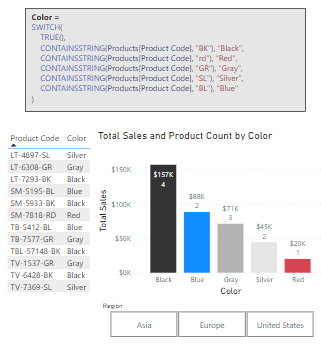
We can use CONTAINSSTRING to dissect our Product Code and enrich our dataset by adding a calculated column containing a user-friendly color value of the product. Here is how.

Color = SWITCH(
    TRUE(),
    CONTAINSSTRING(Products[Product Code], "BK"), "Black",
    CONTAINSSTRING(Products[Product Code], "rd"), "Red",
    CONTAINSSTRING(Products[Product Code], "GR"), "Gray",
    CONTAINSSTRING(Products[Product Code], "SL"), "Silver",
    CONTAINSSTRING(Products[Product Code], "BL"), "Blue"
)

This new calculated column provides us the color of each product that we can use in a slicer, or we can visualize our totals sales by the product color.

CONSTAINSSTRING is case-insensitive, as shown in the red color statement above. When we require case-sensitivity CONSTAINSSTRINGEXACT provides us this functionality.

CONTAINSSTRING just begins to scratch the surface of the DAX functions available to use for in-depth textual analysis, to continue exploring visit this post that focuses solely on DAX Text Functions.

Stringing Along with DAX: Dive Deep into Text Expressions

By leveraging CONTAINS and CONTAINSTRING – alongside understanding when to employ their alternatives – we are equipped with the tools required for precise data discovery within our data analysis.


Deciphering Data Relationships: ISFILTERED & ISCROSSFILTERED

Understanding the dynamics of data relationships is critical for effective analysis. In the world of DAX, there are two functions we commonly turn to that guide us through the relationship network of our datasets: ISFILTERED and ISCROSSFILTERED. These functions provide insights into how filters are applied within our data model, offering a deeper understanding of the context in which our data operates.

ISFILTERED offers a window into the filtering status of a table or column, allowing us to determine whether a filter has been applied directly to that table or column. This insight is valuable for creating responsive measures that adjust based on user selections or filter context. The syntax is as follows.

ISFILTERED(tableName_or_columnName)

A column or table is filtered directly when a filter is applied to any column of tableName or specifically to columnName.

Let’s create a dynamic measure that leverages ISFILTERED and reacts to user selections. In our data model we have a measure that calculates the product sales percentage of our overall total sales. This measure is defined by the following expression.

Product Percentage of All Sales = 
VAR _filterdSales = [Total Sales]
VAR _allSales = CALCULATE([Total Sales], ALL(Products[Product]))

RETURN
DIVIDE(_filterdSales, _allSales, 0)

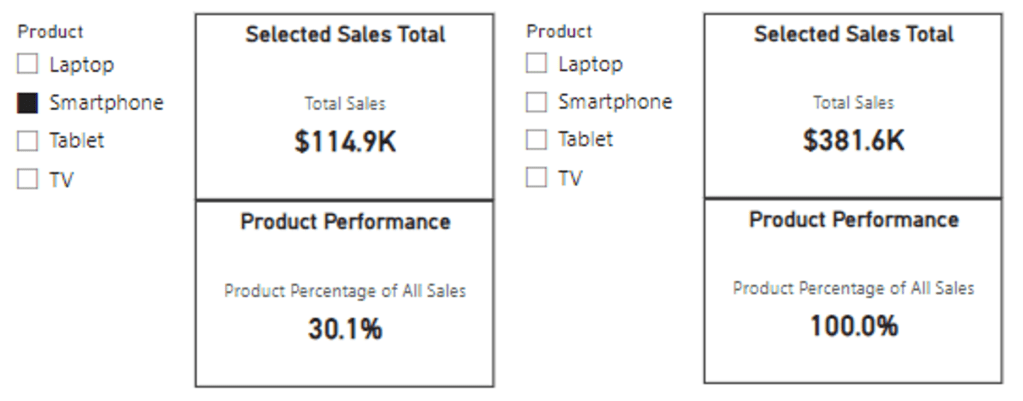
We can see this measure displays the percentage of sales for the selected product. However, when no product is selected it displays 100%, although this is expected and correct, we would rather not display the percentage calculation when there is no product selected in our slicer.

This is a perfect case to leverage ISFILTERED to first check if our Products[Product] column is filtered, and if so, we can display the calculation, and if not, we will display “N/A”. We will update the measure’s definition to the following.

Product Percentage of All Sales = 
VAR _filterdSales = [Total Sales]
VAR _allSales = CALCULATE([Total Sales], ALL(Products[Product]))

RETURN
IF(
    ISFILTERED(Products[Product]),
    //The Product column is directly filtered
    DIVIDE(_filterdSales, _allSales, 0),
    //The Product column is not directly filtered
    "N/A"
)

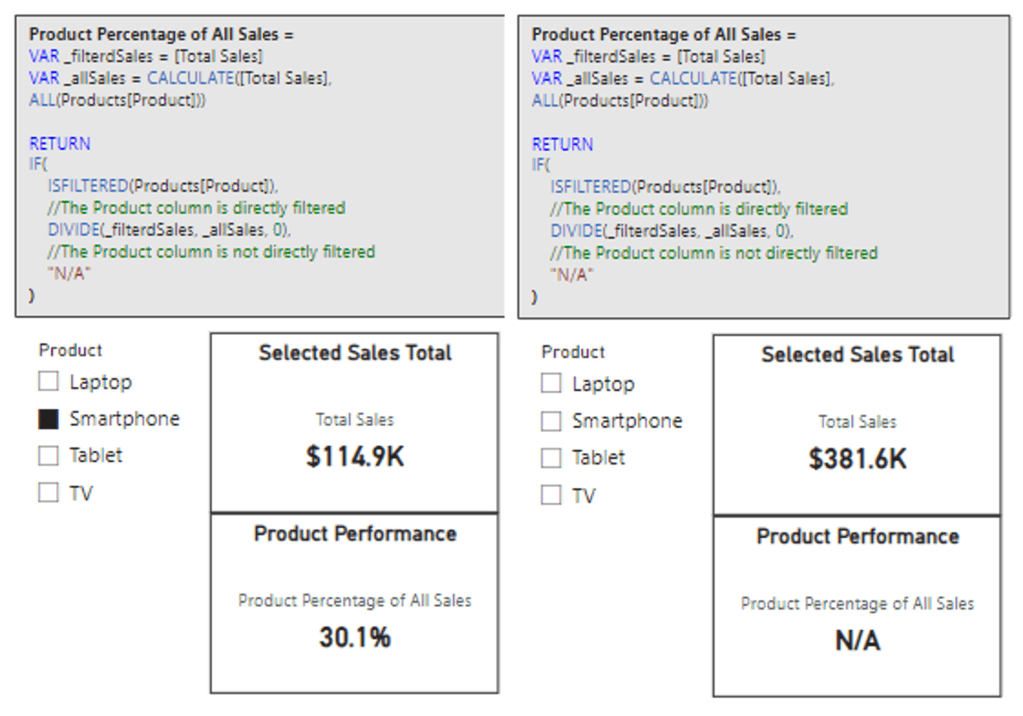
And here are the updated results, we can now see when no product is selected in the slicer the measure displays “N/A”, and when the user selects a product, the measure displays the calculated percentage.

While ISFILTERED focuses on direct filter application, understanding the impact of cross-filtering, or how filters on one table affect another related table, is just as essential in our analysis. ISCROSSFILTERED goes beyond ISFILTERED and helps us identify if a table or column has been filtered directly or indirectly. Here’s its syntax.

ISCROSSFILTERED(tableName_or_columnName)

ISCROSSFILTERED will return a value of true when the specified table or column is cross-filtered. The table or column is cross-filtered when a filter is applied to columnName, any column of tableName, or any column of a related table.

Let’s explore ISCROSSFILTERED and how it differs from ISFILTERED with a new measure similar to the one we just created. We define the new measure as the following.

Product Percentage of All Sales CROSSFILTER = 
VAR _filterdSales = [Total Sales]
VAR _allSales = CALCULATE([Total Sales], ALL(Sales))

RETURN
IF(
    ISCROSSFILTERED(Sales),
    //Sales table is cross-filtered
    DIVIDE(_filterdSales, _allSales, 0),
    //The Sales table is not cross-filterd
    "N/A"
)

In this measure we utilize ISCROSSFILTERED to check if our Sales table is cross-filtered, and if it is we calculate the proportion of filtered sales to all sales, otherwise the expression returns “N/A”. With this measure we can gain a nuanced view of product performance within the broader sales context.

When our Sales table is only filtered by our Product slicer, we see that the ISFILTERED measure and the ISCROSSFILTERED measure return the same value (below on the left). This is because as before the column Products[Product] is directly filtered by our Product slicer, so the ISFILTERED measure carries out the calculation and returns the percentage.

But also, since our data model has a relationship between our Product and Sales table, the selection of a product in the slicer indirectly filters, or cross-filters, our Sales table leading to our CROSSFILTER measure returning the same value.

We start to see the difference in these functions when we start to incorporate other slicers, such as our region slicer. In the middle image, we can see if no product is selected our Product Performance card display “N/A”, because our Products[Product] column is not being directly filtered.

However, the Sales Performance card that uses our CROSSFILTER measure is dynamically updated to now display the percentage of sales associated with the selected region. Again, this is because our data model has a relationship between our Region and Sales table, so the selection of a region is cross-filtering our sales data.

Lastly, we can see both measures in action when a Product and Region are selected (below on the right).

Using ISFILTERED, we can create reports that dynamically adjust to user interactions, offering tailored insights based on specific filters. ISCROSSFILTERED takes this a step further by allowing us to understand and leverage the nuances of cross-filtering impacts within our data, enabling an even more sophisticated analytical approach.

Applying these two functions within our reports allows us to enhance data model interactivity and depth of analysis. This helps us ensure our reports respond intelligently to user interactions and reflect the complex interdependencies within our data.


Wrapping Up

Compared to other function groups DAX Information Functions may be overlooked, however these functions can hold the key to unlocking insights, providing a deeper understanding of our data’s structure, quality, and context. Effectively leveraging these functions can elevate our data analysis and integrating them with other DAX function categories can lead to the creation of dynamic and insightful solutions.

As we continue to explore the synergies between different DAX functions, we pave the way for innovative solutions that can transform raw data into meaningful stories and actionable insights. For more details on Information Functions and other DAX Functions visit the DAX Reference documentation.

Learn more about: DAX Functions


Thank you for reading! Stay curious, and until next time, happy learning.

And, remember, as Albert Einstein once said, “Anyone who has never made a mistake has never tried anything new.” So, don’t be afraid of making mistakes, practice makes perfect. Continuously experiment and explore new DAX functions, and challenge yourself with real-world data scenarios.

If this sparked your curiosity, keep that spark alive and check back frequently. Better yet, be sure not to miss a post by subscribing! With each new post comes an opportunity to learn something new.

DAX Table Manipulation Functions: Transforming Your Data Analysis


Exploring DAX: Table Manipulation Functions

Dive into the world of DAX and discover its critical role in transforming raw data into insightful information. With DAX in Power BI, we are equipped with a powerful tool providing advanced data manipulation and analysis features.

Despite its advanced capabilities, DAX remains approachable, particularly its table manipulations functions. These functions are the building blocks of reshaping, merging, and refining data tables, paving the way for insightful analysis and reporting.

Let’s explore DAX table manipulations functions and unlock their potential to enhance our data analysis. Get ready to dive deep into each function to first understand it and then explore practical examples and applications.

For those of you eager to start experimenting there is a Power BI report pre-loaded with the same data used in this post ready for you. So don’t just read, follow along and get hands-on with DAX in Power BI. Get a copy of the sample data file here:

This dynamic repository is the perfect place to enhance your learning journey.

Here is what the post will cover:

  1. ADDCOLUMNS: Adding More Insights to Your Data
  2. Joining Tables with DAX: CROSSJOIN, NATURALINNERJOIN & NATURALLEFTOUTERJOIN
  3. GROUPBY: The Art of Segmentation
  4. SUMMARIZE & SUMMARIZECOLUMNS: Summary Magic
  5. ROLLUP: Climbing the Aggregation Ladder
  6. SELECTCOLUMNS: Handpicking Your Data
  7. UNION, INTERSECT, EXCEPT: Set Operations in DAX
  8. DISTINCT: Identifying Unique Values
  9. TREATAS: Bridging Data Tables

ADDCOLUMNS: Adding More Insights to Your Data

When it comes to enhancing our data tables in Power BI, ADDCOLUMNS is one of our go-to tools. This expression helps us add new columns to an existing table, which can be incredibly handy for including calculated fields or additional information that was not in the original dataset.

The syntax for ADDCOLUMNS is straightforward.

ADDCOLUMNS(table, name, expression[, name, expression]...)

Here, <table> is an existing table or any DAX expression that returns a table of data, <name> is the name given to the column and needs be enclosed in double quotes, and finally <expression> is any DAX expression that returns a scalar value that is evaluated for each row of <table>.

Let’s take a look how we can create a comprehensive date table using ADDCOLUMNS. We will start with the basics by creating the table using CALENDARAUTO() and then enrich this table by adding several time-related columns.

DateTable = 
ADDCOLUMNS (
    CALENDARAUTO(),
    "Year", YEAR([Date]),
    "YearQuarter", FORMAT([Date], "YYYY \QTR-q"),
    "YearQuarterSort", YEAR([Date]) &amp; QUARTER([Date]),
    "Quarter", QUARTER([Date]),
    "MonthName", FORMAT([Date], "MMMM"),
    "MonthShort", FORMAT([Date], "mmm"),
    "MonthNumber", MONTH([Date]),
    "MonthYear", FORMAT([Date], "mmm YYYY"),
    "MonthYearSort", FORMAT([Date], "YYYYMM"),
    "Day", DAY([Date]),
    "Weekday", WEEKDAY([Date]),
    "WeekdayName", FORMAT([Date], "DDDD"),
    "DateKey", FORMAT([Date], "YYYYMMDD")
)

In this example, we transform a simple date table into a multifaceted one. Each additional column provides a different perspective of the date, from the year and quarter to the month name and day of the week. This enriched table becomes a versatile tool for time-based analysis and reporting in Power BI.

With ADDCOLUMNS, our data tables go beyond just storing data, they become dynamic tools that actively contribute to our data analysis, making our reports richer and more informative.


Joining Tables with DAX: CROSSJOIN, NATURALINNERJOIN & NATURALLEFTOUTERJOIN

In Power BI, combining different datasets effectively can unlock deeper insights. DAX offers powerful functions like CROSSJOIN, NATURALINNERJOIN, and NATURALLEFTOUTERJOIN to merge tables in various ways, each serving a unique purpose in data modeling.

CROSSJOIN: Creating Cartesian Products

CROSSJOIN is our go-to function when we need to combine every row of one table with every row of another table, creating what is known as a Cartesian product. The syntax is simple.

CROSSJOIN(table, table[, table]…)

Here<table> is any DAX expression that returns a table of data. The columns names from the <table> arguments must all be different in all tables. When we use CROSSJOIN the number of rows in the resulting table will be equal to the product of the number of rows from all <table> arguments, and the total number of columns is the sum of all the number of columns in all tables.

We can use CROSSJOIN to create a new table containing every possible combination of products and regions within our dataset.

ProductsRegionsCross = 
CROSSJOIN(Products, Regions)

This formula will create a new table where each product is paired with every region, providing a comprehensive view for various analysis task such as product-region performance assessments.

NATURALINNERJOIN & NATURALLEFTOUTERJOIN: Simplifying Joins

When it comes to joining tables based on common columns, NATURALINNERJOIN and NATURALLEFTOUTERJOIN can be helpful. These functions match and merge tables based on column with the same names and data types.

NATURALINNERJOIN creates a new table containing rows that have matching values in both tables, this function performs an inner join of the tables. Here is the syntax.

NATURALINNERJOIN(left_table, right_table)

The <left_table> argument is a table expression defining the table of the left side of the join, and the <right_table> argument defines the table on the right side of the join. The resulting table will include only the rows where the values in the common columns are present in both tables. This table will have the common columns from the left table and other columns from both tables.

For instance, to see products data and sales data for only products that have sales we could create the following table.

NATURALLEFTOUTJOIN, on the other hand, includes all the rows from the first (left) table and the matched rows from the second (right) table. Unmatched rows in the first table will have null values in columns of the second table. This is useful for scenarios where we need to maintain all records from one table while enriching it with data from another. Its syntax is the same as NATURALINNERJOIN.

NATURALLEFTOUTERJOIN(left_table, right_table)

The resulting table will include only rows from the <right_table> where the values in the common columns specified are also present in the <left_table>.

Let’s explore this and how it differs from NATURALINNERJOIN by creating the same table as above but this time using NATURALLEFTOUTERJOIN.

Here we can see the inclusion of our TV line of products, which have no sales. NATURALLEFTOUTERJOIN provides a list of all products, along with the sales data where it is available for each product. While the previous example shows that NATURALINNERJOIN provides only products and sales where the ProductID is matched between these two tables.

Each of these functions serves a distinct purpose: CROSSJOIN for comprehensive combination analysis, NATURALINNERJOIN for intersecting data, and NATURALLEFTOUTERJOIN for extending data with optional matching from another table. Understanding when to use each will significantly enhance our data modeling in Power BI.


GROUPBY: The Art of Segmentation

Segmenting data is a cornerstone of data analysis, and in Power BI, the DAX GROUPBY function is a powerful ally for this task. GROUPBY allows you to group a table by one or more columns and performs calculations on each group. It helps us organize our data into manageable clusters, then glean insights from each cluster. The syntax for GROUPBY is as follows.

GROUPBY (table [, groupBy_columnName[, groupBy_columnName[, …]]] [, name, expression [, name, expression [, …]]])

Let’s break this down. The <table> argument is any DAX expression that returns a table of data. The <groupBy_columnName> argument is the name of an existing column in <table> (or a related table) by which the data is to be grouped and cannot be an expression. The <name> argument is the name given to a new column that is being added to the list returned by GROUPBY enclosed in double quotes. Lastly, <expression> is the expression to be evaluated for each group and must be a supported aggregation iterator function.

For details on aggregation iterator functions visit this in-depth post.

A guide to transforming data into meaningful metrics: Explore essential aggregation functions.

Let’s get into some details and examples.

The general use of GROUPBY is to create a table with a new column(s) which contain aggregated results. When using GROUPBY for grouping and aggregation we must be familiar with the related CURRENTGROUP function. The CURRENTGROUP function returns the set of rows from the table argument of the GROUPBY function that belongs to the current row of the GROUPBY results, and the function can only be used within the GROUPBY expression. This function has not argument and is only supported as the first argument to a supported aggregation function, for a list of supported functions see the reference document below.

Learn more about: CURRENTGROUP

We will start with a basic use of GROUPBY to analyze our sales by product. We can try to create a new table using the following expression.

Sales by Product = 
GROUPBY(
    Sales,
    Products[Product],
    "Total Sales", SUM(Sales[Amount])
    "Average Sales", AVERAGE(Sales[Amount)
)

However, we will see this returns an error stating:

Function 'GROUPBY' scalar expression have to be Aggregation functions over CurrentGroup(). The expression of each Aggregation has to be either a constant or directly reference the column in CurrentGroup().

We can correct this and get our expected results but updating our expression to:

Sales by Product = 
GROUPBY(
    Sales,
    Products[Product],
    "Total Sales", SUMX(CURRENTGROUP(), Sales[Amount]),
    "Average Sales", AVERAGEX(CURRENTGROUP(), Sales[Amount])
)

Although we can use GROUPBY to create the above summary table, for efficient aggregations over physical tables in our data model such as our Sales table we should conder using the functions SUMMARIZECOLUMNS or SUMMARIZE. We will explore these functions later in this post. The true power of GROUPBY is to perform aggregations over intermediate results from DAX table expressions.

We will leverage this use case by creating a new measure that calculates the total sales amount for each product category, but only for the categories where the average sales amount per transaction exceeds a threshold. Here is how we can use GROUPBY and a virtual table to define the Total Sales by High Performing Categories measure.

Total Sales by High Performing Categories = 
VAR ThresholdAverage = 3500
VAR IntermediateTable = GROUPBY(
    Sales,
    Products[Product],
    "Total Sales", SUMX(CURRENTGROUP(), Sales[Amount]),
    "Average Sales", AVERAGEX(CURRENTGROUP(), Sales[Amount])
)
VAR FilteredTable = FILTER(
    IntermediateTable,
    [Average Sales] &gt; ThresholdAverage
)
RETURN
SUMX(FilteredTable, [Total Sales])

In this measure we first define the threshold average as $3,500. Then using GROUPBY we create an intermediate table that groups our sales by product and calculates the total sales and average for each product, this is the same expression we used in the above example. We then create another table by filtering the intermediate table to include only the product groups where the average sales exceed the defined threshold. Then we use SUMX to sum up the total sales from the filtered tabled.

We can see the measure returns a total sales value of $267,000 which from the previous example we can see is the sum of our total sales for our Laptop and Tablet product categories, leaving out the Smartphone category which has an average of $3,379 and is below the threshold. This measure effectively uses GROUPBY to segment and analyze our data in a sophisticated manner, tailoring the calculation to specific business requirements.

Using GROUPBY in measures provides immense flexibility in Power BI, enabling us to perform complex aggregations and calculations that are directly reflected in our report visuals.


SUMMARIZE & SUMMARIZECOLUMNS: Summary Magic

In Power BI, creating summary tables is a common requirement, and DAX offers us two powerful functions for this purpose: SUMMARIZE and SUMMARIZECOLUMNS. These functions are designed to simplify the process of aggregating and summarizing data, making it easier to create our reports and dashboards.

SUMMARIZE: The Classic Aggregator

SUMMARIZE allows us to create a summary table by specifying the columns we want to group by and the aggregations we want to perform. It is particularly useful for creating customized groupings and calculations. Here is its syntax.

SUMMARIZE (table, groupBy_columnName[, groupBy_columnName]…[, name, expression]…)

Here, <table> can be any DAX expression that returns a table of data, <groupBy_columnName> is optional and is the name of an existing column used to create summary groups, <name> is the name given to a summarized column enclosed in double quotes, and <expression> is any DAX expression that returns a single scalar value.

Let’s see how we can more effectively create our Sales by Product summary table. We will create a Sales by Product SUMMARIZE table using the following:

Sales by Product SUMMARIZE = 
SUMMARIZE(
    Sales,
    Products[Product],
    "Total Sales", SUM(Sales[Amount]),
    "Average Sales", AVERAGE(Sales[Amount])
)

A key difference to note is the use of SUM and AVERAGE compared to the use of SUMX and AVERAGEX that were required when we used GROUPBY. Unlike GROUPBY the SUMMARIZE function has an implied CALCULATE providing the required context to aggregate our values.

SUMMARIZECOLUMNS: Enhanced Efficiency and Flexibility

SUMMARIZECOLUMNS offers enhanced efficiency and flexibility, especially in handling complex filter contexts. It may be preferred over SUMMARIZE for its performance benefits and ease of use with measures. The syntax is:

SUMMARIZECOLUMNS(groupBy_columnName[, groupBy_columnName]…, [filter_table]…[, name, expression]…)

The <groupBy_columnName> argument is a column reference to a table within our data model, the <filterTable> is a table expression which is added to the filter context of all columns specified by <groupBy_columnName>, <name> specifies the column name, and the <expression> is any DAX expression that returns a single value.

We are interested in calculating the total and average sales by product and region, but only for the previous year. This is a common scenario in business analysis, where understanding historical performance is key. We can use SUMMARIZECOLUMNS to help us achieve this.

We will create a new Last Year Sales by Product and Region table using the following:

Last Year Sales by Product and Region = 
SUMMARIZECOLUMNS(
    Regions[Region],
    Products[Product],
    Filter(Sales, Year(Sales[SalesDate]) = Year(TODAY())-1),
    "Total Sales", SUM(Sales[Amount]),
    "Average Sales", AVERAGE(Sales[Amount])
)

Here we begin with defining the dimension for group with Regions[Region] and Products[Product], this means our resulting summary will include these two levels of data granularity. The FILTER function is applied to the Sales table to include only sales records from the last year. This is achieved by comparing the year of the SalesDate to the previous year (YEAR(TODAY()) - 1). We then define two new columns in our summary: Total Sales, which sums up the amount for each product-region combination, and Average Sales, which calculates the average sales amount.

This example highlights SUMMARIZECOLUMNS and its strength in handling complex data relationships and filters. By seamlessly integrating time-based filtering and multi-dimensional grouping, it enables the creation of insightful, context-rich summary tables, pivotal for time-sensitive business analysis.

In summary, while SUMMARIZE is great for basic aggregation tasks, SUMMARIZECOLUMNS is the go-to function for more complex scenarios, offing better performance and handling of filter context in Power BI.


ROLLUP: Climbing the Aggregation Ladder

The ROLLUP function in DAX is a robust tool in Power BI for creating layered aggregations, especially useful in multi-level data analysis. It facilitates the generation of subtotals and grand totals within a single query, offering a detailed yet consolidated view of your data. ROLLUP modifies the behavior of the SUMMARIZE function by adding rollup rows to the results on columns defined by the <groupBy_columnName> argument.

Understanding the syntax and functionality of ROLLUP is key to leveraging its full potential. The basic syntax of ROLLUP is as follows:

ROLLUP (groupBy_columnName [, groupBy_columnName [, … ]])

The <groupBy_columnName> argument is a name of an existing column or ROLLUPGROUP function to be used to create summary groups.

To better understand our resulting summary table when using ROLLUP we can incorporate another helpful function: ISSUBTOTAL. We can use ISSUBTOTAL to create another column within our SUMMARIZE expression that returns true if the row contains a subtotal value for the column passed to ISSUBTOTAL as an argument.

Let’s explore an example. Suppose we want to analyze sales data and see subtotals at different levels: by region, then by product within each region, and finally a grand total across all regions and products. Here is how ROLLUP and ISSUBTOTAL can help.

Sales by Region and Production Rollup = 
SUMMARIZE(
    Sales,
    Regions[Region],
    ROLLUP(Products[Product]),
    "Total Sales", SUM(Sales[Amount]),
    "Product SubTotal", ISSUBTOTAL(Products[Product])
)

This example uses SUMMARIZE and groups our Sales data by Region. Then using ROLLUP it generates subtotals first at the product level within each region, followed by region-level subtotals. Total Sales calculates the sum of sales amounts for each group. Product SubTotals, through ISSUBTOTAL indicates whether a row is a subtotal for a product, enhancing the analysis by clearly marking these subtotal rows.

This approach, using ROLLUP with SUMMARIZE is highly effective for multi-layered data analysis. It allows for an intricate breakdown of data, showcasing how individual segments (in the example, products within regions) cumulatively contribute to broader totals. Such a perspective is critical for in-depth data analysis and informed decision-making.


SELECTCOLUMNS: Handpicking Your Data

In Power BI, tailoring our dataset to include just the right columns is often essential for efficient and focused analysis. This is where the SELECTCOLUMNS function in DAX becomes invaluable. SELECTCOLUMNS allows us to create a new table by selecting specific columns from an existing table. The syntax for SELECTCOLUMNS is straightforward:

SELECTCOLUMNS(table, [name], expression, name], …)

The arguments of this function are <table> which is any DAX expression that returns a table, <name> is the name given to the column, and <expression> is any expression that returns a scalar value.

Let’s use SELECTCOLUMNS to create a simplified table from our dataset, focusing on product sales and the corresponding sales date.

Simplified Product Sales = 
SELECTCOLUMNS(
    Sales,
    "Product Name", RELATED(Products[Product]),
    "Sales Amount", Sales[Amount],
    "Date of Sale", Sales[SalesDate]
)

UNION, INTERSECT, EXCEPT: Set Operations in DAX

Set operations in DAX including UNION, INTERSECT, and EXCEPT are fundamental in Power BI for efficiently managing and manipulating data sets. Each operation serves a unique purpose in data analysis, allowing for combining, intersecting, and differentiating data sets.

UNION: Merging Data Sets

UNION is used to combine two or more tables by appending rows from one table to another. The tables must have the same number of columns, and corresponding columns must have compatible data types. Here is its syntax.

UNION(table_expression1, table_expression2[,table_expression]…)

The <table_expression> arguments are any DAX expression that returns a table.

In our data model we have our products table and a new table containing other products, we can use UNION to merge these two product tables.

INTERSECT: Finding Common Elements

INTERSECT returns the common rows between two tables. This function is useful when we need to identify overlapping data. It’s syntax is simple.

INTERSECT(table_expression1, table_expression2)

The <table_expression> arguments are any DAX expression that returns a table. Duplicated rows are retained. The column names in the resulting table will match the column names in <table_expression1>. The table returned by INTERSECT has lineage based on the column in <table_expression1> regardless of the lineage of the columns in the second table.

Let’s use our new All Products table and INTERSECT to examine what products have sales.

Product IDs with Sales INTERSECT = 
INTERSECT(
   SELECTCOLUMNS(
      'All Products', 
      "ProdictID", 
      'All Products'[ProductID]
   ), 
   SELECTCOLUMNS(
      Sales, 
      "ProductID", 
      Sales[ProductID]
   )
)

EXCEPT: Identifying Differences

EXCEPT takes two tables and returns the rows from the first table that are not found in the second table. This is useful for finding discrepancies or exclusions between datasets.

The syntax for EXCEPT will look familiar.

EXCEPT(table_expression1, table_expression2)

Where <table_expression> can be any DAX expression that returns a table.

Let’s look at the list of ProductIDs that do not have sales, by modifying the above example using EXCEPT.

Understanding and utilizing UNION for merging data, INTERSECT for finding common data, and EXCEPT for identifying unique data helps enhance our data manipulation and analysis capabilities in Power BI.


DISTINCT: Identifying Unique Values

Identifying unique values in a data set is a common requirement, and the DISTINCT function in DAX provides a straightforward solution. DISTINCT is used to return table that contains the distinct values from a specified column or table. This function can help remove duplicate values and obtain a list of unique entries for further analysis.

The syntax for DISTINCT is simple.

DISTINCT(column)

Here, <column> is the column from which distinct values are to be returned, or an expression that returns a column. When we are using DISTINCT it is important to be aware that the results of this function are affected by the current filter context. For example, if we use DISTINCT to create a measure of the distinct products from our sales table, the result of this measure would change whenever our Sales table was filtered by date or region for example.

Using DISTINCT on a Column

When applied to a column, DISTINCT generates a one column table of unique values from the specified column. For example, we want to create a measure that returns the column of employees that have a sale. For this we can use DISTINCT to get a list of the distinct employee Ids from our Sales table and pass the list to the COUNTROWS functions to produce the count. Here is the expression.

Count of Employee with Sales = 
COUNTROWS(
   DISTINCT(
      Sales[EmployeeID]
   )
)

Using DISTINCT on a Table

When used on a table, DISTINCT returns a table with unique rows, effectively removing any duplicated rows. We can use this to examine our Sale table to identify if there are any duplicated sales records. We will create two measures, the first to return the count of rows in our Sales table and the second to return the count of rows of our Sales table using DISTINCT.

Our Count of Sales DISTINCT measure produced a count of our Sales table where each row is unique across all columns in the table. With this compared to our count of Sales we can identify our Sales table has a duplicated record.


TREATAS: Bridging Data Tables

A common challenge we may encounter is linking data from different tables that do not have a direct relationship in the data model. TREATAS in DAX is a powerful function designed to address this issue. It applies the values from one table as filters to another unrelated table. This can be especially useful when we are working with complex models where establishing direct relationships may not be feasible or optimal.

The syntax for TREATAS is as follows:

TREATAS(table_expression, column[, column[, column[,…]]]} )

The arguments of TREATAS are the <table_expression> which is an expression that results in a table, and <column> which is one or more existing columns, it cannot be an expression. The table returned by TREATAS contains all the rows in <column(s)> that are also in <table_expression>. When using TREATAS the number of columns specified must match the number of columns in <table_expression> and they must be in the same order. TREATAS is best used when a relationship does not exist between the tables, if there are multiple relationships between the tables, we should consider using USERELATIONSHIP to specify what relationship to use.

Previously, using SUMMARIZECOLUMNS we created a summary table of sales for the previous year. We now wish to visualize the total sales of this table utilizing a measure that allows the user to filter the value by a selected region.

Let’s start by adding a table to visualize our Last Year Sales by Product and Region table, a card visual to visualize the default aggregation of the Total Sales field in this table, and a slicer to allow for selection of a region.

When we select a region in our slicer, an issue becomes clear. The table and Total Sales card visual are not filtered. This is because there is no direct relationship between our Regions table and our Last Year Sales by Product and Region table. Here is how we can create a measure using TREATAS to help solve this issue.

Last Year Sales by Region = 
CALCULATE(
    SUM('Last Year Sales by Product and Region'[Total Sales]), 
    TREATAS(
        VALUES(Regions[Region]),
        'Last Year Sales by Product and Region'[Region]
    )
)

Adding a new card visual to visualize this measure we can see now that the total sales value is filtered by our Region slicer as expected.

By using TREATAS, we can dynamically filter and aggregate data across tables without the need for a physical relationship in the data model. This function is invaluable for creating flexible, context-specific calculations in Power BI.


Wrapping Up: Harnessing the Full Potential of Table Manipulation in DAX

As we wrap up our exploration of table manipulation functions in DAX, it is clear that these tools offer a wealth of possibilities for transforming and understanding our data. The functions we discussed here and many others found in the DAX Reference Guide each serve unique purposes and can be combined in various ways to unlock deeper insights.

Learn more about: Table manipulation functions.

These functions offer flexibility in data manipulation, enabling custom analyses and efficient data modeling. Mastering these functions enhances the power of our reports, making them more insightful and interactive. However, as always, it is important to balance complexity with efficiency to maintain sufficient performance.


Thank you for reading! Stay curious, and until next time, happy learning.

And, remember, as Albert Einstein once said, “Anyone who has never made a mistake has never tried anything new.” So, don’t be afraid of making mistakes, practice makes perfect. Continuously experiment and explore new DAX functions, and challenge yourself with real-world data scenarios.

If this sparked your curiosity, keep that spark alive and check back frequently. Better yet, be sure not to miss a post by subscribing! With each new post comes an opportunity to learn something new.

Dive Into DAX: Data Aggregation Made Easy


Welcome to another insightful journey of data analysis with Power BI. This guide is crafted to assist you in enhancing your skills no matter where you are in your DAX and Power BI journey through practical DAX function examples.

As you explore this content, you will discover valuable insights into effective Power BI reporting and develop strategies that optimize your data analysis processes. So, prepare to dive into the realm of DAX Aggregation functions.

  1. Unraveling the Mystery of Aggregation in DAX
  2. SUMming It Up: The Power of Basic Aggregations
    1. SUM
  3. Understanding DAX Iterators: The X Factor in Aggregations
  4. AVERAGEx Marks the Spot: Advanced Insights with Average Functions
    1. AVERAGEX
  5. COUNTing on Data: The Role of Count Functions in DAX
    1. COUNT
    2. COUNTA
    3. COUNTROWS
    4. DISTINCTCOUNT
  6. MAXimum Impact: Extracting Peak Value with MAX and MAXX
    1. MAX
    2. MAXX
  7. MINing for Gold: Uncovering Minimum Values with DAX
    1. MIN
    2. MINX
  8. Blending Aggregates and Filters: The Power Duo
  9. Navigating Pitfalls: Common Mistakes and How to Avoid Them
  10. Mastering Aggregation for Impactful Analysis

Unraveling the Mystery of Aggregation in DAX

Aggregation functions in DAX are essential tools for data analysis. They allow us to summarize and interpret large amounts of data efficiently. Let’s start by first defining what we mean when we talk about aggregation.

Aggregation is the process of combining multiple values to yield a single summarizing result. In the realms of data analysis, this typically involves calculating sums, averages, counts, and more to extract meaningful patterns and trends from our data.

Why is aggregation so important? The goal of our analysis and repots is to facilitate data-driven decision-making and quick and accurate data summarization is key. Whether we are analyzing sales data, customer behavior, or employee productivity, aggregation functions in DAX provide us a streamlined path to the insights we require. These functions enable us to distil complex datasets into actionable information, enhancing the effectiveness of our analysis.

As we explore various aggregation functions in DAX throughout this post, we will discover how to leverage these tools to transform data into knowledge. Get ready to dive deep into each function to first understand it and then explore practical examples and applications.

For those of you eager to start experimenting there is a Power BI report-preloaded with the same data used in this post ready for you. So don’t just read, follow along and get hands-on with DAX in Power BI. Get a copy of the sample data file here:

This dynamic repository is the perfect place to enhance your learning journey.


SUMming It Up: The Power of Basic Aggregations

SUM

When it comes to aggregation functions, SUM is the foundational member. It is straightforward and common but don’t underestimate its power. The SUM function syntax is simple as well.

SUM(column)

The argument column is the column of values that we want to sum.

Let’s put this function to work with our sample dataset. Suppose we need to know the total sales amount. We can use the SUM function and the Amount column within our Sales Table to create a new TotalSales measure.

TotalSales = 
SUM(Sales[Amount])

This measure quickly calculates the total sales across the entire dataset.

However, the utility of SUM goes beyond just tallying totals. It can be instrumental in uncovering deeper insights within our data. For a more advanced application, let’s analyze the total sales for a specific product category in a specific sales region. We can do this by combining SUM with the CALCULATE function, here is how the measure would look.

US Smartphone Sales = 
CALCULATE (
   [TotalSales],
   Products[Product] = "Smartphone",
   Regions[Region] = "United States"
)

The measure sums up sales amounts exclusively for smartphones in the United Sales. For additional and more complex practical applications of SUM, for example calculating cumulative sales over time, continue your exploration with the examples in the following posts.

Demystifying CALCULATE: An exploration of advanced data manipulation. 

Discover how to effortlessly navigate through intricate data landscapes using DAX Filter Functions in Power BI.

The beauty and power of SUM lies in its simplicity and versatility. It is a starting point for deeper analysis, and commonly serves as a steppingstone towards more complex functions and insights. As we get more comfortable with SUM we will soon find it to be an indispensable part of our analytical approach in Power BI.


Understanding DAX Iterators: The X Factor in Aggregations

Before we continue diving deeper, if we review the aggregation function reference, we will notice several aggregation functions ending with X.

Learn more about: Aggregation Functions

These are examples of iterator functions in DAX and include functions such as SUMX, AVERAGEX, MAXX, MINX, and COUNTX. Understanding the distinction between these functions and their non-iterative counterparts like SUM is crucial for advanced data analysis.

Iterator functions are designed to perform row-by-row computations over a table (i.e. iterate over the table). In contrast to standard aggregations that operate on a column, iterators apply a specific calculation to each row, making them more flexible and powerful in certain scenarios.

In other words, SUM will provide us the total of a column while SUMX provides the total of an expression evaluated for each row. This distinction is key in scenarios where each row’s data needs individual consideration before aggregating to a final result.

For more in-depth insights into the powerful capabilities of DAX iterator functions, explore this in-depth post.

Iterator Functions — What they are and What they do


AVERAGEx Marks the Spot: Advanced Insights with Average Functions

AVERAGEX

Let’s explore an aggregation iterator function with AVERAGEX. This function is a step up from our basic average. As mentioned above, since it is an iterator function it calculates an expression for each row in a table and then calculates the average (arithmetic mean) of these results. The syntax for AVERAGEX is as follows:

AVERAGEX(table, expression)  

Here, table is the table or an expression that specifies the table over which the aggregation is performed. The expression argument is the expression which will be evaluated for each row of the table. When there are no rows in the table, AVERAGEX will return a blank value, while when there are rows but non meet the specified criteria, the function returns a value of 0.

Time to see it in action with an example. We are interested in finding the average sales made by each employee. We can create the following measure to display this information.

Employee Average Total Sales = 
AVERAGEX(
   Employee, 
   [TotalSales]
)

This measure evaluates our TotalSales measure for each employee. The sales table is filtered by the EmployeeID, the employee’s total sales is calculated, then finally after all the employees totals sales are calculated the expression calculates the average.

In this above example, we can see the difference between AVERAGE and AVERAGEX. When we use the AVERAGE function this calculates the average of all the individual sale values for each employee, which is $3,855. The Employee Average Total Sales measure uses AVERAGEX and first calculates the total sales for each employee (Sum of Amount column), and then averages these total sales values returning an average total sales amount of $95,400.

What makes AVERAGEX particularly useful is its ability to handle complex calculations within the averaging process. It helps us understand the average result of a specific calculation for each row in our data. This can reveal patterns and insights that might be missed with basic averaging methods. AVERAGEX, and other iterators, are powerful tools in our DAX toolkit, offering nuanced insights into our data.


COUNTing on Data: The Role of Count Functions in DAX

The COUNT functions in DAX, such as COUNT, COUNTA, and DISTINCTCOUNT, are indispensable when it comes to understanding the frequency and occurrence of data in our dataset. These functions provide various ways to count items, helping us to quantify our data effectively.

COUNT

For our exploration of DAX counting functions, we will start with COUNT. As the name suggests, this function counts the number of non-blank values within the specified column. To count the number of blank values in a column check out the reference document for COUNTBLANK. The syntax for COUNT is shown below, where column is the column that contains the values to be counted.

COUNT(column)

If we want to get a count of how many sales transactions are recorded, we can create a measure with the expression below.

Sale Transaction Count = 
COUNT(Sales[SalesID])

This new measure will provide the total number of sales transactions that have a sales id recorded (i.e. not blank).

The COUNT function counts rows that contain numbers, dates, or strings and when there are no rows to count the function will return a blank. COUNT does not support true/false data type columns, if this is required, we should use COUNTA instead.

When our goal is to count the rows in a table, it is typically better and clearer to use COUNTROWS. Keep reading to explore and learn more about COUNTA and COUNTROWS.

COUNTA

COUNTA expands on COUNT by counting all non-blank values in a column regardless of datatype. This DAX expression follows the same syntax as COUNT shown above.

In our Employee tables there is a true/false value indicating if the employee is a current or active employee. We need to get a count of this column, and if we use COUNT we will see the following error when we try to visual the Employee Active Column Count measure.

Employee Active Column Count = 
COUNT(Employee[Active])

Since the Active column contains true/false values (i.e. boolean data type) we must use COUNTA to get a count of non-blank values in this column.

Employee Active Column Count = 
COUNTA(Employee[Active])

Building on this measure we can use COUNTAX to get a current count of our active employees. We will create a new measure shown here.

Active Employee Count = 
COUNTAX(
   FILTER(
      Employee, 
      Employee[Active]=TRUE()
   ), 
   Employee[Active]
)

Here we use COUNTAX, and for the table argument we use the FILTER function to filter the Employee table to only include employees whose Active status is true.

COUNTROWS

Next, we will look at COUNTROWS, which counts the number of rows in a table or table expression. The syntax is:

COUNTROWS([table])

Here, table is the table that contains the rows to be counted or an expression that returns a table. This argument is optional, and when it is not provided the default value is the home table of the current expression.

It is typically best to use COUNT when we are specifically interested in the count of values in the specified column, when it is our intention to count the rows of a table, we can use COUNTROWS. This function is more efficient and indicates the intention of the measure in a clearer manner.

A common use of COUNTROWS is to count the number of rows that result from filtering a table or applying context to a table. Let’s use this to improve our Active Employee Count measure.

Active Employee CountRows = 
COUNTROWS(
   FILTER(
      Employee, 
      Employee[Active]=TRUE()
   )
)

In this example it is recommended to use COUNTROWS because we are not specifically interested in the count of values in the Active column. Rather, we are interested in the number of rows in the Employee table when we filter the table to only include Active=true employees.

DISTINCTCOUNT

Adding to these, DISTINCTCOUNT is particularly useful for identifying the number of unique values in a column, with the following syntax.

DISTINCTCOUNT(column)

In our report we would like to examine the number of unique products sold within our dataset. To do this we create a new measure.

Unique Products Sold = 
DISTINCTCOUNT(Sales[ProductID])

We can then use this to visual the number of unique Product Ids within our Sales table, and we can use this new measure to further examine the unique products sold broken down by year and quarter.

Together, DAX count functions provide a comprehensive toolkit for measuring and understanding the dimensions of our data in various ways.


MAXimum Impact: Extracting Peak Value with MAX and MAXX

In DAX, the MAX and MAXX functions are the tools to use for pinpointing peak performances, maximum sales, or any other type of highest value within in our dataset.

MAX

The MAX function is simple to use. It finds the highest numeric value in a specified column.

MAX(column)

The column argument is the column in which we want to find the largest value. The MAX function can also be used to return the largest value between to scalar expressions.

MAX(expression1, expression2)

Each expression argument is a DAX expression which returns a single value. When we are using MAX to compare two expressions, a blank value is treated as 0, and if both expressions return a blank value, MAX will also return a blank value. Similar to COUNT, true/false data types are not supported, and if we need to evaluate a column of true/false values we should use MAXA.

Let’s use MAX to find our highest sale amount.

Max Sale Amount = 
MAX(Sales[Amount])

This new measures scans through the Amount column in our Sales table and returns the maximum value.

MAXX

MAXX builds on the functionality of MAX and offers more flexibility. It calculates the maximum value of an expression evaluated for each row in a table. The syntax follows the similar pattern as the other aggregation iterators.

MAXX(table, expression, [variant])

The table and expression arguments are the table containing the rows for which the expression will be evaluated, and the expression specifies what will be evaluated. The optional argument variant can be used when the expression has a variant or mixed value type, by default MAXX will only consider numbers. If variant is set to true, the highest value is based on ordering the column in descending order.

Let’s add some more insight to our Max Sale Amount measure. We will use MAXX to find the highest sales amount per product across all sales regions.

Max Product Total Sales = 
MAXX(
   Products, 
   [TotalSales]
)

This measure iterates over each product and calculates the totals sales amount for that product by evaluating our previously created TotalSales measure. After the total sales for each product is calculated the measure returns the highest total found across all products.

These functions provide us the tools to explore the maximum value within specific columns and also across different segments and criteria, enabling a more detailed and insightful understanding of our data’s maximum values.


MINing for Gold: Uncovering Minimum Values with DAX

The MIN and MINX functions help us discover the minimums in various scenarios, whether we are looking for the smallest sale or quantity, or any other type of lowest value.

MIN

MIN is straightforward, it finds the smallest numeric value in a column or, similar to MAX, the smallest value between two scalar expressions.

MIN(column)
MIN(expression1, expression2)

When comparing expressions, a blank value is handled the same as how the MAX function handles a blank value.

We have already identified the highest sale value, let’s use MIN to find our lowest sale amount.

Min Sale Amount = 
MIN(Sales[Amount])

This measure checks all the values in the Amount column of the Sales table and returns the smallest value.

MINX

MINX, on the other hand, offers more complex analysis capabilities. It calculates the minimum value of an expression evaluated for each row in a table. Its syntax will look familiar and follows the same pattern as MAXX.

MINX(table, expression, [variant])

The arguments to MINX are the same as MAXX, see the previous section for details on each argument.

We used MAXX to find the maximum total product sales, in a similar manner let’s use MINX to find the lowest total sales by region.

Min Region Total Sales = 
MINX(
   Regions, 
   [TotalSales]
)

The Min Region Total Sales measure iterates over each region and calculates its total sales, then it identifies and returns the lowest totals sales value.

These functions are powerful and prove to be helpful in our data analysis. They allow us to find minimum values and explore these values across various segments and conditions. This helps us better understand the lower-end spectrum of our data.


Blending Aggregates and Filters: The Power Duo

Blending aggregation functions with filters in DAX allows for more targeted and nuanced data analysis. The combination of functions like CALCULATE and FILTER can provide a deeper understanding of specific subsets in our data.

CALCULATE is a transformative function in DAX that modifies the filter context of a calculation, making it possible to perform aggregated calculations over a filtered subset of data. CALCULATE is crucial to understand and proves to be helpful in many data analysis scenarios. For details on this function and plenty of examples blending aggregations functions with CALCULATE take a look at this in-depth post focused solely on this essential function.

Demystifying CALCULATE: An exploration of advanced data manipulation. 

FILTER is another critical function that allows us to filter a table based on a given conditions. We used this function along with COUNTROWS to count the number of active employees. For additional examples and more details on FILTER and other filter functions see the post below.

Discover how to effortlessly navigate through intricate data landscapes using DAX Filter Functions in Power BI.


Working with DAX in Power BI can be incredibly powerful, but it is not without its pitfalls. Being aware of common mistakes and understanding how to avoid them can save us time and help ensure our data analysis is as accurate and effective as possible.

One frequent mistake is misunderstanding context in DAX calculations. Remember, DAX functions operate within a specific context, which could be row context or filter context. Misinterpreting or not accounting for this can lead to incorrect results. For instance, using an aggregate function without proper consideration of the filter context can yield misleading totals or averages.

Another common issue is overlooking the differences between similar functions. For example, SUM and SUMX might seem interchangeable, but they operate quite differently. SUM aggregates values in a column, while SUMX performs row-by-row calculations before aggregating. Understanding these subtleties is crucial for accurate data analysis.

Lastly, we should always beware of performance issues with our reports. As our datasets grow, complex DAX expression can slow down our reports. We should look to optimize our DAX expressions by using appropriate functions and minimizing the use of iterative functions (like aggregations functions ending in X) when a simpler aggregation function would suffice.


Mastering Aggregation for Impactful Analysis

As we reach the conclusion of our exploration into DAX aggregation functions, it’s clear that mastering these tools is essential for impactful data analysis in Power BI. Aggregation functions can be the key to unlocking meaningful insights and making informed decisions.

Remember, the journey from raw data to actionable insights involves understanding not just the functions themselves, but also the context in which they are used. From the basic SUM to the more complex SUMX, each function has its place and purpose. The versatility of AVERAGEX and the precision of COUNT functions demonstrate the depth and flexibility of DAX.

Incorporating MAX and MIN functions helps us identify extremes in our datasets. Blending aggregations with the power of CALCULATE and FILTER shows the potential of context-driven analysis, enabling targeted investigations within our data.

The journey through DAX aggregation functions is one of continuous learning and application. As we become more comfortable with these tools, we will find ourselves able to handle increasingly complex data scenarios, making our insights all the more powerful and our decisions more data driven. Continue exploring DAX aggregation functions with the DAX Reference.

Learn more about: Aggregation Functions


Thank you for reading! Stay curious, and until next time, happy learning.

And, remember, as Albert Einstein once said, “Anyone who has never made a mistake has never tried anything new.” So, don’t be afraid of making mistakes, practice makes perfect. Continuously experiment and explore new DAX functions, and challenge yourself with real-world data scenarios.

If this sparked your curiosity, keep that spark alive and check back frequently. Better yet, be sure not to miss a post by subscribing! With each new post comes an opportunity to learn something new.