Power Apps: Model-driven App Overview and Tutorial

This post starts with background information on Power Apps in general, Dataverse, and Model-Driven apps. If you are looking to jump right into building a model-driven app click here Build a Model-driven App

Background Information

Power Apps is a rapid low-code application development environment consisting of apps, services, connectors, and a data platform. It provides tools to build apps that can connect to your data stored in various data sources. The data sources can be Microsoft Dataverse (i.e. the underlying data platform) or other online and on-premises data sources including SharePoint, Excel, SQL Server, etc.

Within the Power Apps development environment you build applications with visual tools and apply app logic using formulas. This approach is similar to other commonly used business tools. Meaning you can get started using skills and knowledge you already have. The Power Platform also provides the opportunity to build upon the platform with custom developed components providing a way to create enriched experiences using web development practices.

The Power Apps platform provides two different types of apps that you can create. There are Canvas Apps and Model-driven Apps. Both app types are similar and built with similar components however, the major difference lie in the amount of developer control and uses cases.

Canvas apps provide the developer with the most control when developing the app. A canvas app starts with a blank canvas and provides full control over every aspect of the app. In addition to providing full control over the app a canvas app supports a wide variety of data sources.

Model-driven apps begin with the data model and are built using a data-first approach. The data-first approach requires more technical knowledge and is best suited for more complex applications. Model-driven apps are controlled by and depend on the underlying data model. The layout and functionality of the app is determined by the data rather than the develper who is developing the app.

The use cases of canvas apps and model-driven apps are different and each are leveraged in different situations. Canvas apps provide flexibility in the appearance and data sources and excel at creating simplified apps. Model-driven apps build a user interface on top of a data model utilized for a well defined business process.

This article will focus on creating a model-driven app including the underlying data model. Check back for a follow up article on creating your first Canvas App.


Dataverse Introduction

Dataverse is a relational database and is the data layer of the Power Platform.

Like other relational databases it contains tables or entities as the representation of real world objects. Relationships define how table rows relate to rows in other tables. What sets it apart from traditional relational databases are the business-oriented features. Some of these features include the set of standard tables and automatically adding columns to custom tables which support underlying processes. It also provides features such as creating views, forms, dashboards, charts, and business rules directly from the table configuration.

The components of the Dataverse include Storage, Metadata, Compute, Security, and Lifecycle Management.

The storage layer has different types of data storage available. Each type suited for different needs and types of data. These storage types include relational data, file storage, and key:value data.

The metadata component stores information about the primary data in Dataverse. A simple example of metadata for a table is the Display Name which you can customized. After applying customizations the changes in the table definition get stored in the metadata layer. The metadata layer is then available to the various components of the Power Platform. The metadata layer consists of the schema and the data catalog.

The compute layer is a set of functionalities that include Business Logic, Data Integration, and the API layer. Business rules or logic that apply across all applications for an organization get applied in a single location rather than each individual application. The single location these rules get applied is the Business Logic sub-layer. The business logic layer contains business rules, workflows, and plugins. The Data Integration layer consists of methods which bring data into the platform and integrating existing data in other data sources. The API layer provides the interface for other applications to connect to Dataverse.

The security layer of Dataverse can support enterprise-grade security for applications. Some features relevant to building applications include authorization, privilege, roles/groups, and auditing. Data in Dataverse is only available to authorized users with a security model based on the various components (e.g. table, columns, rows). A user’s privilege define what level of access they have or what they are able to do within the system (e.g. read, write, delete). Roles/groups are privileges that get bundled together. Authentication is the process of validating the identity of someone trying to access the system.

Application lifecycle management (ALM) is the process of managing the different phases of creating and maintaining an application. Such as development, maintenance, and decommissioning. The Lifecycle Management layer helps this process through implementing different environments, diagnostics, and solutions.


Model-Driven Apps Introduction

Model-driven apps build a user interface on top Dataverse. The foundation of the app is the underlying data model. Although a main requirement in any app development is setting up data sources, for model-driven apps it is the primary requirement. The first and essential step of model-driven app development is properly structuring the data and processes. The user interface and functionality of the app is dependent on the data model.

The development approach for model-driven apps has 3 focus areas:

  • Data Model: determining the required data and how it relates to other data
  • Defining Processes: defining and enforcing consistent processes is a key aspect of a model-driven app
  • Composing the app: using the app designer to add and configure the pages of the application

Components of Model-driven Apps

The components of a model-driven app get added through the app designer and build the appearance and functionality of the app. The components included in the app and their properties make up the app’s metadata.

There are four main types of components in the application and each has a designer used to create and edit the component.

Data Components

The data components specify the data the app builds upon.

The app design approach focuses on adding dashboards, forms, views, and charts to the application. The primary goal of a model-driven app is to provide a quick view of the data and support decision making.

ComponentDescriptionDesigner
TableA container of related recordsPower Apps table designer
ColumnA property of a recorded which is associated with a table.Power Apps table designer
RelationshipDefine how data in different tables relate to one another.Power Apps table designer
ChoiceSpecialized column that provides the user a set of predefined options.Power Apps option set designer

User Interface Components

The user interface (UI) components define how the user will interact with the app.

ComponentDescriptionDesigner
AppThe fundamental properties of the application specifying components, properties, client types, and URLApp designer
Site MapDetermines the navigation of the appSite map designer
FormA set of data-entry column for a specified tableForm designer
ViewDefine how a list of records for a table appear in the appView designer

App Logic

The logic defines the processes, rules, and automation of the app.

ComponentDescriptionDesigner
Business Process FlowA step-by-step aid guiding user through a standard processBusiness process flow designer
WorkflowAutomate processes without a user interfaceWorkflow designer
ActionsActions are a type of process that are invoked from a workflowProcess designer
Business RuleApply rules or recommendation logic to a formBusiness Rule Designer
Power AutomateCloud-based service to create automated workflows between apps and servicesPower Automate

Visual Components

The visual components visualize the app data.

Component
ChartA single graphic visualization that can be displayed within a view, on a form, or added to a dashboardChart designer
DashboardA collection of one or more visualizationsDashboard Designer
Embedded Power BIPower BI tiles and dashboards can be embedded in an appChart designer, dashboard designer, Power BI

Build a Model-driven App

We will be creating an app for Dusty Bottle Brewery. Dusty Bottle Brewery is a brewery that operates multiple brewpubs and distributes products to other local businesses.

The goal of the app is to provide greater insight on brewpub locations and partners. The app should provide details on brewpub capacities, outdoor seating, food availability, pet policies, landlords, etc.

Setting Up a Development Environment

First we will set up an environment to develop the app within. An environment is a container to store, manage, and share apps, workflows, and data. Environments can separate apps by security requirements or audiences (e.g. dev, test, prod).

Environments are created and configured on the Environments page of the Power Platform Admin Center (admin.powerplatform.microsoft.com). Each tenant when created has a Default environment, although it is generally recommended not to use this environment for app development that is not intended for personal use.

We will start by creating an environment for use during this post. Types of environments include Sandbox, Trial, Developer, and Production. Choose the environment appropriate for your needs, you can review more details at the link below.

Learn how to create and manage environments in the Power Platform admin center

Then we can navigate to make.powerapps.com.

When your tenant has multiple environments it is important to note which environment you are working in. You can view the current environment on the top right of the screen. You switch between environments by clicking on the Environment area of the top menu. This will open the Select environment pane where you can switch between the available environments.

Once in the correct environment you could start creating apps with the options provided. However, before we do we will first look at solutions.

Solutions Overview

A solution is a container within an environment that holds system changes and customizations (e.g. apps). You can export a solution from an environment, as a .zip file and deploy it to other environments.

In this demo we will first create a solution to hold the customizations needed for the app we will create.

When working with solutions you will also need to be familiar with publishers. All solutions require a publisher and the publisher will provide a prefix to all the customizations (e.g. a prefix to table names).

Now that we created the DustyBottleBrewery solution we can start developing our model-driven app within this solution.

Design the Data-model

We will start creating the data model for the app first focusing on tables, columns, rows, and relationships in Dataverse. When working with Dataverse the common terminology includes table, column, row, choice, and Yes/No. You may come across the associated legacy terms entity, field/attribute, record, option set/multi-select option set, pick list and two options.

The tables that we will need for the application include BrewPub, Landlord, Accounts, and Contact tables. Here it is important to note that when we provisioned Dataverse for an environment it comes with a set of commonly used standard tables. So before creating custom tables it is helpful to evaluate the standard tables.

For example, in Dataverse there already is a Contact table that includes columns such as address and phone number. We can use this standard table for the Brew Pub’s contact information.

A summary of the tables we will work with is:

BrewPub (Custom)Landlord (Custom)Manager (Standard Table: Contact)Account (Standard Table)
Street AddressStreet AddressBuilt-in ColumnsBuilt-in Columns
CityCity
StateState
Phone NumberPhone Number
Capacity
Pets Allowed
Patio Seating
Landlord
Contact

You may have noticed that the BrewPub table contains a Landlord and Contact column. These will be created when creating the relationships between these tables and serve as the basis for the relationships we will create within the data model.

Creating Tables

You create a custom table by navigating to the environment where the app is being developed (e.g. DustyBottleBrewery). Then on the Solutions page select the solution. On the Solution Objects page you can create a new table by selecting New on the top menu and then table. For this demo we will provide the table name and leave the other options as their default values. However, there are many advanced options that you can configure if needed.

After creating the table you can view the columns and see that it comes with a number of automatically created columns. These columns support underlying system processes. We will have to add some column such as Phone Number, Street Address, City, State, and other columns listed above.

You add columns by expanding Tables on the Object pane of the solution and then expanding the specific table to show its components. Then select columns to view the columns page.

From the columns page there are two options, add a New column or Add existing column. We will add the columns below with the New column option.

Column NameData Type
Street AddressText > Plain text
CityText > Plain text
StateText > Plain text
Phone NumberText > Phone number
CapacityNumber > Whole number
Pets AllowedChoice > Yes/no
Patio SeatingChoice > Yes/no
Food AvailableChoice > Yes/no

After adding the columns to the newly created BrewPub table repeat the process for the Landlord table.

After creating our two custom tables we must add the existing Contacts and Accounts table to our solution. We can do this by using the Add existing option in the menu. After selecting the table there are two options to be aware of. The first is include all components. The components of the table include the columns, relationships, views, etc. If this option is not selected specific components can be explicitly selected and added to the solution. The second is include table metadata. If you include all components then this option is selected and disabled. If components are added individually this option will have to be selected to include the metadata.

Creating Table Relationships

Relationships define how tables in the database relate to other tables. When working with the Power Platform there are two main relationship types to work with.

A one-to-many relationship is when a row in the Primary Table is associated or reference many rows in the Related Table. In Power Apps there are actually three relationship types listed when creating a relationship. However, every one-to-many relationship is also a many-to-one relationship viewed from the perspective of the related table. For this type of relationship, different relationship behaviors can be defined (e.g. cascading delete). For more detail on the various behaviors and actions check out Table Relationships for more information. Power Apps does provide pre-defined behavior/action grouping that can be used. These include Referential Remove Link, Referential Restrict Delete, and Parental.

Learn about table relationships in Microsoft Dataverse

A many-to-many relationship is when many rows in one table are associated or reference many rows in another table.

Creating a one-to-many (or many-to-one) relationship can be done in two ways. The first is to create a lookup field which creates the relationship for you. The second is to manually create the relationship which creates the lookup field for you. Manually creating the relationship is the only option available for the many-to-many relationship.

We will first create the one-to-many relationship between Landlord and BrewPub by creating a lookup field. In this relationship a BrewPub can have one landlord and a Landlord can have many BrewPubs. So the first question is on which table to add the lookup field.

Now will will create the many-to-many relationship between BrewPub and Contacts. In this relationship a BrewPub can have multiple contacts and a Contact can be associated with multiple BrewPubs. Since this relationship is many-to-many in Power Apps it does not matter which table you select to create the relationship.


Creating the App and the App Components

Now that the underlying data model is complete we can move to creating the user interface (UI). The UI resides on top of the data-model that users will interact with. Creating the app involves working with various UI components including the site map, forms, and views. In addition to the visual components we will incorporate business rules.

We create the model-driven app from within the solution under New > App > Model-driven app.

App Navigation

With the app now created we start by building out the site map or the navigation element of the app. On the left hand menu select Navigation to view the Navigation pane. Here you will see listed a few options created automatically. The Navigation bar is where you can set the options to show Home, Recent, and Pinned which are enabled by default. You can also enable collapsible groups and enable areas, both of these options are disabled by default.

We will first create an Accounts and Contacts group with two subareas. The subareas will be Accounts and Contacts linked to the associated table. Then we will repeat this process creating a second Dusty Bottle Brewery group with subareas for BrewPubs and Landlords.

App Forms

After building the navigation element we will add Forms to the app. Forms display a single row of data from a table. There are various elements of the form used to view associated data and carry out tasks.

  1. Command Bar: used to take action such as saving a record or creating a new one
  2. Tabs: easy access to grouped information
  3. Columns: displays the column data for the specific record
  4. Lookup Fields: specialized column to lookup a single related record
  5. Timeline: a list of recent actions or activities associated with the record
  6. Subgrid: displays the many side of a relationship (e.g. all the contacts associated with the account below)
  7. Form Selector: navigate between different forms for the specific table

The form selector (#7 above) navigates to different forms. There are various types of forms that look different and offer different functionalities.

Typedescription
Mainmain user interface for working with table data
Quick Createabbreviated form optimized for creating new rows
Quick Viewread-only form contained within another form to show information about related data
Cardpresents data in the unified interface dashboards

We will modify the main form of the BrewPub table. We locate the table in the objects viewer and navigate to Forms. All forms created automatically have a Name of Information so the main form can be identified by the Form type. Select the correct form to open the Form designer.

From here we can modify and add elements to the form. By default any required fields are included in the form (e.g. Name and Owner).

Within the form designer the default layout is 1 column and can be modified to 2 or 3 columns in the Formatting properties of the section. We will use 2 columns. Following this we will add additional table columns to the form. All available columns can be seen by selecting the Table columns in the left hand menu and then dragged and dropped on the form.

Additional sections can also be added from the Components menu. Sections here are containers for the displayed fields. We will add a new Contacts section to display the related contacts for the BrewPub record. Previously, we created a many-to-many relationship between the BrewPub and the Contact tables. Since for each BrewPub we need to display multiple contacts we will need to add a subgrid to this new section.

Following the change we Save and Publish to make the updates available. Then we can go to the Power App and add an example BrewPub and Landlord. Navigate to each in the left-hand Navigation of the app and select New.

After adding the data we can view a BrewPub record and associated contacts with that BrewPub using the subgrid. Navigate to the BrewPub Form and in the Contacts section select Add Existing Contact in the subgrid. This will open a lookup record menu, and since the dataverse was loaded with sample data, a list of contacts is presented. Select appropriate records and click Add.

App Views

Views within a model-driven app display a list of rows that are typically the same type (e.g. Active Contacts). The view definition is primarily made up of the columns that are displayed and any sorting or filter that should be applied.

There are three main types of views. Personal views are owned by an individual and only visible to them and anyone they share it with. Public views are general purpose and viewable by everyone. System views are special views used by the application (e.g. Quick Find, Lookup).

You toggle between different views from within the App. The default view can also be changed from within the app. The current default view for Contacts in My Active Contacts. We will first change the view to Inactive Contacts and then set the default to Active Contacts.

Business Rules

Business rules are utilized to dynamically update the app UI. Typical use cases for business rules include displaying error messages, setting or clearing field values, setting required fields, showing or hiding fields, and enabling or disabling fields.

We will create a business rule for the Account table to set the value of a company’s Payment Terms based on the company’s Credit Limit. First we look at the details of an Account and in the Billing section we can see both of these values are blank.

The business rule we will create looks at the companies credit limit and if it is greater or equal to $125,000 then the payment terms should be set to Net 60. Otherwise, the payment terms is set to Net 30.

To create the new business rule we must go to view the objects in the solution. Expand the Account table then Business rule, and finally New business rule. After selecting New business rule the visual designer will open in a new tab.

Once the business rule is complete we must Save it and then Activate the rule.

After activating the business rule we can move back to the app UI to see it in action.


Model-Drive App Security

Before adding a user to the environment the new app resides in the user must first be a user in the Microsoft tenant. If the user does not yet exist the account must be created in the tenant before adding then to the Power Apps environment.

After creating the user in the tenant we can go to the Power Apps Admin Center, and select Environments. We then navigate to the environment we are working in. Users are added to an environment in the environment settings under Users + permissions. You can also access this on the Environment overview screen in the Access section, under Users select See all. Once on the Users page select Add user and then search for the user to add. After adding the user you are prompted to set an appropriate security role for the user.

In general a security role defines what actions a user is allowed to do and where they are allowed to do those actions. For example a user’s security role could specify they have read permissions on the Account table. The permissions provided by the security role are on a per table basis. The same role describe above could provide the user read permissions on the Account table and write permissions on the BrewPub table.

In addition, to specifying the entity within the security role definition you can also specify which rows within the table the user can read or modify. More information on the built-in security roles and configuring a custom security role can be found here: Configure user security to resources in an environment. When we added the new user to the environment we assigned them the Basic User security role. Looking at the documentation, linked above, we can get more information on the type of privileges the role has.

security rolePrivilegesDescription
Basic UserRead (self), Create (self), Write (self), Delete (self)Can run an app within the environment and perform common tasks for the records that they own. Note that this only applies to non-custom entities.

Learn how to configure user access to resources in a Microsoft Dataverse environment.

An important thing to notice in the description is the last note. The Basic User role’s default privileges only apply to non-custom entities. For any custom table the privileges must be explicitly assigned.

Security roles are viewed, modified, and created by navigating to the environment settings > Users + permissions > security roles. In the list of roles we will locate the Basic User role and select the check mark next to it. Then on the top menu select Edit to open the security role designer. Then on the Custom Entities tab we locate the BrewPub and Landlord table and give the role basic access to these tables.


Sharing a Model-driven App

Sharing a model-driven app consists of three steps including setting up the security roles, sharing the app, and finally providing the app URL to the users.

To share our Dusty Bottle Brewery app, we select the check mark next to the app in our solution. Then on the top menu select Share. This opens a pane to share the app and consists of a couple different parts.

First on the top left is the security role of the app. This specifies the security roles that can be used by the app.

Second, under people we search for the users that we want to share the app with and set their security role.

Lastly, we must share the app URL with the users. The web URL is located on the app details page and provided to the users of the app. In addition, there are other ways to provide access and includes methods such as embedding an app within Microsoft Teams.


Next Steps

Now that the data-model and the app UI have been created, the security roles configured and assigned, and the app has been shared with the users the focus shifts to management of the app.

This management is simplified through the use of solutions. Remember the solution acts as a container of all the different components which can be deployed to different environments (e.g. development to testing to production).

There are many options on how the management can be carried out and involves working with unmanaged and managed solutions. The deployment of the app can be a manual process or utilize tools such as Azure DevOps pipelines to automate and incorporate source control into the deployment process.

Check back for a follow up post focused specifically on the lifecycle management of apps created in Power Apps.


Summary

This post covered the different aspects of building and deploying a Power Apps Model-driven app. We started with general background information about Power Apps. Highlighted the two types of apps that you can build in Power Apps. These app type primarily differ on the amount of user control over the app’s data sources and interface elements. Canvas apps can be used with a variety of data sources and allow full control over the app’s user interface. And Model-driven apps must be used with Dataverse and the user interface is driven by the underlying data-model.

After covering the basics of Power Apps the post provided an introduction to Dataverse. Understanding of Dataverse and its components is critical for model-driven apps.

Then the post provides more detailed background on Model-driven apps specifically. Covering the different components that make up the model-driven app.

Finally, the post provided a step-by-step to get a model-driven app up and running. This started with the development of the data-model, the creation of the app UI, defining security roles, and sharing the app with end users.


Thank you for reading! Stay curious, and until next time, happy learning.

And, remember, as Albert Einstein once said, “Anyone who has never made a mistake has never tried anything new.” So, don’t be afraid of making mistakes, practice makes perfect. Continuously experiment and explore new DAX functions, and challenge yourself with real-world data scenarios.

If this sparked your curiosity, keep that spark alive and check back frequently. Better yet, be sure not to miss a post by subscribing! With each new post comes an opportunity to learn something new.

What is the Microsoft Power Platform?


Introducing Microsoft Power Platform

Microsoft Power Platform is a set of tools and services used to build custom applications and automate processes. It provides a low-code development platform for building applications, business intelligence tools, and process automation. The main components of the Power Platform are Power BI, Power Apps, Power Automate, and Power Virtual Agents. You can use the main components together or individually.

Power BI is a business intelligence tool that allows for analyzing data and communicating insights. Power BI includes a desktop application for report development and a cloud service to host and share reports and dashboards.

Power Apps is a low-code platform for custom application development. Power App’s simple and approachable interface allows business users and developers to create applications.

Power Automate is a workflow automation tool that helps automate repetitive processes (e.g. data collection, and document approvals).

Power Virtual Agents is a tool to develop and deploy chatbots in a low-code environment.

Utilizing the components of the Power Platform allows organizations to Analyze data and deliver insights, Act by building low-code solutions, Automate business processes, and Assist with inquiries with chatbots.


Power BI

Power BI is a tool for analyzing data and making informed decisions. The basic parts of Power BI include Workspaces, Datasets, Reports & Dashboards, and Apps.

A workspace is a container to store related datasets, reports, dashboards, and dataflows. Workspaces come in two types either My workspace or workspaces. My workspace is a personal workspace. Workspaces is a container for collaborating and sharing content. All workspace members require a Power BI Pro license.

Datasets are the data imported, connected to, or created within Power BI. The datasets are the data that underlie Power BI reports. When creating a dataset you associate it with a workspace. You can include a dataset in multiple workspaces and use it in multiple reports.

A report is a collection of visualizations (e.g. line chart, bar chart, KPIs, etc.). Reports can consist of multiple pages each with its own set of visualizations. A Dashboard is a collection of tiles. A tile can display a single visualization pinned from a report or an entire report page. An app in Power BI is a collection of reports, dashboards, and datasets that you package together and share.

Power BI Desktop

Power BI Desktop is a free application that you can use to extract and transform data. The data can be from various sources and you build reports on this data. After extracting the data Power BI provides the option to transform the data. The data transformations can range from data cleaning operations to improving readability by clarifying column names and setting data types to more complex operations.

There are three main pages in Power BI Desktop which you can navigate between on the left menu. The first is the Report page. This is the report canvas where you add and configure visualizations.

The second is the Data page. Once you load data to the Power BI data model you can view it on this page. Also, from here you can perform additional data manipulation. This can include operations such as adding calculated columns using the Power Query Editor.

The last is the Model page. On this page, you can construct and view the data model. You can also view, configure, and add any relationships between different data tables.

Power BI Report Visuals

When viewing the report canvas you can add a variety of elements to your report from the Insert menu on the top ribbon. On the right-hand side of the Power BI Desktop application, there are panes for Filters, Visualizations, and Fields. You can add visuals to the report from the Visualizations pane. On the Field pane, you are able to add or change the data displayed on the visual. There are many built-in visualizations to add to Power BI reports. A few examples include bar and column charts, single and multi-row cards, KPIs, pie charts, and tables. In addition to the built-in visualizations, you can add custom visuals from the Power BI AppSource.

Publishing Power BI Reports

Once you complete a report you must publish it to share with others. You publish a report from the Power BI Desktop Home menu using the Publish option in the top ribbon. When publishing a report you must select the workspace to associate it with. Selecting any workplace other than My workspace requires a Power BI Pro license. Any reports published to My workspace are for personal content.

For more details on Power BI Fundamentals check out this four-part series.

Row Context — What it is, When is it available, and its Implications

Iterator Functions — What they are and What they do

Filter Context – How to create it and its impact on measures


Power Apps

Power Apps is a rapid low-code platform for custom application development. It consists of apps, connectors, and data that are all integrated providing the tools and environment required for application development.

With Power Apps, there are 3 types of apps that you can create. The first type is a Canvas app. These apps start blank and connect to various data sources. You construct the app using the low code interface. Model-driven apps are applications built on top of an existing data model. You build these apps using forms, views, and dashboards. Dataverse is the data source for model-driven apps. The last type of app is Portal. Portal creates public-facing websites. Like model-driven apps, Dataverse is the data source for Power Apps Portal.

The Build Blocks of Power Apps

The basic building blocks of Power Apps include screens, controls, and functions. Screens are the canvas of the app’s user interface. You add different components and controls to the screens. Each app can have multiple screens. Each with its own set of controls, with each screen typically serving a different purpose.

Components are reusable groupings of controls and formulas within the app. Components become helpful when creating parts of an app (e.g. navigation section) that repeat on multiple screens. Without the use of components the repeated part of the app would have to be rebuilt on each screen.

Controls are the different elements that make up the app. Controls include things such as buttons, text labels and inputs, galleries, and icons. The complete list is viewable in the Power Apps Studio on the Insert tab. Each control has its own array of properties and events which are viewable after adding it to the app.

The basic building blocks above develop the visual aspects of the app. However, typically there is a data aspect to the app. Power Apps connectors connect to and access data from various sources. There are standard connectors and there are premium connectors that require a Power Apps premium license.


Power Automate

Power Automate is a workflow engine used to improve business processes through automation. It excels at automating repetitive manual processes which consist of predefined steps. The processes automated can range in complexity. They can be as simple as sending notifications and document approvals. Or complex multi-flow processes where certain tasks are conditionally triggered.

Power Automate flows consist of the trigger, actions, and controls. The triggers available depend on the type of flow. While the actions available depend on the specific connector. Controls can create conditional evaluations and branches within the workflow.

Types of Flows

In Power Automate there are three types of flows.

Cloud flows are flows built that consist of a trigger and at least one other action. There are different types of cloud flows. Automated flows get triggered when a specific action occurs. Examples of these trigger actions include a new document in a SharePoint document library or when a new Outlook email arrives. Instant flows are triggered by a user. The trigger of instant flows can be a button click, running the flow from a Power App, or on a selected SharePoint list item.

Business Process flows provide a guided experience for the collection and entry of data. They augment the experience of a model-driven app.

Desktop flows provide robotic process automation to Power Automate. Desktop flows allow users to record their actions while completing a process. These actions and interactions with applications are then played back and automated by the flow.

For Power Automate examples see the following related posts.

Your document approvals are about to get a whole lot smarter!

Utilize Power Automate to automate Outlook inbox cleanup, management, and sorting of emails.

Leverage flow control structures to create a flexible approval process


Power Virtual Agents

Power Virtual Agents is an app powered by AI and used to create chatbots. Power Virtual Agents is a tool to develop solutions for a specific topic where the bot will ask a series of questions. Using the responses to the questions the Power Virtual Agent will perform associated actions.

Topics

When developing a Power Virtual Agent a topic is what the person who is interacting with the bot talks to the bot about. The topic is a discrete conversation path that defines how the conversation will be processed. Each topic has phrases, keywords, or questions that act as trigger phrases. These phrases define how the bot responds and what it should do.

Entities

Entities group information. Power Virtual Agents provide prebuilt entities and the ability to create custom ones. Pre-built entities represent commonly used information. With the use of these entities, the bot recognizes relevant information from user interactions. The information is then saved and used to inform later actions. Use custom entities when developing a chatbot for a specific purpose. Creating a custom entity involves teaching the chatbot language understanding model the domain-specific information.

Canvas

The canvas is where the conversation pattern gets constructed. The conversation pattern generally consists of questions, conditions, and messages. Questions can be multiple choice, text input, or an entity. The response to questions then gets stored in variables. Conditions create flow control and branches within the conversation pattern based on the responses to questions. Messages are the blocks of text displayed on the screen and viewed by the user.

Actions

The Power Virtual Agents can perform actions by calling a Power Automate flow. The flows get passed the required information from Power Virtual Agent. Power Virtual agents can leverage flows that are already created in the Power Apps environment or can use a flow created within the Power Virtual Agent canvas.

Publishing

Once complete the chatbot can be published to multiple platforms or channels including websites, mobile apps, and Microsoft Teams. Following each update of the chatbot, it must be published again to update the bot on all channels.


Power Platform Related Components

Across each of the four apps mentioned there are cross-cutting features that enable utilizing the Power Platform to its full potential. The Power Platform products use a set of three shared services or components. The core components include AI Builder, Dataverse, and Connectors. These components allow the Power Platform apps to be closely integrated.

AI Builder is a solution that lets users add intelligence to created workflows and apps. These AI capabilities can predict outcomes and aid in improving business performance.

Dataverse is a data storage service that allows users to securely store and manage data. A Dataverse database provides the data structure supporting interconnected apps and processes.

Connectors enable users to connect apps, data, and devices. They act as an abstraction layer for APIs for other services.


Thank you for reading! Stay curious, and until next time, happy learning.

And, remember, as Albert Einstein once said, “Anyone who has never made a mistake has never tried anything new.” So, don’t be afraid of making mistakes, practice makes perfect. Continuously experiment and explore new DAX functions, and challenge yourself with real-world data scenarios.

If this sparked your curiosity, keep that spark alive and check back frequently. Better yet, be sure not to miss a post by subscribing! With each new post comes an opportunity to learn something new.

Power BI Context Transition: Navigating the Transition between Row and Filter Contexts

Series Review

One of the early stages of creating any Power BI report is the development of the data model. The data model will consist of data tables, relationships, and calculations. There are two types of calculations: calculated columns, and measures.

Check out Power BI Row Context: Understanding the Power of Context in Calculations for key differences between calculated columns and measures.

Row Context — What it is, When is it available, and its Implications

One of the most powerful elements of Power BI is that all measure calculations are done in context. The evaluation context limits the values in the current scope when evaluating an expression. The filter context and/or the row context make up the evaluation context.

Power BI Row Context: Understanding the Power of Context in Calculations of this series explores the row context in depth.

While Power BI Iterators: Unleashing the Power of Iteration in Power BI Calculations explores iterator functions, which are functions that create row context.

Iterator Functions — What they are and What they do

And finally, Power BI Filter Context: Unraveling the Impact of Filters on Calculations explores the concept of the filter context.

Filter Context – How to create it and its impact on measures

When evaluating expressions, the row context can be transitioned into a filter context within Power BI. This transition can help create more complex measures. Row context, filter context, and context transition can be confusing when starting with DAX so visit references and documentation often.

This post is the fourth of a Power BI Fundamental series with a focus on the context transition. The example file used in this post is can be found on GitHub at the link below.

Power BI key fundamentals example files


Understanding Context Transition

The row context by itself does not filter data. Row context iterates through a table row-by-row. Context transition is when the row context transitions into the filter context. Context transition occurs with the CALCULATE() function and when the expression of an iterator function is a DAX measure.

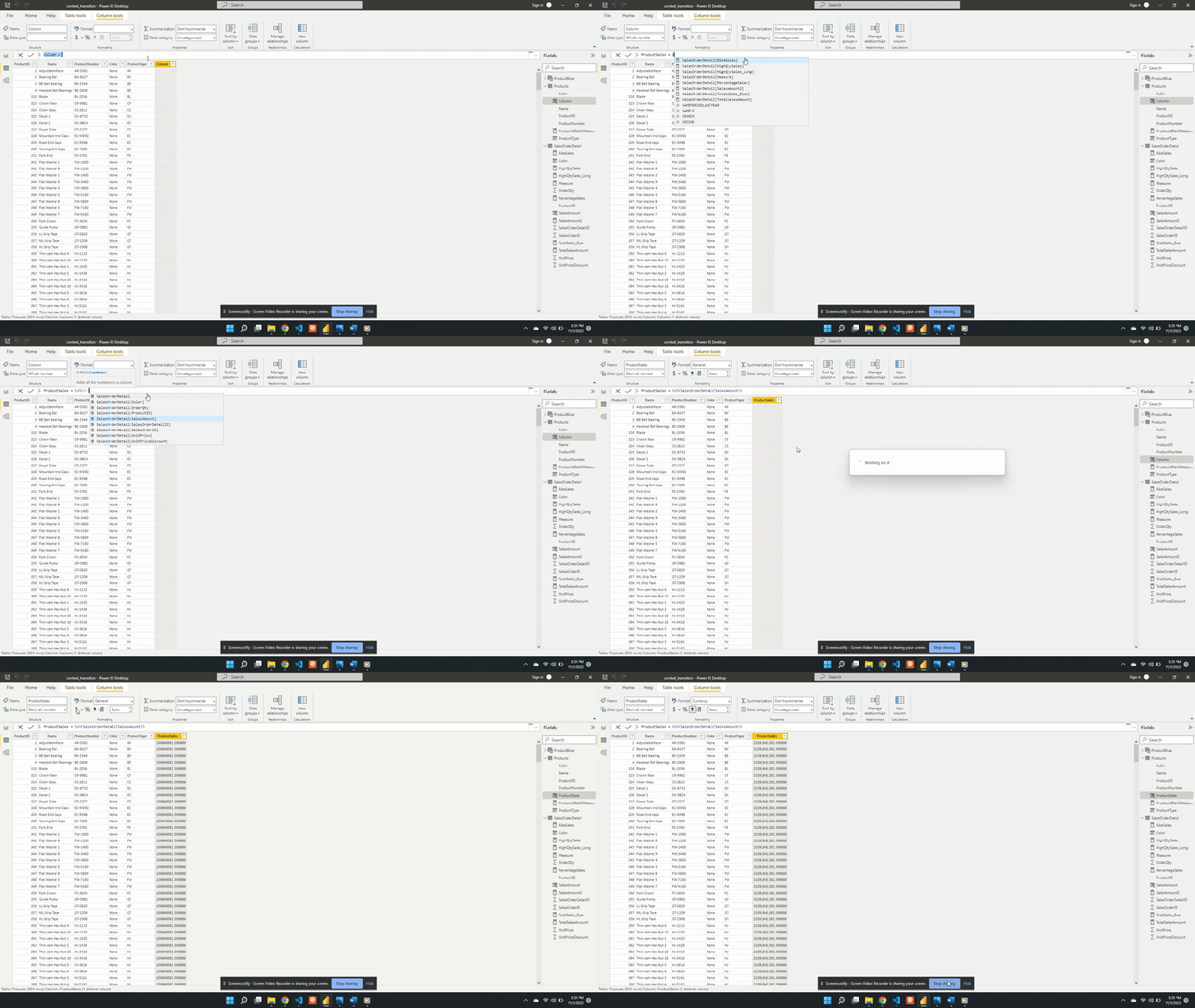
The concept of context transition can be a bit abstract so it can be easiest to learn through examples. To explore, we will create a new calculated column in the Products table. The new ProductsSales calculates the total sales for each product and we define it as:

ProductSales = 
SUM(SalesOrderDetail[SalesAmount])

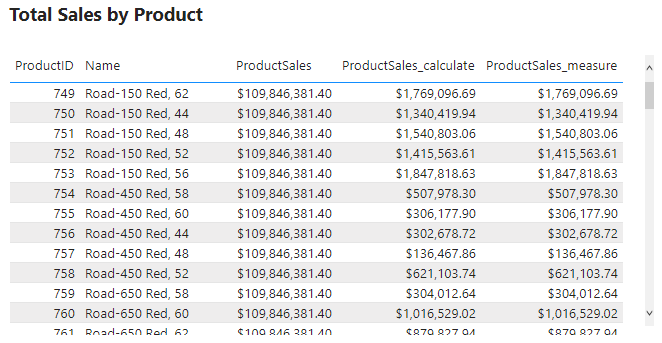
After evaluating ProductSales we see it repeats the same $109.85M sales value for each row. This value is the total sales amount for the entire dataset. This is not what we want ProductSales to calculate, so what happened?

ProductSales calculates the total sales of the entire data rather than the filtered per-product value because row context is not a filter. For example, the row context includes the ProductID value but this identifier is not a filter on the data during evaluation. And because the row context is not a filter DAX does not distinguish between different rows (i.e products) when evaluating ProductSales.

For example, looking at the table above while evaluating the measure DAX does not distinguish the Adjustable Race row from the LL Crankarm row. Since all rows are viewed as the same the total sales value is repeated for each row.

You may have guessed it but, the example above calculates the wrong value because it does not contain a context transition. The row context does not shift to the filter context causing the error in the calculated value. This simple example highlights why context transition is important and when it’s needed. To correct this we must force the context transition. This will convert the row values into a filter and calculate the sales for each product. There are various ways to do this, and below are two options.

Option #1: The CALCULATE() Function

We can force context transition by wrapping ProductSales with the CALCULATE() function. To demonstrate we create a new ProductSales_calculate column. ProductSales_calculate is defined as:

ProductSales_calculate = 
CALCULATE(
   SUM(SalesOrderDetail[SalesAmount])
)

This new calculated column shows the correct sales value for each product. We view the product type BK and can see now each row in the ProductSales_calculate column is different for each row.

Option #2: Using Measures

Within the data model, we have already created a measure SalesAmount2.

We defined SalesAmount2 as:

SalesAmount2 = 
SUMX(
   SalesOrderDetail, 
   SalesOrderDetail[OrderQty] * SalesOrderDetail[UnitPrice] * (1 - 
   SalesOrderDetail[UnitPriceDiscount])
)

We can see by the expression SalesAmount2 uses the iterator function SUMX(). This measure calculates the sales amount row-by-row in the SalesOrderDetail table. As mentioned before context transition occurs within iterator functions. So rather than using CALCULATE() and SUM() we create another calculated column that references this measure.

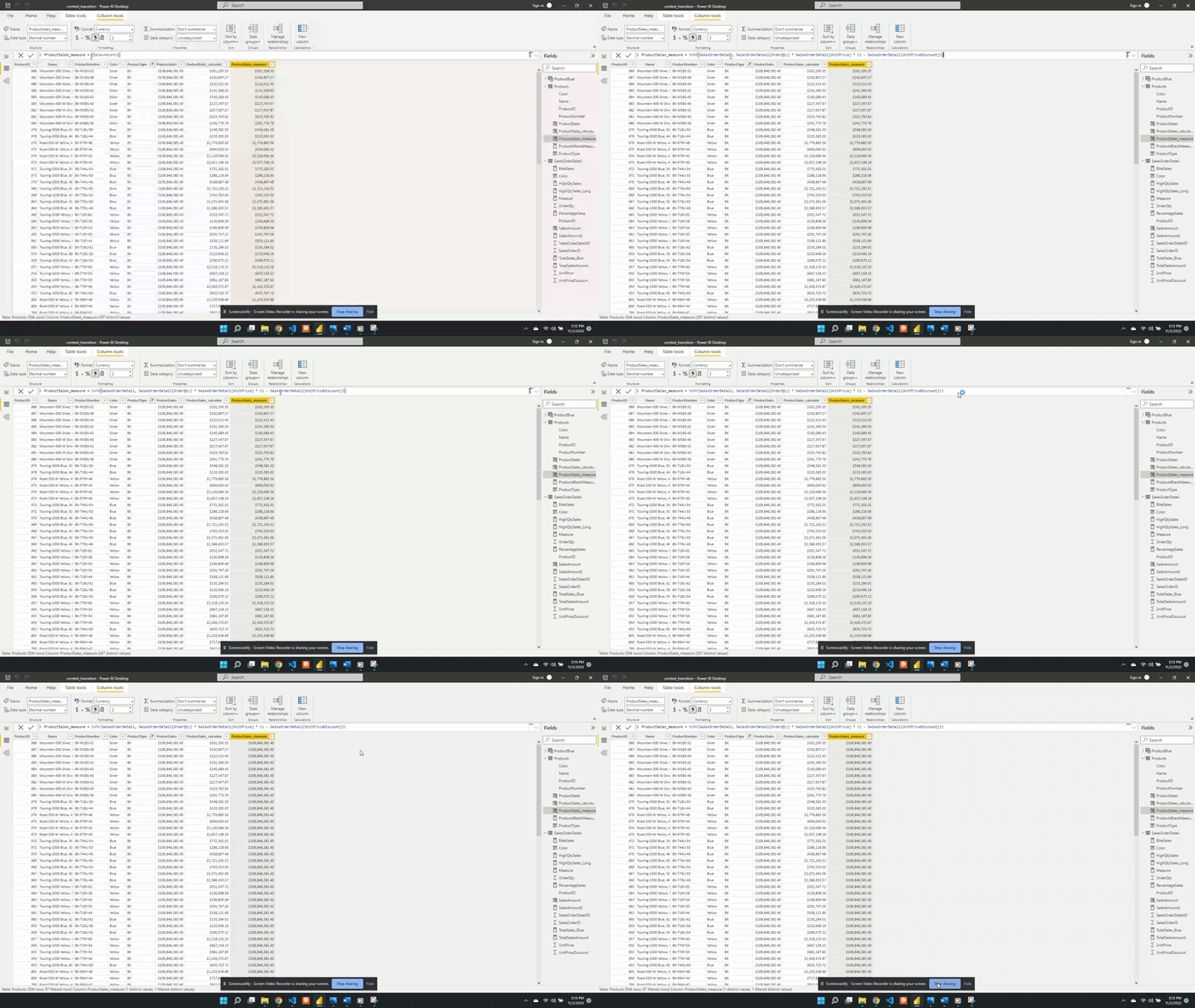
ProductSales_measure = SalesAmount2

We add the new column to the table visual and can see that it has the same value as ProductSales_calculate. This shows that a measure defined with an iterator also forces context transition.

An important note about this new column is that the ProductsSales_measure works as expected when referencing the measure. However, it will not work if we define this column as the same expression that defines SalesAmount2.

We can see below if we update ProductSales_measure to:

SUMX(
   SalesOrderDetail, 
  SalesOrderDetail[OrderQty] * SalesOrderDetail[UnitPrice] * (1 - 
  SalesOrderDetail[UnitPriceDiscount])
)

The same expression used when defining SalesAmount2, will result in wrong values.

After updating ProductSales_measure we can see it returns the total sales values and not the sales per product. With this updated definition DAX is no longer able to apply the context transition. We can correct this by wrapping the expression with CALCULATE().


Maximum Daily Sales by Month Example

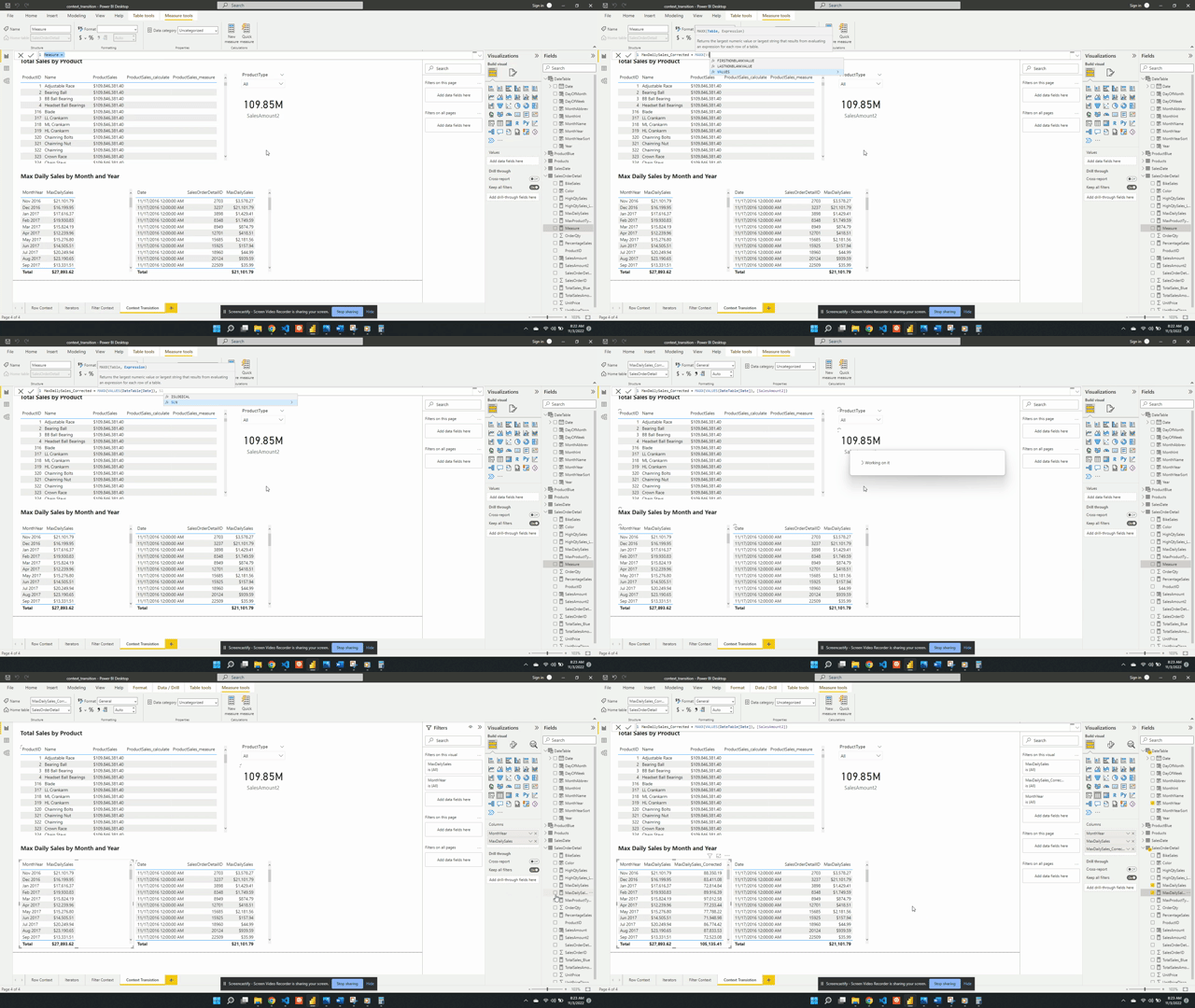
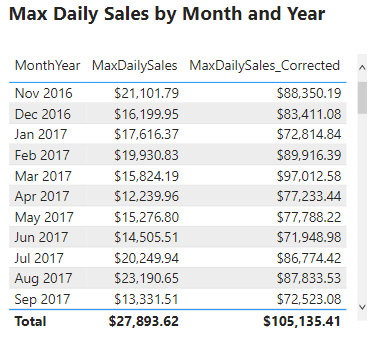
A question of interest is what is the maximum daily sales amount for each month in the dataset. In other words we would like to determine for each month what day of the month had the highest sales and what was the total daily sales value. We start by creating a new MaxDailySales measure and add it to the Max Daily Sales by Month and Year table visual.

We define MaxDailySales as:

MaxDailySales = 
MAXX(SalesOrderDetail, [SalesAmount2])

After adding the measure to the table we can see the sales amount value for each month. For example, the table currently shows that the maximum daily sales for November 2016 is $21,202.79. This value may appear reasonable but when examined closely we can determine it is incorrect. Currently, MaxDailySales is returning the maximum sale for each month and is not accounting for multiple sales within each day. We can see this by creating a new visual with the Date, MaxSales, and SalesOrderDetailID fields.

This table shows that the MaxDailySales for November 2016 is the same value as a single sale that occurred on November 17th. Yet, there are multiple sales on this day and every other day. The desired outcome is to calculate the total sales for each day and then determined the highest daily total value for each month.

This error occurs because context transition is not being applied correctly. It is important to note that context transition is occurring while evaluating MaxDailySales because it is a measure. However, the context transition is not being applied on the correct aggregation level. The context transition is occurring on the SalesOrderDetail level, meaning for each row of this table. To correct this measure we will have to force the context transition on the correct, daily, aggregation level. We update the MaxDailySales expression using the VALUES() function.

We define MaxDailySales_Corrected as:

MaxDailySales_Corrected = 
MAXX(
   VALUES(DateTable[Date]), 
   [SalesAmount2]
)

We change the table passed to MAXX() from SalesOrderDetail to VALUES(DateTable[Date]). Using VALUES(DateTable[Date]) aggregates all the dates that are the same day shifting the context transition to the correct aggregation level. The VALUES() function in the expression provides a unique list of dates. For each day in the unique list, the SalesAmount2 measure gets evaluated and returns the maximum daily total value. We then add the new measure to the table visual and now it shows the correct maximum daily sales for each month.

The above example shows context transition at two different aggregation levels. They also highlight that the context transition can be shifted to return the specific value that is required. As well as showing why it is important to take into consideration the aggregation level when developing measures like MaxDailySales.


Context Transition Pit Falls

Context transition is when row values transition into or replace the filter context. When context transition occurs it can sometimes lead to unexpected and incorrect values. An important part of context transition to understand is that it transitions the entire row into the filter. So what occurs when a row is not unique? Let’s explore this with the following example.

We add a new SimplifiedSales table to the data model.

Then we add a TotalSales measure. TotalSales is defined as:

TotalSales = 
SUMX(
   SimplifiedSales, 
   SimplifiedSales[OrderQty] * SimplifiedSales[UnitPrice] * (1 - 
   SimplifiedSales[UnitPriceDiscount])
)

Viewing the two tables above, we can confirm that the TotalSales values are correctly aggregating the sales data. Now we add another measure to the table which references the measure TotalSales. Referencing this measure will force context transition due to the implicit CALCULATE() added to measures. See above for details.

We define TotalSales_ConextT as:

TotalSales_ContextT = 
SUMX(SimplifiedSales, [TotalSales])

In the new column we can see that the values for Road-350-W Yellow, 48 and Touring-3000 Blue, 44 have not changed and are correct. However, Mountain-500 Silver, 52 did update, and TotalSales_ContextT column shows an incorrect value. So what happened?

The issue is the context transition. Viewing the SimplifiedSales table we can see that Mountain-500 Silver, 52 appears twice in the table. With both records having identical values for each field. Remember, context transition utilizes the entire row. Meaning the table gets filtered on Mountain-500 Silver, 52/ 1/$450.00. Because of this, the result gets summed up in the TotalSales measure returning a value of $900.00. This value is then evaluated twice, once for each identical row.

This behavior is not seen for the Road-350-W, 48 records because they are unique. One row has a UnitPriceDiscount of 0.0% and the other has a value of 5.0%. This difference makes each row unique when context transition is applied.

Knowing what context transition is and when it occurs is important to identifying when this issue may occur. When context transition is applied it is important to check the table and verify calculations to ensure it is applied correctly.


Thank you for reading! Stay curious, and until next time, happy learning.

And, remember, as Albert Einstein once said, “Anyone who has never made a mistake has never tried anything new.” So, don’t be afraid of making mistakes, practice makes perfect. Continuously experiment and explore new DAX functions, and challenge yourself with real-world data scenarios.

If this sparked your curiosity, keep that spark alive and check back frequently. Better yet, be sure not to miss a post by subscribing! With each new post comes an opportunity to learn something new.

Power BI Filter Context: Unraveling the Impact of Filters on Calculations

Series Review

One of the early stages of creating any Power BI report is the development of the data model. The data model will consist of data tables, relationships, and calculations. There are two types of calculations: calculated columns, and measures.

Check out Power BI Row Context: Understanding the Power of Context in Calculations for key differences between calculated columns and measures.

Row Context — What it is, When is it available, and its Implications

All expressions, either from a calculated column or a measure, get evaluated within the evaluation context. The evaluation context limits the values in the current scope when evaluating an expression. The filter context and/or the row context make up the evaluation context.

Power BI Row Context: Understanding the Power of Context in Calculations explores the row context in depth. While Power BI Iterators: Unleashing the Power of Iteration in Power BI Calculations explores iterator functions, which are functions that create row context.

Iterator Functions — What they are and What they do

This article is the third of a Power BI Fundamental series with a focus on the filter context. The example file used in this post is located here – GitHub.


Introduction to Filter Context

Filter context refers to the filters applied before evaluating an expression. This filter context limits the set of rows of a table available to the calculation. There are two types of filters to consider, the first is implicit filters or filters applied by the user via the report canvas. The second type is explicit filters which use functions such as CALCULATE() or CALCULATETABLE().

The applied filter context can contain one or many filters. When there are many filters the filter context will be the intersection of all the filters. When the filter context is empty all the data is used during the evaluation.

Filter context propagates through the data model relationships. When defining each model relationship the cross-filter direction is set. This setting determines the direction(s) the filters will propagate. The available cross-filter options depend on the cardinality type of the relationship. See available documentation for more information on Cross-filter Direction and Enabling Bidirectional Cross-filtering.

It is important to be familiar with certain DAX functions which can modify the filter context. Some examples used in the post include CALCULATE()ALL(), and FILTER().


The CALCULATE Function

The CALCULATE() function can add filters to a measure expression, ignore filters applied to a table, or overwrite filters applied from within the report visuals. The CALCULATE() function is a powerful and important tool when updating or modifying the filter context.

The syntax of CALCULATE() is:

CALCULATE(<expression>, <filter1>, <filter2>, ...)

Use the CALCULATE() function when modifying the filter context of an expression that returns a scalar value. Use CALCULATETABLE() when modifying the filter context of an expression that returns a table.


Exploring Filter Context

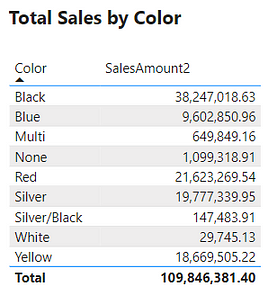
The table below is a visualization of the total sales amount for each product color.

The table visual creates filter context, as seen by the total sales amount for each color or row. Evaluating SalesAmount2 occurs by first filtering the SalesOrderDetail table by the color, and then evaluating the measure with the filtered table. This is then repeated for each product color in the SalesOrderDetail table.

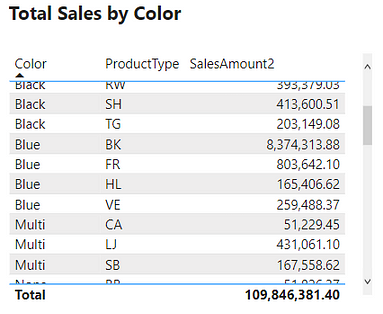
The above example only contained the single product color filter. However, as mentioned previously, the filter context can contain multiple filters. The example table below adds the ProductType to the table. The addition of this field breaks down the total sales first by color and then by product type. For each row, the underlying SalesOrderDetail table is first filtered by color and product type before evaluating the SalesAmount2 measure. In these examples, it is the table visual that is creating the filter context.


Create Filter Context with Slicers

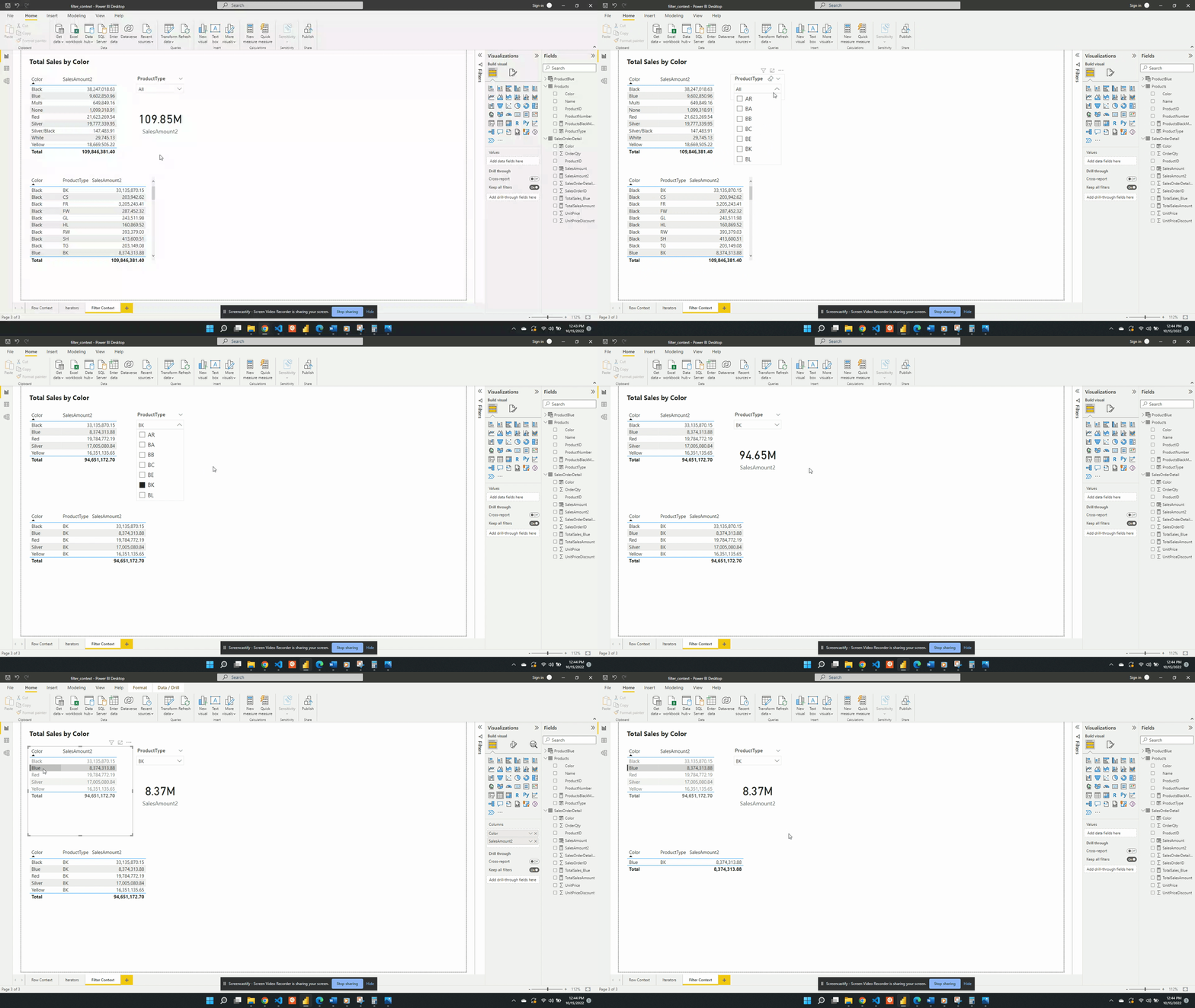
Another way to create filter context is through the use of slicer visuals. For this example, a slicer of the ProductType is created.

When no value is selected in the slicer the filter context from the slicer visual is null. Meaning at first the card visual shows the SalesAmount2 value evaluated for all data. Additionally, when no value is selected in the slicer the only filter context is ProductColor from the table visual.

Following the selection of BK in the product type slicer, the values in both the table and the card visual are updated. The card visual now has one filter context which is the product type BK. This is evaluated by creating a filtered table and SalesAmount2 is evaluated for this filtered table.

The SalesAmount2 measure is defined by:

SalesAmount2 =
SUMX (
    SalesOrderDetail,
    SalesOrderDetail[OrderQty] * SalesOrderDetail[UnitPrice] * 
    ( 1 - SalesOrderDetail[UnitPriceDiscount] )
)

After selecting an option from the slicer the measure is re-evaluated. The re-evaluation occurs to account for the newly created filter context. The filter context creates a subset of the SalesOrderDetail table that matches the slicer selection. Then the row context evaluates the expression row-by-row for the filtered table and is summed. SUMX() is an example of an iterator function, see Power BI Iterators: Unleashing the Power of Iteration in Power BI Calculations for more details. The updated value is then displayed on the card visual.

Iterator Functions — What they are and What they do

The table visual works in a similar fashion but, there are two filters applied. The table visual has an initial filter context of the product color. After the selection of BK, the table gets updated to visualize the intersection of the product color filter and the product type filter.

Following a selection in the slicer visual, if a row in the table visual is selected this will also apply a filter. The filter context is the intersection of the table selection filters and the slicer. The updated filter context gets applied to all other visuals (e.g. the card visual).


Create Filter Context with CALCULATE

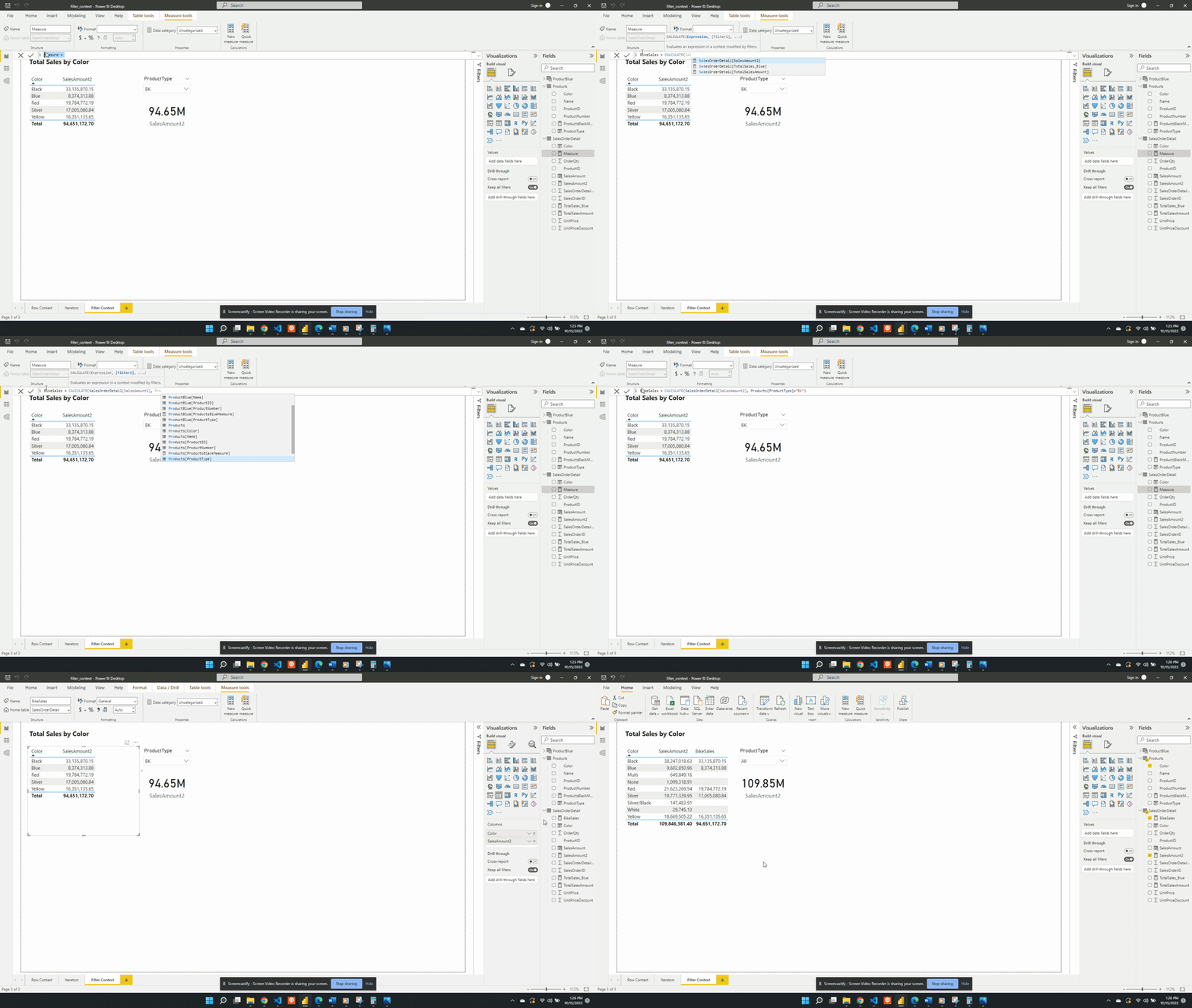
Previous examples created the filter context using implicit filters. Generally, the user creates this type of filter through the user interface. Another way to create filter context is by using explicit filters. Explicit filters get created through the use of functions such as CALCULATE(). For this example, rather than having to select BK in the slicer to view total bike sales, we will use CALCULATE(). We will create a new measure that will force the filter context. We can do this because CALCULATE() allows us to set the filter context for an expression.

We define the BikeSales measure as:

BikeSales =
CALCULATE ( 
   SalesOrderDetail[SalesAmount2], 
   Products[ProductType] = "BK" 
)
  • Expression: SalesOrderDetails[SalesAmount2]
  • Filter: Products[ProductType]="BK"

BikeSales is then added to the table visual alongside SalesAmount2. When the BK product type is the slicer selection the two table columns are equal. Both measures have the same filter context created by product color and product type. Removing the implicit product type filter by unselecting a product type updates the filter context. The SalesAmount2 expression is re-evaluated with the updated filter context. Since the filter context created by the slicer is now null the SalesAmount2 value calculates using all the data. The BikeSales values do not change. This is because of the explicit filter used by the CALCULATE() function when we defined the measure. The BikeSales measure still has the filter Products[ProductType]="BK" applied regardless of the product type slicer.

The CALCULATE() function only creates filter context and does not create row context. So an important question to ask is why or how the BikeSales measure works. The CALCULATE() function references a specific column value, Products[ProductType]="BK". Yet, the CALCULATE() function does not have row context. So how does Power BI know which row it is working with? The answer is that the CALCULATE() function applies the FILTER() function. And the FILTER function creates the row context required to evaluate the measure.

Within the CALCULATE() function the Products[ProductType]="BK filter is shorten syntax. The filter argument passed to CALCULATE() is equivalent to FILTER(ALL(Products[ProductType]), Products[ProductType]="BK")). The ALL() function removes any external filters on the ProductType column and is another example of a function that can modify the filter context.

Keep External filters with CALCULATE

The CALCULATE() function evaluates the filter context both outside of and within the function. The filter context outside of the function can come from user interaction with visuals. The filter context within the function is the filter expression(s).

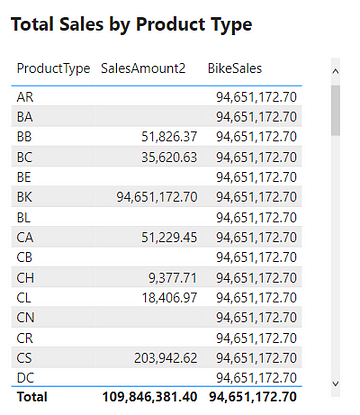
To explore this we create a table with the Product Type, SalesAmount2, and SalesBike.

The SalesAmount2 column shows the total sales amount, if any, as expected. While the BikeSales column shows the same repeated value for all rows and is incorrect. Looking at the Product Type BK row we can see this row is correct. This table demonstrates that CALCULATE()overwrites external filters.

For example, the BB product type row filters SalesOrderDetail before evaluating SalesAmount2. This returns the correct total sales for the BB product type. When evaluating BikeSales this external product type filter gets overwritten. The measure calculates the sales amount value for the BK product type due to the explicit filter and returns this value for all rows.

Using the KEEPFILTERS() function within CALCULATE() will force CALCULATE() to keep both external and internal filters.

To do this we update BikeSales to:

BikeSales = 
CALCULATE(
   SalesOrderDetail[SalesAmount2], 
   KEEPFILTERS(Products[ProductType]="BK")
)

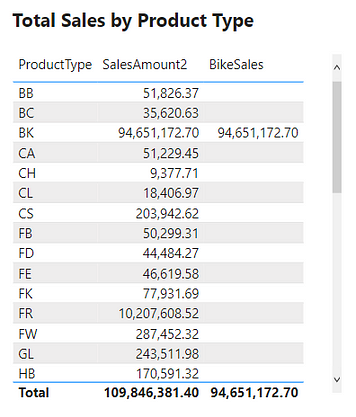
After updating the measure definition the resulting table is shown below.

Keeping the external filters is shown by the empty values for all rows except BK. For example, we look again at the BB product type row. When evaluating BikeSales Power BI keeps the external filter Products[ProductType]="BB" and the internal filter Products[ProductType]="BK". When applying more than one filter the filter context is the intersection of the two. The intersection of the two applied filters for the BB row is empty. A product cannot be both of type BB and BK.


More CALCULATE Examples

The CALCULATE() function plays an integral part in the filter context. Below are more examples to show key concepts and show that CALCULATE() is an important part of the filter context.

Creating a measure of High Quantity Sales

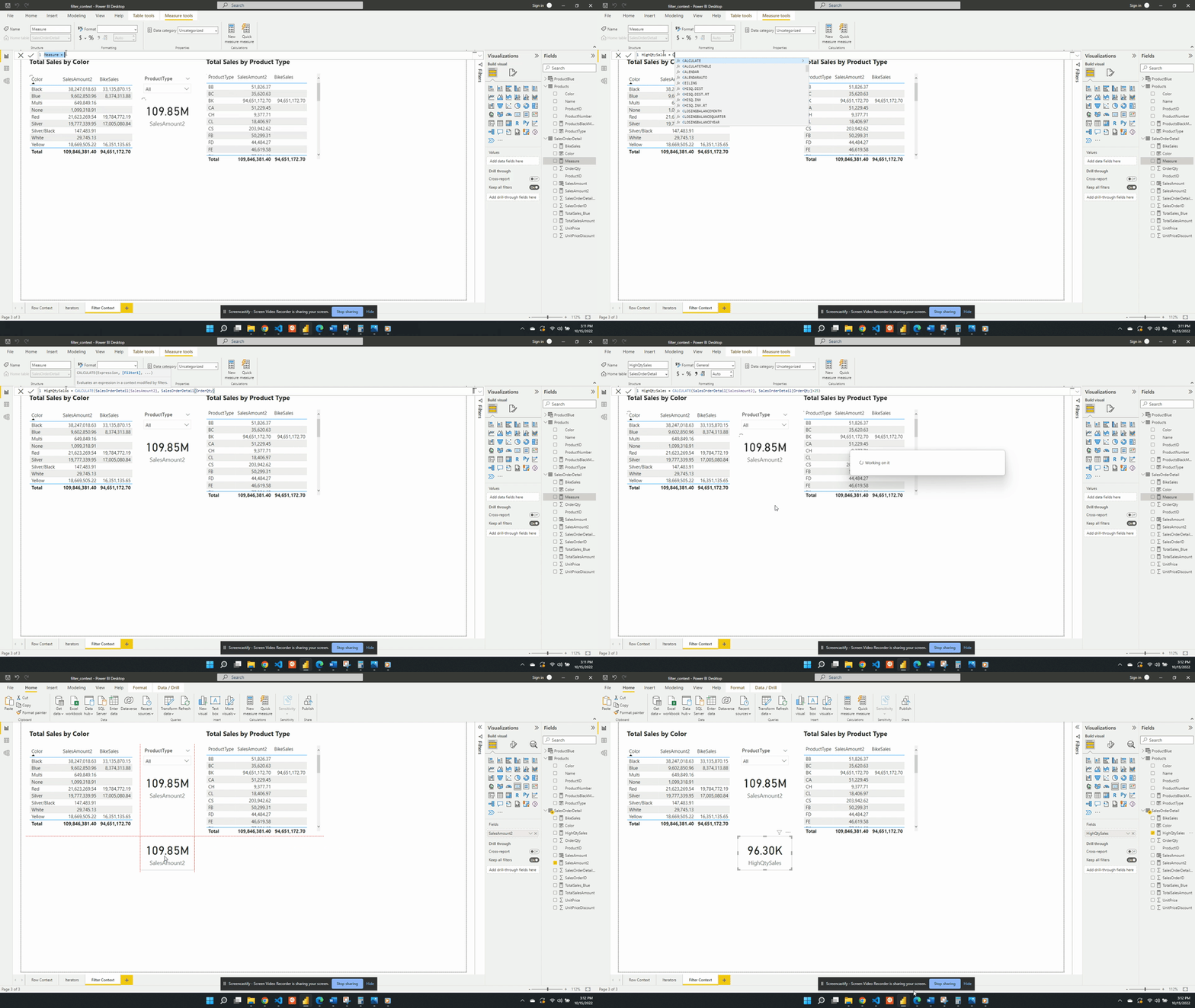
For the first example, we will be creating a sales measure showing the total sales amount for high-quantity orders. Creating this measure requires first filtering the SalesOrderDetail table based on the OrderQty. Then evaluating the SalesAmount2 measure with this filtered table.

We define HighQtySales as:

HighQtySales = 
CALCULATE(
   [SalesAmount2], 
   SalesOrderDetail[OrderQty]>25
)

We then visualize this measure on a card visual and see that 96.30K of our total 109.85M sales come from a high-quantity order. This again demonstrates the filter arguments passed to CALCULATE() are shorthand syntax. The filter arguments within CALCULATE() use the FILTER() function to create the row context required. In this example SalesOrderDetail[OrderQty]>25 is equivalent to FILTER(ALL(SalesOrderDetail),SalesOrderDetail[OrderQty] > 25).

The FILTER() function is an example of an iterator function and creates the row context. The row context allows for row-by-row evaluation of the OrderQty. Meaning it evaluates SalesOrderDetail[OrderQty] > 25 for each row of the SalesOrderDetail table. FILTER() then returns a virtual tale that is a subset of the original and contains only orders with a quantity greater than 25.

Percentage of Sales by Product Color

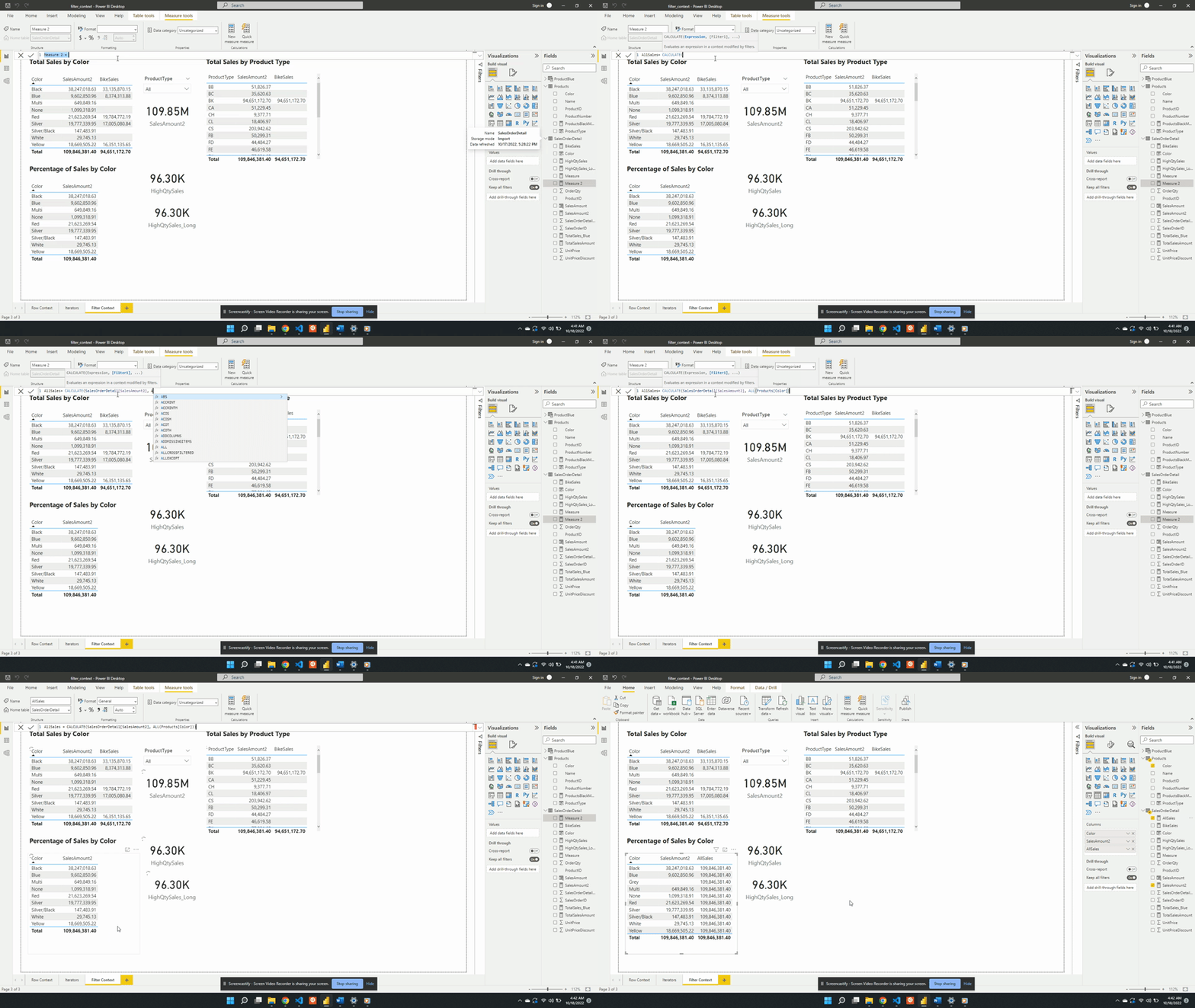
For the second example, we will create a measure to show the percentage of total sales for each product color. To create this we will start with a new AllSales measure. AllSales uses the CALCULATE() function to remove any filters and evaluates SalesAmount2.

We define AllSales as:

AllSales = 
CALCULATE(
   [SalesAmount2], 
   ALL(Products[Color])
)

AllSales is then added to the table visual Percentage of Sales by Color. Once added the AllSales column shows 190.85M total sales value for each color. This is consistent with the SalesAmount2 card visual. Repeating this value for each color is also expected because of the filter expression ALL(Products[Color]).

ALL(Products[Color]) creates a new filter context and gets evaluated with any other filters from the visuals. In this example, CALCULATE() overwrites any external filters on Products[Color]. This is why once added to the table visual AllSales displays the total sales value repeated for each row.

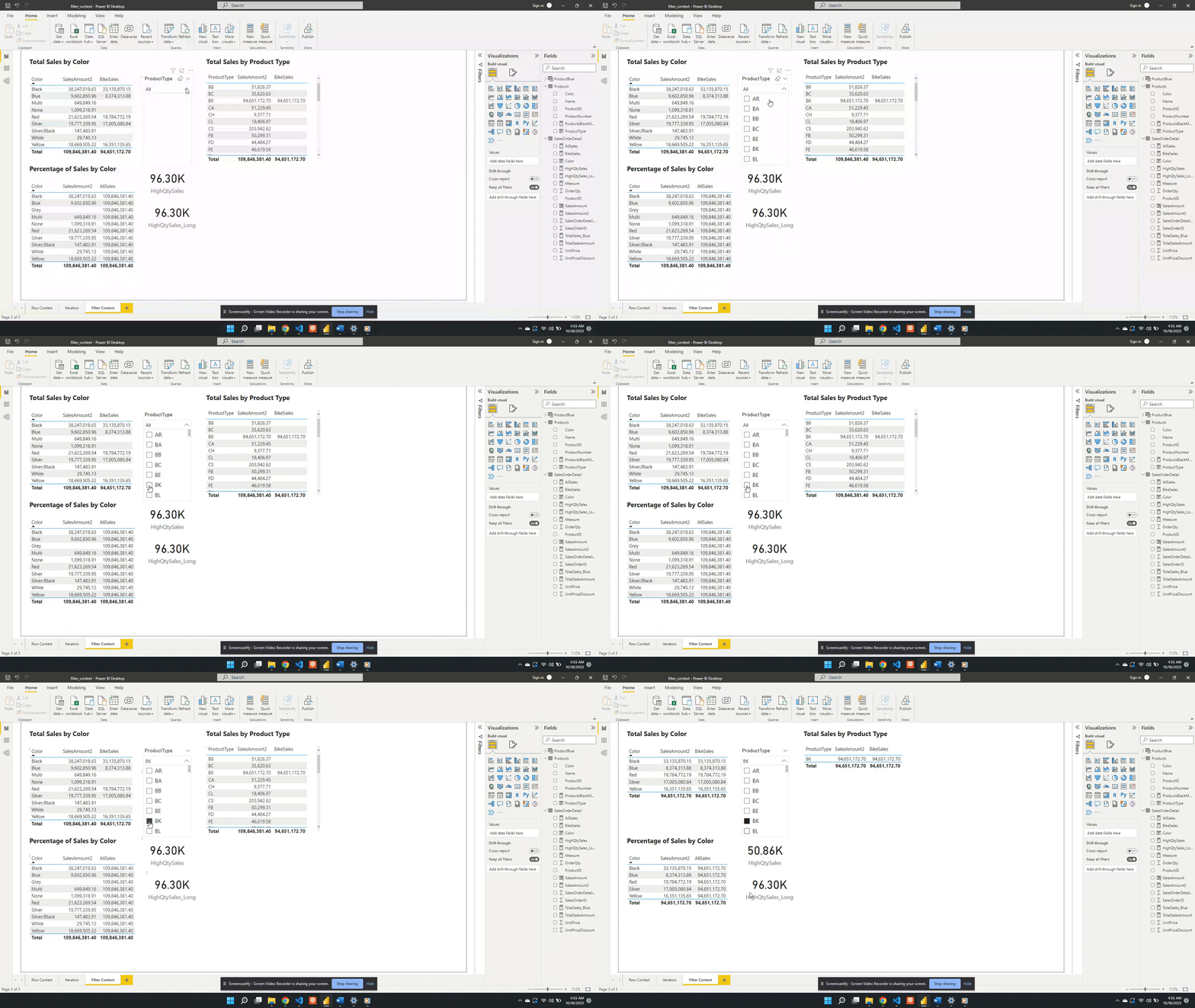
The ALL() function removes any filter limiting the color column that may exist while evaluating AllSales. It is best practice to define a measure as specific as possible. Notice, in this example ALL() applies to Product[Color], rather than the entire Product table. If other filters exist on other columns from the visuals these filters will still impact the evaluation. For example, selecting a product type from the slicer will adjust all values.

Following the selection, SalesAmount2 represents the total BK sales for each color. While the AllSales measure now represents the total sales for all BK product types. This occurs because when there are multiple filters the result is the intersection of all the filters.

In this case, All(Product[Color]) removes the filter on the color column. The slicer visual creates an external filter context of only BK product types. During the evaluation, the intersection of these two creates the evaluation context.

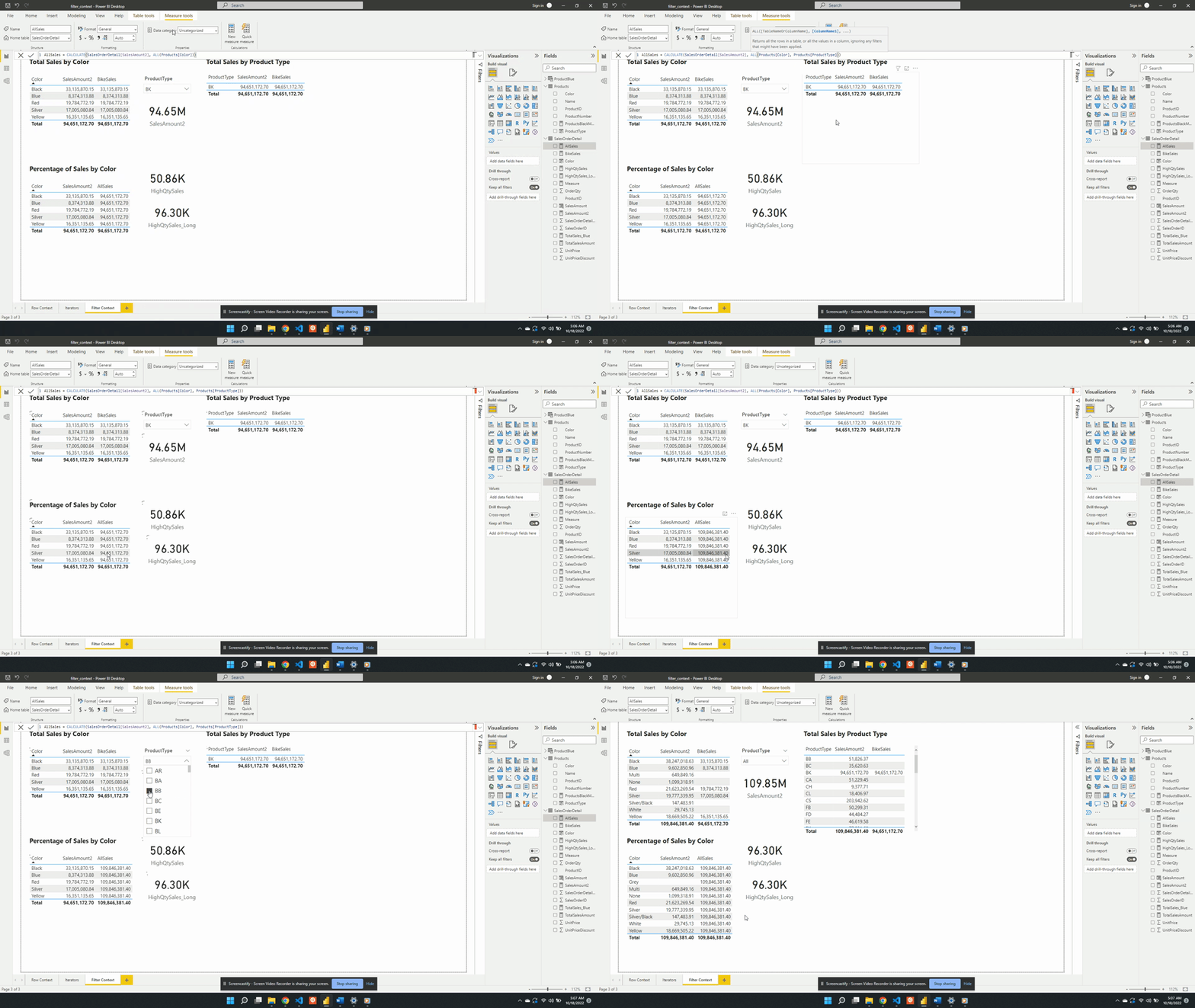
We can also remove the external filter context created by the product type slicer. To do this, we update the AllSales measure to include Products[ProductType] as an additional filter argument.

We update the filter expression of the CALCULATE() function to:

AllSales = 
CALCULATE(
   [SalesAmount2], 
   ALL(Products[Color], 
   Products[ProductType]
)

After updating the measure the AllSales column of the table visual updates to the total sales value. The column now displays the expected 109.85M value and is no longer impacted by the filter context created by the slicer visual.

Another option to remove the filter context within CALCULATE() is to use the REMOVEFILTER() function.

AllSales = 
CALCULATE(
   SalesOrderDetail[SalesAmount2], 
   REMOVEFILTERS(
      Products[Color], 
      Products[ProductType]
   )
)

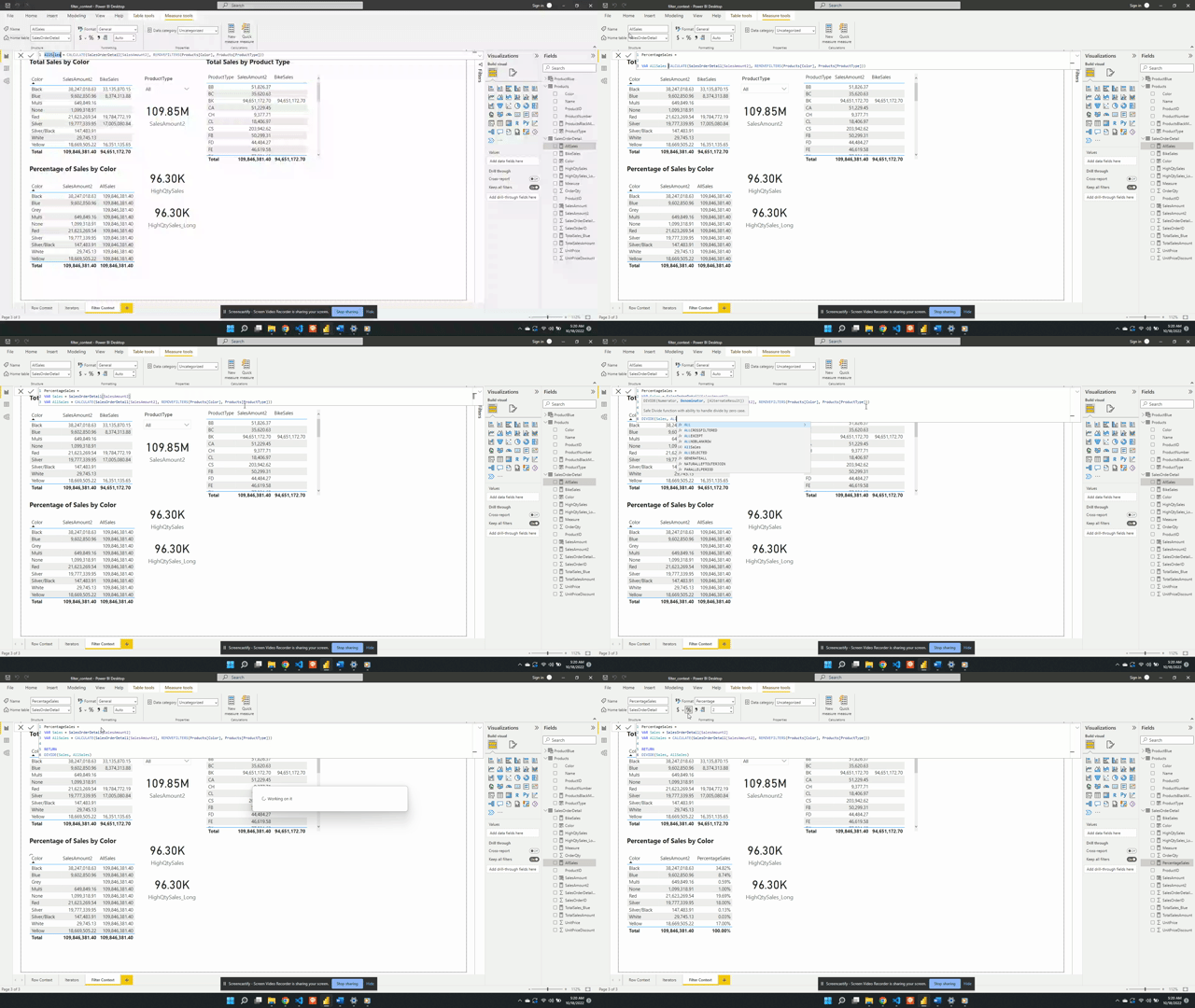
We created AllSales as an initial step of the broader goal to calculate the percentage of total sales. To calculate the percentage we will update the AllSales expression. We can do this by saving the AllSales expression as a variable within the measure. We will also create another variable to store the SalesAmount2 value, which will be the total sales for each product color. Lastly, we will update the measure name to PercentageSales which will RETURN the division of the two sales variables.

PercentageSales =
VAR Sales = SalesOrderDetail[SalesAmount2]
VAR AllSales = 
CALCULATE(
   SalesOrderDetail[SalesAmount2], 
   REMOVEFILTERS(
      Products[Color],
      Products[ProductType]
   )
)

RETURN
DIVIDE(Sales, AllSales)

Thank you for reading! Stay curious, and until next time, happy learning.

And, remember, as Albert Einstein once said, “Anyone who has never made a mistake has never tried anything new.” So, don’t be afraid of making mistakes, practice makes perfect. Continuously experiment and explore new DAX functions, and challenge yourself with real-world data scenarios.

If this sparked your curiosity, keep that spark alive and check back frequently. Better yet, be sure not to miss a post by subscribing! With each new post comes an opportunity to learn something new.

Power BI Iterators: Unleashing the Power of Iteration in Power BI Calculations

Overview

In order to facilitate analysis and visualization in Power BI a data model must first be created. The data model consists of individual data tables, relationships, and calculations. Calculations come in the form of either calculated columns or measures.

Check out this post to explore the key differences between calculated columns and measures.

Row Context — What it is, When is it available, and its Implications

The evaluation context limits the values in the current scope when Power BI evaluates a DAX expression. There are two types of evaluation context, filter and row, that can be active during the evaluation of a DAX expression.

This post is the second of a Power BI Fundamental series with a focus on iterator functions. The example file used in this post is located found on GitHub at the link below.
Power BI key fundamentals example files


Introduction

This post will build upon the Power BI file created in Part 1 of the series titled row_context_example. The example file for this post is iterator_functions, and both can be found on GitHub at the link above.

As noted at the end of Power BI Row Context: Understanding the Power of Context in Calculations, creating a measure by default was unable to reference the row values of a column. When creating a measure a column can be referenced and passed to a standard aggregation function. The standard aggregation function will return only a single aggregated value. This is not the row-by-row functionality that will be required to replace a calculated column, such as SalesAmount found in the SalesOrderDetail table.

Creating the desired measure will require an iterator function to create row context.

Understanding Iterators

An iterator moves row-by-row or iterates through an object. The object can be a data model table or a virtual/temporary table. Data model tables are tables loaded into or linked to within Power BI. A table generated from within a measure that persists only for a temporary period of time is a virtual table.

An iterator function can return a single value (e.g. number, text, date) or a virtual table. An iterator generally has two arguments:

  • The object (i.e. table) to iterate through
  • The expression evaluated for each row of the object

It can be helpful to think of the expression as a temporary column of the object. Evaluation of the expression occurs row-by-row creating a column of calculated results. The column of results only persists during the evaluation and is not loaded to the data model. The purpose of the temporary column is to calculate the final returned value of the iterator.

Examples of iterator functions include SUMXMINXMAXXAVERAGEX, and RANKX. The ending X is only a common identifier, FILTER is an example of an iterator function that does not end with a X.

Example iterator function:

SUMX(
   SalesOrderDetail, 
   SalesOrderDetail[OrderQty] * SalesOrderDetail[UnitPrice] * (1 - SalesOrderDetail[UnitPriceDiscount])
)
  • Table: SalesOrderDetail – the object iterated over
  • Expression: SalesOrderDetail[OrderQty] * SalesOrderDetail[UnitPrice] * (1 - SalesOrderDetail[UnitPriceDiscount]) – the expression evaluated for each row.

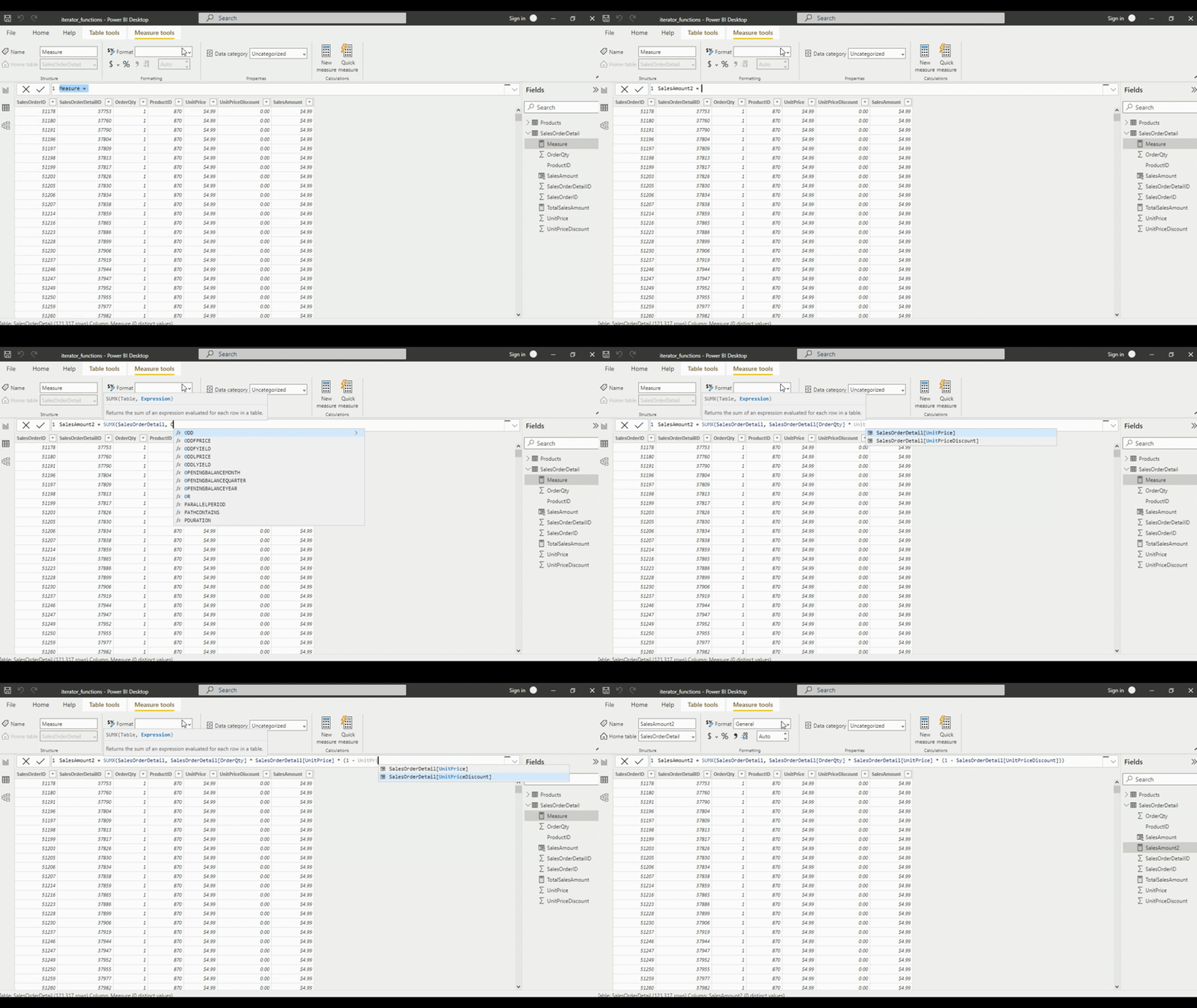
Once implementing the iterator SUMX and specifying the table as SalesOrderDetails the columns of the table will be recognized and able to be referenced like when a calculated column was created. The new measure SalesAmount2 created using an iterator will replace the calculated column SalesAmount. Comparing the default aggregation of the SalesAmount column (i.e. Sum of SalesAmount) and the new measure SalesAmount2 it can been see the values are equal.


Iterator Functions that Generate Virtual Tables

There are iterator functions such as SUMX that return a scalar value and there are ones like FILTER that return virtual tables.

To further explore, first create a new table in the data model generated by the returned table of the FILTER function.

For this example, we use the FILTER function to create a new ProductBlue table. For the first argument of the FILTER function we pass in the Product table. Then we filter that table using a filter expression defined as Products[Color] = "blue".

ProductBlue = FILTER(Products, Products[Color] = "blue")

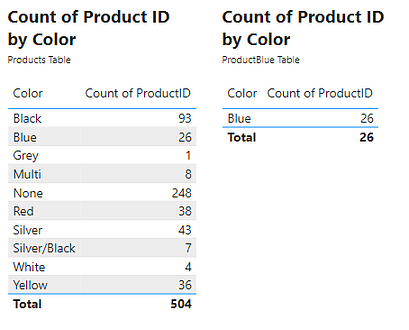
We then can visualize this new table and compare the row count to the count of ProductID by color of the original table. Comparing these two tables we see that ProductBlue is a subset of the Product table.

The generation of this table highlights the iterating functionality and the row context when evaluating the FILTER function. To create the ProductBlue table the FILTER iterator function must create row context. During the evaluation, the function must go within the Products table and for each row (i.e. row context) evaluate what the product color is. If the color is Blue the function returns True otherwise returns False. The resulting table then consists of only rows from the original table which evaluated to a value of True.

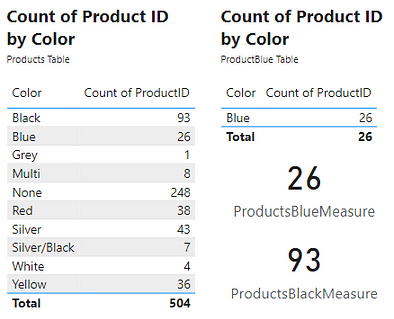
Creating the new ProductBlue table was for demonstrative purposes. The table returned by FILTER can be a virtual table used within a measure. In this case, the ProductBlue table would only persist while the measure is being evaluated. As an example, create a new ProductBlueMeasure measure using the COUNTROWS function. COUNTROWS takes a single argument, the table to count the row of. To do this we will pass the FILTER expression used to create the ProductBlue table to the COUNTROWS function. To further demonstrate that the ProductBlue table is unnecessary, we can create a similar ProductBlackMeasure by changing =”blue" to =”black". Viewing these measures shows the result is the same counts that were produced by the other methods used to obtain this count.


Combining Iterators

More complex measures can be created by combining or nesting iterators. For example, combining the product color and the sales data, such as evaluating the total sales for only blue products. This measure will first create a virtual table of the sales data for only blue products. Then iterate row-by-row through the virtual table and evaluate the sales amount. Finally, return the total sales amount.

The DAX expression will be:

SUMX(
   FILTER(
      SalesOrderDetail, 
      RELATED(Products[Color])="Blue"
   ), 
  SalesOrderDetail[OrderQty] * SalesOrderDetail[UnitPrice] * (1 - SalesOrderDetail[UnitPriceDiscount])
)

The virtual table mentioned above is generated by FILTER(SalesOrderDetail, RELATED(Products[Color])="Blue").
This is the first iterator function that is evaluated using the SalesOrderDetail table and the expression RELATED(Products[Color])="Blue".

RELATED() is a function that returns a related value from another table. This function can be used since the Product table is related to the SalesOrderDetail table with a key value of ProductID. The FILTER function then returns a subset of the SalesOrderDetail table containing only rows where the product is blue. This virtual table is then passed to SUMX.

Then the expression evaluated row-by-row is:

SalesOrderDetail[OrderQty] * SalesOrderDetail[UnitPrice] * (1 - SalesOrderDetail[UnitPriceDiscount])

Which returns the total sales amount for each row. Then this temporary column is summed by the SUMX function.

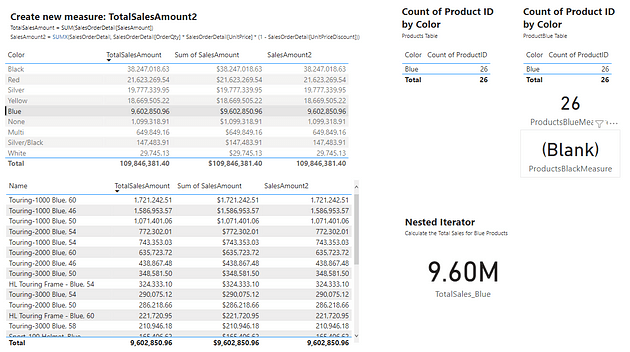
Viewing the two tables on the left, the totals sales for the Blue products for all methods is approximately 9.60M. Selecting the blue row in the top table filters the table below, to show sales by Product for only blue products. Viewing the totals for all three methods also shows a value of approximately 9.60M. Lastly, viewing the value card under Nested Iterator shows that the above created DAX expressions results in the same value of 9.60M.

Key concepts are highlighted in the above example

  • Both SUMX and FILTER create row context
  • The FILTER function returns a virtual table which is a subset of SalesOrderDetail
  • SUMX returns the sum of the row-by-row calculation of the sale amount
  • The table passed to SUMX is the table that is returned by the FILTER function, this table only persists during the evaluation of SUMX

The concept of evaluation context has been mentioned in this post as well as in the previous post – Power BI Row Context: Understanding the Power of Context in Calculations.

Row Context — What it is, When is it available, and its Implications

Evaluation context is the context in which a DAX formula evaluates a calculation. There are two types, Power BI Row Context: Understanding the Power of Context in Calculations explored the first type, row context. This post explored iterators or specific functions which create row context to perform multi-column calculations. Check out Part Three of this series which will explore the second type of evaluation context, the filter context.

Filter Context – How to create it and its impact on measures


Thank you for reading! Stay curious, and until next time, happy learning.

And, remember, as Albert Einstein once said, “Anyone who has never made a mistake has never tried anything new.” So, don’t be afraid of making mistakes, practice makes perfect. Continuously experiment and explore new DAX functions, and challenge yourself with real-world data scenarios.

If this sparked your curiosity, keep that spark alive and check back frequently. Better yet, be sure not to miss a post by subscribing! With each new post comes an opportunity to learn something new.