Design Meets Data: A Guide to Building Interactive Power BI Report Navigation


In the world of data visualization, we are constantly seeking ways to convey information and captivate our audience. Our goal is to enhance the aesthetic appeal of our Power BI reports, making them more than just vehicles for data—they become compelling narratives. By leveraging Figma, we aim to infuse our reports with design elements that elevate the overall user experience, transforming complex data into interactive stories that engage and enlighten.

A cornerstone of impactful multi-page reports is effective navigation. Well-designed navigation is a beacon that guides our users through the sea of data, ensuring they can uncover the insights they seek without feeling overwhelmed or lost. This post serves as a guide on how we can use Figma to enhance our Power BI report navigation beyond the use of just Power BI shapes, buttons, and bookmarks to create interactive report navigation that boosts the user experience of our reports.

In this guide, we will explore how to go beyond using the page navigator button option in Power BI and craft a report navigation that is intuitive, interactive, and elevates the visual aspects of our report. We will dive into how we can use Figma’s design capabilities combined with the interactive features of Power BI to create such an experience.
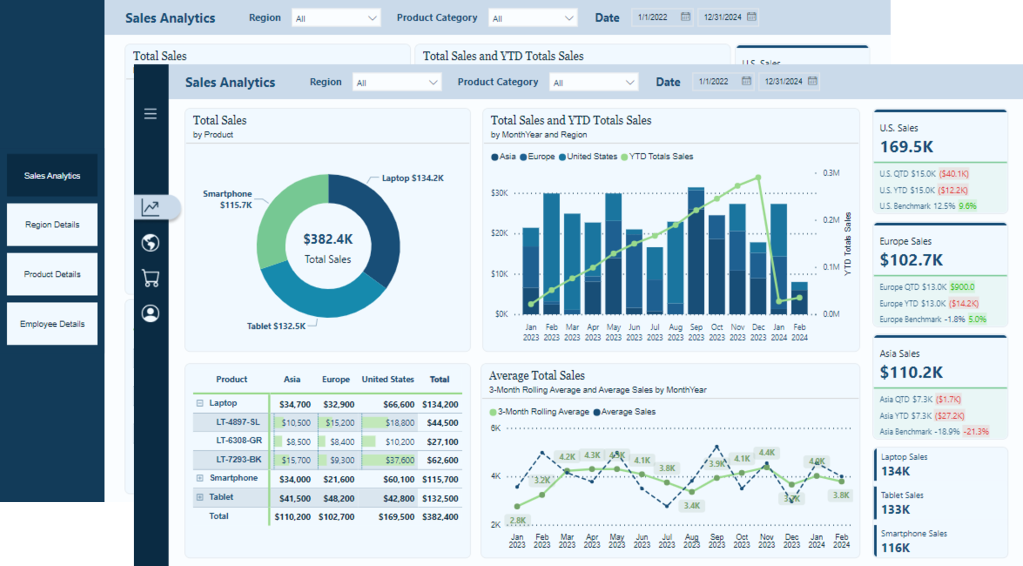
The navigation we will create is a vertical and minimalistic navigation displaying visual icons for each of the report’s pages. This allows our users to focus on the data and the report visuals and not be distracted by the navigation. However, when our users require details on the navigation options, we will provide an interactive experience to expand and collapse the menu.
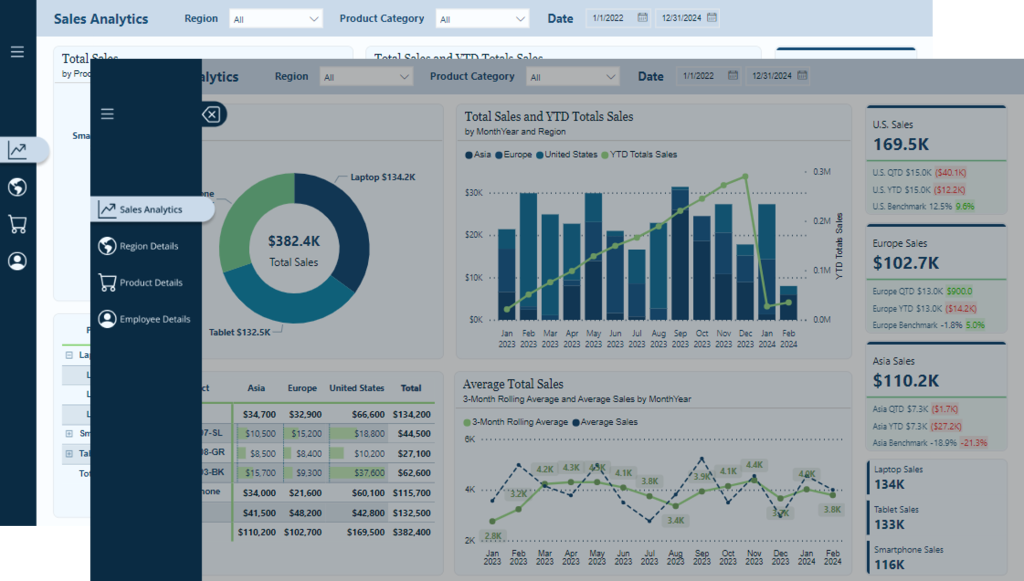
Keep reading to get all the details on leveraging the design functionality offered by Figma and the interactive elements, including buttons and bookmarks in Power BI. By the end, we will have all we need to craft report navigation elements that captivate and guide our audience, making every report an insightful and enjoyable experience.

Get Started with Power BI Templates: For those interested in crafting a similar navigation experience using Power BI built-in tools, visit the follow-up post below. Plus, get started immediately with downloadable Power BI templates!

User-Centric Design: Next level reporting with interactive navigation for an enhanced user experience

Also, check out the latest guide on using Power BI’s page navigator for a streamlined, engaging, and easy-to-maintain navigational experience.

Streamlined report navigation with built-in tools to achieve functional, maintainable, and engaging navigation in Power BI reports.

Diving Into Figma: Designing Our Navigation

Starting the journey of enhancing our Power BI reports with Figma begins with understanding why Figma is a powerful design tool. The beauty of Figma lies in its simplicity and power. It is a web-based tool that allows designers to create fluid and dynamic UI elements without a steep learning curve associated with some other design software. Another great aspect of Figma is the community that provides thousands of free and paid templates, plugins, and UI kits to get our design kickstarted.

Explore thousands of free and paid templates, plugins, and UI kits to kickstart your next big idea.

To get started with Figma, we will need to create an account. Figma offers various account options, including a free version. The free version provides access to the most important aspects of Figma but limits the number of files we can collaborate on with others. Here is a helpful guide on getting started.

Welcome to Figma. Start your learning journey with beginner-friendly resources that will have you creating in no time.

For our Power BI reports, using Figma means designing elements that are aesthetic and functional. Reducing the number of shapes and design elements required in our Power BI reports aids in performance.

Crafting the Report Navigation

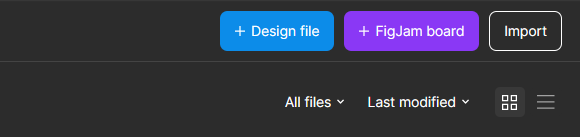
Once logged into Figma, we will start by selecting Drafts from the left side menu, then Design File in the upper right to open a new design file in Figma.
To get started with our new design we will add a frame to our design file and define the shape and size of our design.
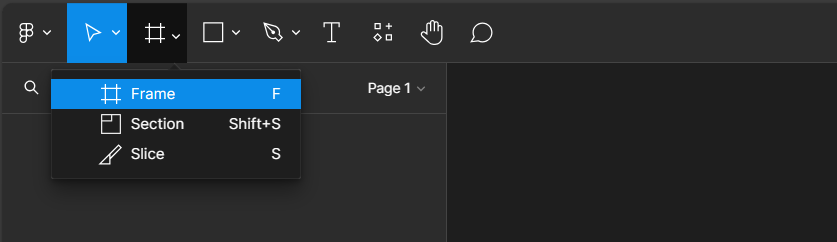
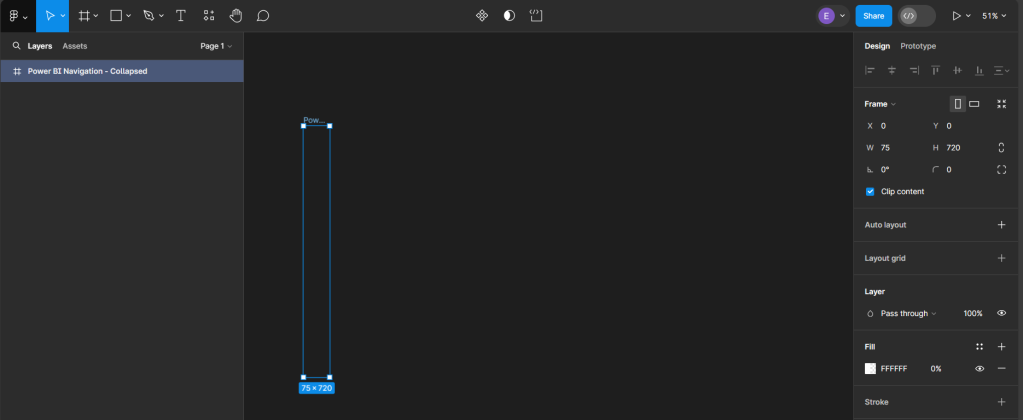
After selecting Frame, a properties panel will open to set the size of the Frame. For a standard Power BI report, the canvas size is typically 1280 x 720. We can use the pre-established size option for TV (under Desktop). We then rename the Frame by double-clicking on the Frame name in the Layers Panel and entering the new name, here we will use Power BI Navigation Collapsed. Then modify the width, since the navigation won’t occupy the entire report, to 75, and set the fill to transparent. This will act as the background or a container for our navigation when collapsed.
Creating Local Variables and Base Elements

Before getting started adding elements to our navigation we will create local variables to store the theme colors of our navigation. On the Design pane, locate local variables and then select open variables.
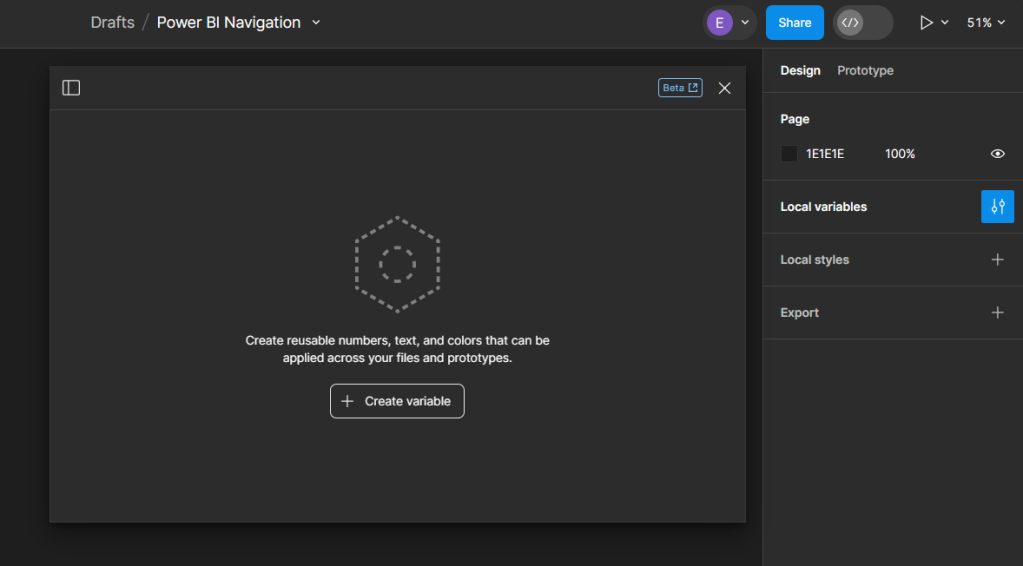
Select Create variable and then Color to get started. For the navigation, we will create two color variables, one corresponding to the background element color and the other the first-level element color of our Power BI theme. If we are using Figma to design wireframes or mock-ups of our Power BI report, we can easily expand the number of variables to include all the colors used within the Power BI theme.

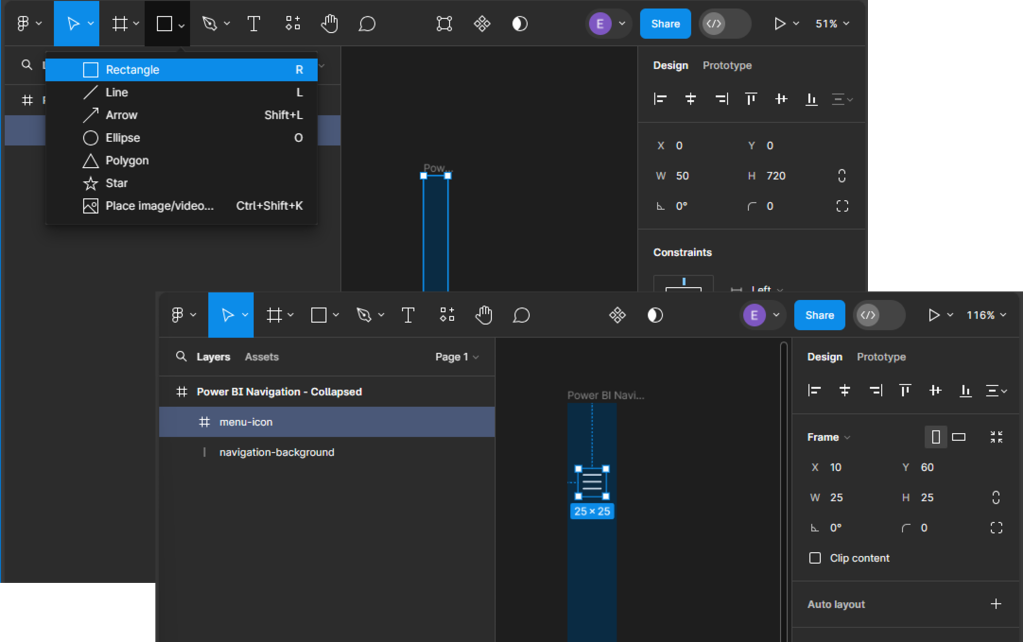
We start building our navigation by adding the base elements. This design includes the dark blue rectangle that will contain our navigation icons and the menu icon that, when clicked, will expand the navigation menu. Under the Shape tools menu select rectangle to add it to our Power BI Navigation - Collapsed frame, then set the width to 45.

Next, we will add the menu icon that will act as a button to expand and collapse the navigation menu. For this navigation, we will use a list or hamburger menu icon with a height and width of 25 that is centered and set towards the top within our navigation background. Then, set the color of the icon to our background-element variable. When searching for icons that fit the report’s styling, the Figma community has a wide range of options to offer.
Adding Page Navigation Icons

Once our base elements are set, we can move on to adding our page icons that will act as the page navigation buttons when the menu is collapsed. In the final report, we will add this navigation menu to contain four pages, so we will add an icon for each page. All icons will be the same size as the menu icon (height and width set to 25), centered horizontally in the navigation background, positioned vertically towards the top, and their color set to our background-element color.
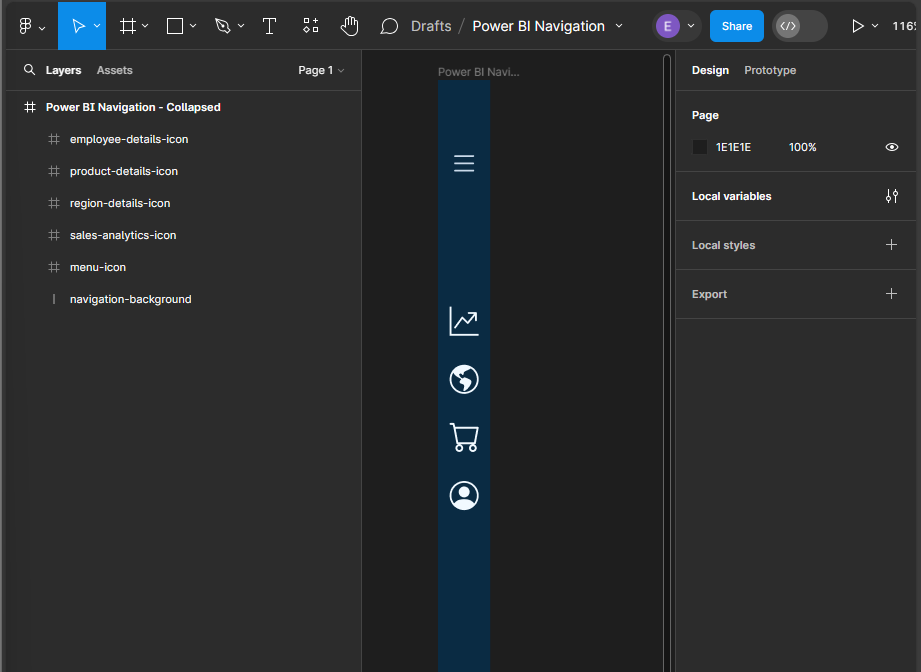
This will serve as our base or template navigation menu for all pages. Next, we will copy this for each page in our report and modify it to indicate the current page.

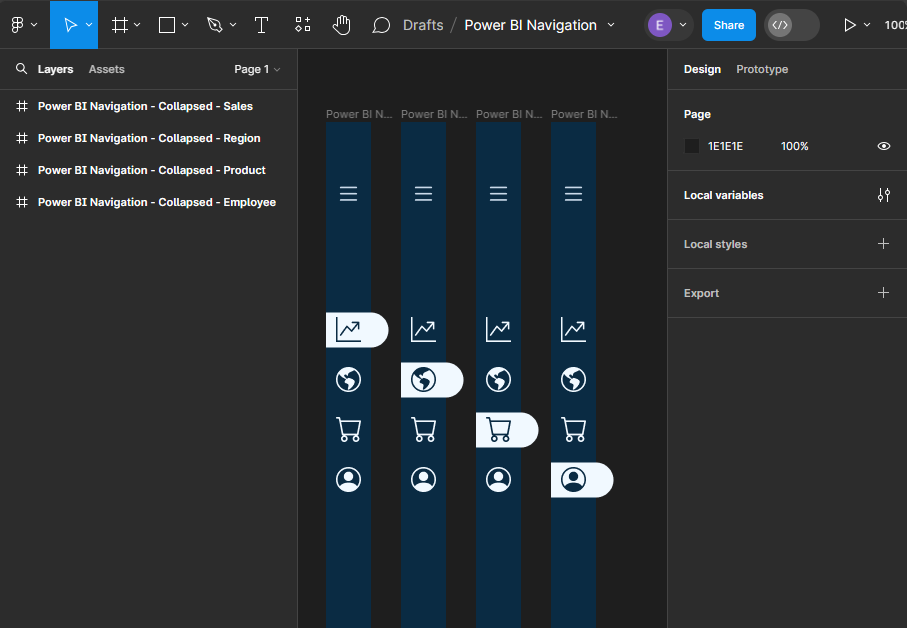
To do this, we first add a line (under the Shape tools) with a width of 45, a stroke color of our background element, a stroke size of 35, and a round end point. Then, position it in the layers pane directly above the navigation so that it appears under the page icons. Once created, align it horizontally with the navigation background, and vertically centered under the current page icon. Update the color of the icon to the first-level-element variable, and then add a drop shadow. Repeat this process for each page icon, creating a navigation menu that can be added to each page of our report.
Creating the Expanded Menu

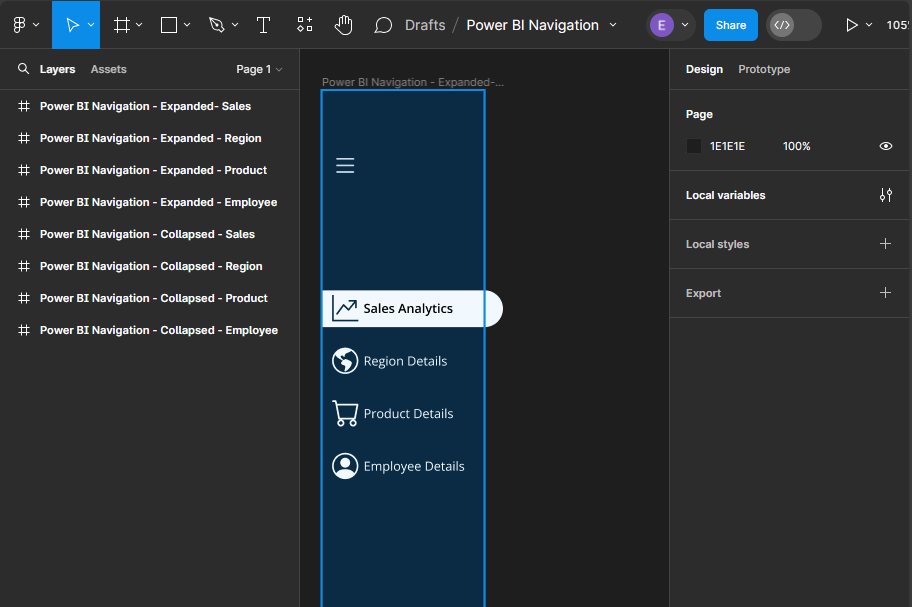
Now that we have completed the collapsed menu design elements, we will use these as the base to create the expanded menu. Creating the expanded menu starts by duplicating each of the collapsed menus. Once duplicated, we will rename each of the Power BI Navigation Frames to replace Collapsed with Expanded and then carry out a few steps for each.

First, we increase the width of the Frame from 75 to 190, the width of the navigation-background rectangle, and the current-page indicator from 45 to 155.

Next, add new Text components for each page icon in the menu. The font color for each text component will match the icon’s color, and the font weight for the selected page text will be set to semi-bold.
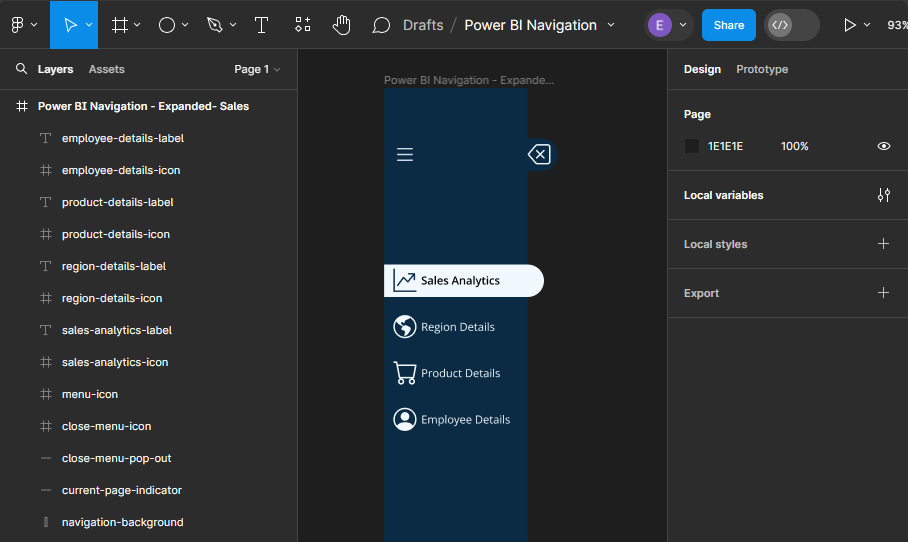
In addition to being able to use the menu icon to toggle the navigation between collapsed and expanded, we will also add a specific collapse menu icon to the expanded menu. We first add a new line element to the expanded menu frame, with a width of 15, stroke size 35, and stroke color first-level-element. We position this on the right side of our navigation background and align it vertically centered with the menu icon. Then add a close icon with the same dimensions as all of our other icons and position it centered on this new line component.
By following these steps, we have taken the first step towards creating a visually appealing, dynamic, and interactive navigation element that will make our Power BI reports more engaging and user-friendly.

Exporting Figma Designs and Importing in Power BI

Once our navigation element is finished in Figma, the next step is bringing it to life within our Power BI Report. This involves exporting the designs from Figma and importing them into Power BI.

Preparing Our Figma Design for Export

Before exporting our design, it is always a good idea to double-check the size of the different components to ensure they are exactly what we want, and so they integrate with our Power BI report seamlessly. Figma allows us to export our designs in various formats, but for Power BI, PNG or SVG files are a common choice.

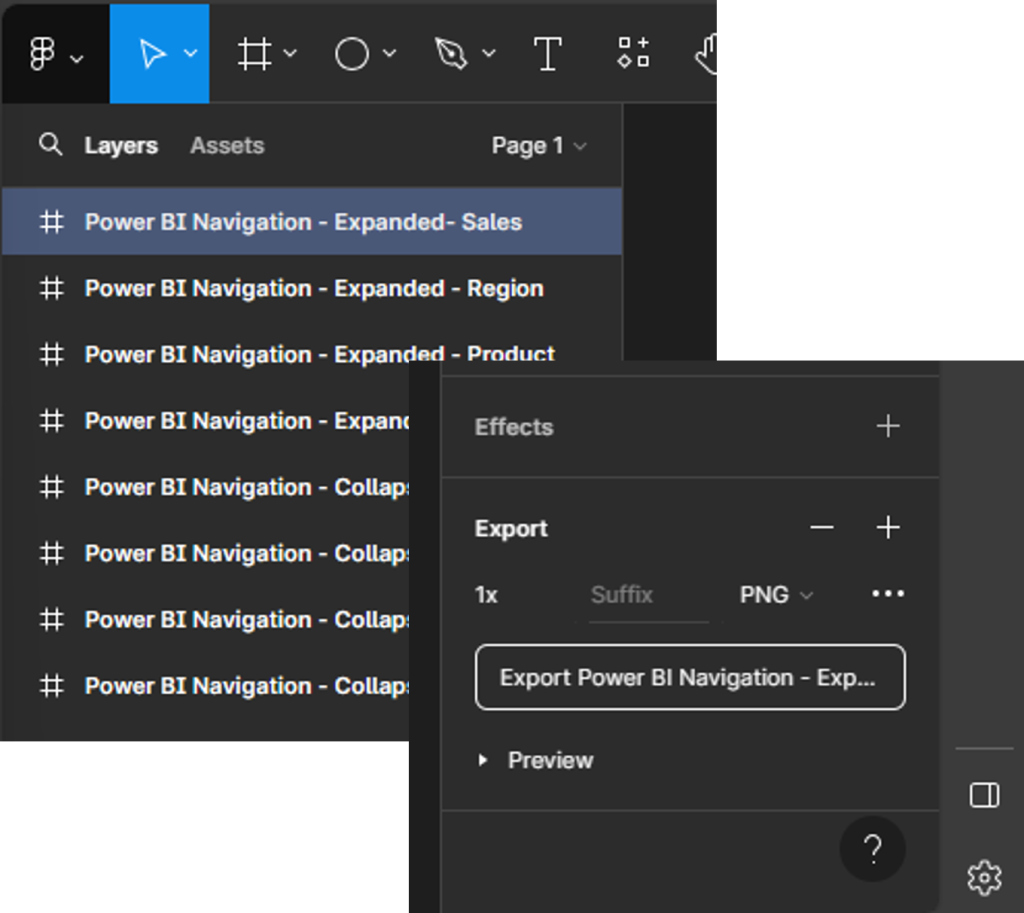
To export our designs, select the Frame from the layers pane (e.g., Power BI Navigation—Expanded—Sales), and then locate export at the bottom of the design pane on the right. Select the desired output file type, then select Export.
Importing and Aligning Figma Designs within Power BI

Once our designs are exported, importing them into Power BI is straightforward. We can add images through the Insert menu, selecting Image and navigating to our exported design files.

Once imported, we adjust a few property settings on the image so it integrates with our report, creating a cohesive look and feel. First, select the image, and in the Format pane under General > Properties, we turn off the Lock aspect ratio option and then set the height to 720 and width to the width of the Figma frame (e.g., 75). Then we set the padding on all sides to zero. This ensures that our navigation is the same height as our report and appears properly.
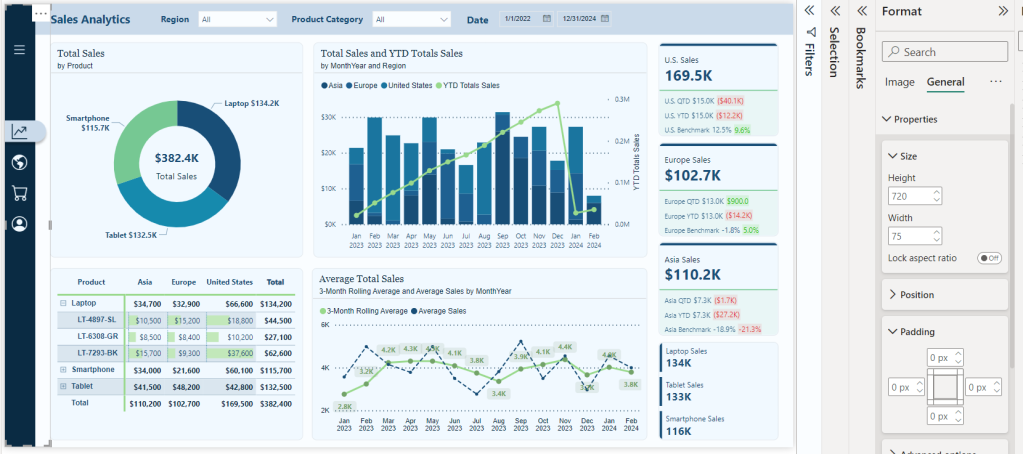
Repeat the above process for the expanded navigation design.

Bringing Our Navigation to Life with Power BI Interactivity

When we merge our design elements with the functionality of interactivity of Power BI, we elevate our Power BI reports into dynamic, user-centric journeys through the data. This fusion is achieved through the strategic use of Power BI’s buttons and bookmarks, paired with the aesthetic finesse of our Figma-designed navigation.

Understanding the Role of Buttons and Bookmarks

Buttons in Power BI serve as the interactive element that users engage with, leading to actions such as page navigation, data filtering, or launching external links. The key to leveraging buttons effectively is to design them in a way that they are intuitive and aligned with the overall design of our report.

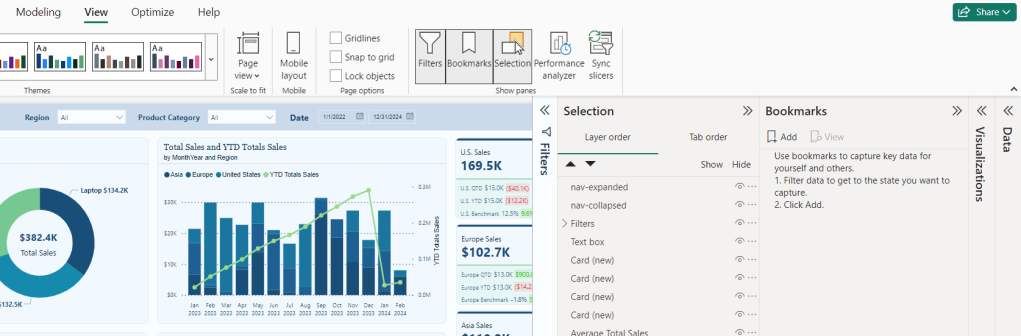
Bookmarks capture and recall specific states of a report, and most importantly for our navigation, this includes the visibility of objects. To create a bookmark first go to the View menu and select bookmarks to show the Bookmarks pane. Then we set our report how we want it to appear, then click Add, or if the bookmark already exists, we can right-click and select Update.

Step-by-Step Guide

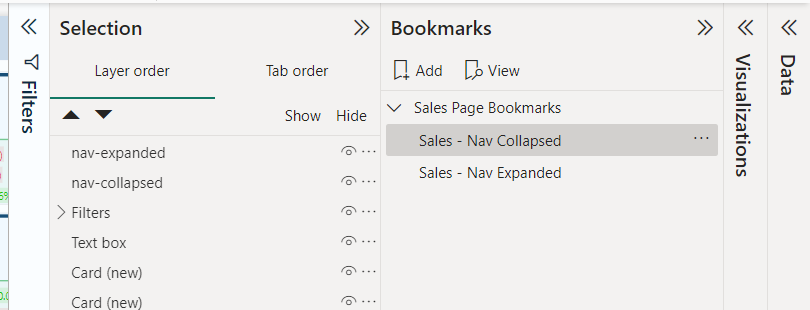
  1. First from the View menu we will turn on the Selection and Bookmarks pane to get our report objects and bookmarks set for our navigation. We will see the image object in our Selection pane, which will be the two navigation images we previously imported. Rename these to give descriptive names, so we can tell them apart. For example nav-collapsed and nav-expanded.
  1. We will add two bookmarks to this page of the report, one corresponding to the collapsed navigation and one for the expanded navigation. To keep our bookmarks organized, we will give them a descriptive name (<page-name>- Nav Collapsed and <page-name>-Nav Expanded) and if needed we can use groups to further organize them.
  1. Now we will add buttons that overlay our navigation design element to add interactivity for our users. We will a blank button to our report with a width of 45 and a height of 35.
    • Then on the Format pane under Style, locate the Fill option for the button toggle it on, and set the following for the Default, On Hover, and On Press states.
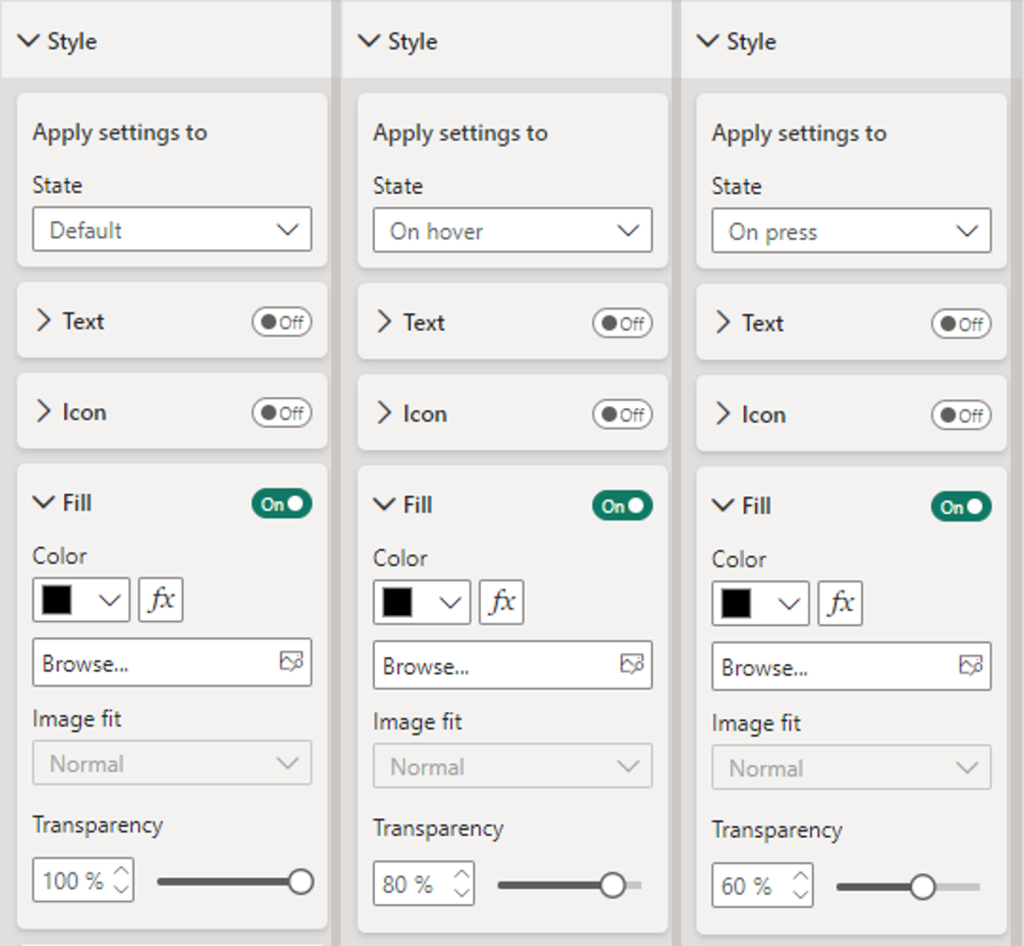
      • Default: Fill: Black, Transparency: 100%
      • On Hover: Fill: Black, Transparency: 80%
      • On Press: Fill: Blank, Transparency: 60%

Duplicate this button for each page icon and position the buttons so that they overly each icon in the navigation menu. In the Selection pane double-click each button to rename the object providing it a description name (e.g. nav-collapsed-menu). Then select all and group them, providing the group a name as well (e.g. nav-collapsed-buttons).
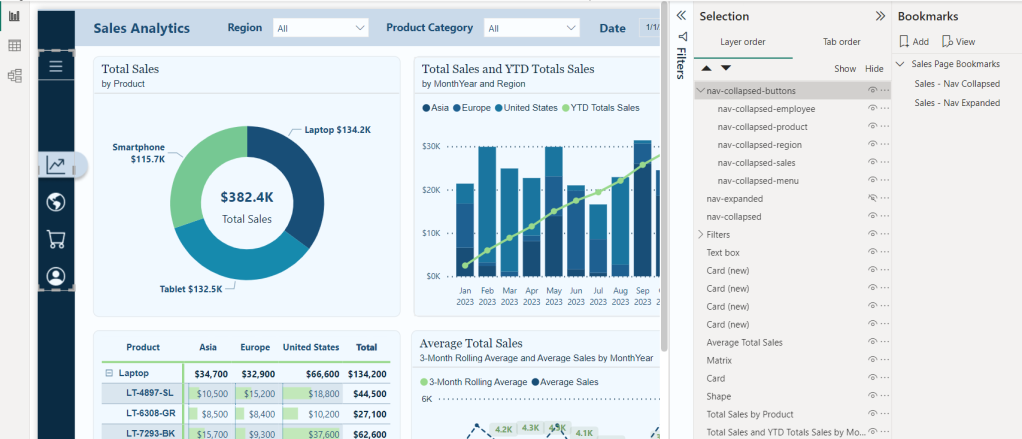
  1. Now that our buttons are created, styled, and positioned, we will set the specific actions required by each.
    • Navigation menu icon
      • Action
        • Type: Bookmark
        • Bookmark: Sales – Nav Expanded
        • Tooltip text: Expand Navigation Menu
    • The current page icon button
      • Action
        • Type: Page navigation
        • Destination: None
        • Tooltip text: Sales Analytics
      • Style
        • Fill: Toggle off (this will remove the darkening effect when hovered over since this page is active)
    • All other page icon buttons
      • Action
        • Type: Page navigation
        • Destination: Select the appropriate page for the icon
        • Tooltip text: Name of the destination page
  1. Next, we copy and paste the nav-collapsed-buttons group to duplicate the buttons so we can modify them for our expanded navigation menu. After pasting the nav-collapsed-buttons group ensure to set the position to the same position as the initial grouping.
    • Rename this group with a descriptive name such as nav-expanded-buttons.
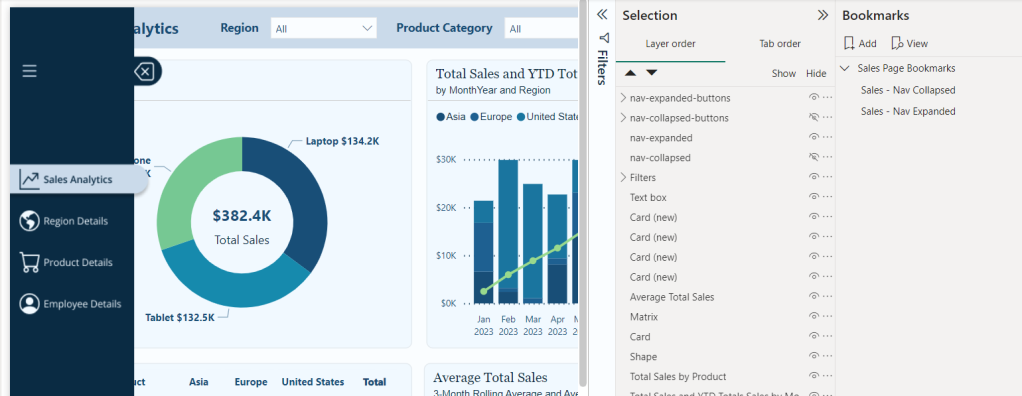
    • Additionally, rename all the buttons objects within the group to keep all our objects well organized and clearly named (e.g. nav-expanded-menu).
    • Adjust the visibility of our object so that the nav-collapsed-buttons group and nav-collapsed image are not visible, and their expanded counterparts are visible.
  1. Set the width for all the page navigation buttons to 155. This will match our navigation background, which we created in Figma. No other properties should have to be set for these buttons.
  2. Update the action of the nav-expanded-menu button and select the Sales - Nav Collapsed bookmark we created previously.
    • Copy and paste this button, then rename the new button as nav-expanded-close.
    • Resize and position this button over the close icon in our expanded navigation.
    • In the Selection pane drag and drop this button into the nav-expanded-buttons grouping.
  3. When the navigation is expanded, we want to prevent interaction with report visuals. To do this, we will add a new blank button to the report and size it to cover the entire report canvas.
    • In the Selection pane, place this button directly following the navigation images so it is below nav-expanded.
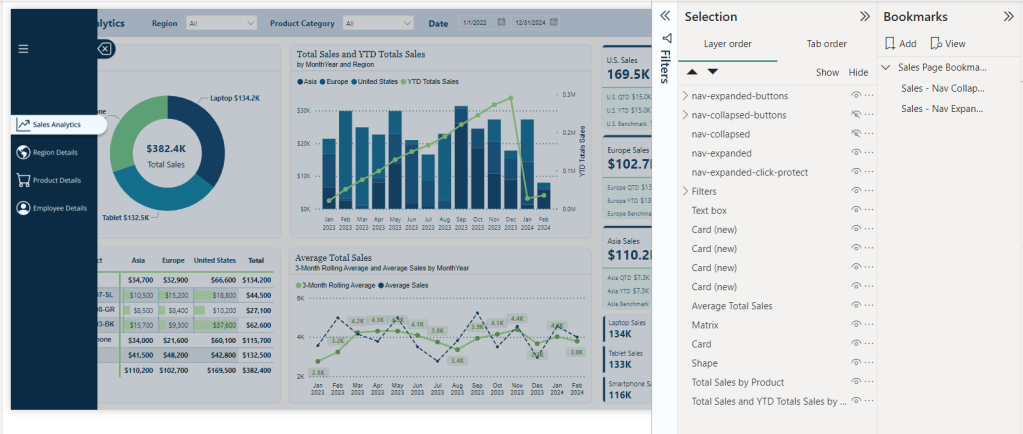
    • In the Format pane for the new button, under the General tab turn on the background and set the color to black with 80% transparency.
    • Turn on the action for this button, set it to a Bookmark type, and set the bookmark to our Sales—Nav Collapsed bookmark. This will ensure that if a user selects outside of the navigation options when the navigation is expanded, they are returned to the collapsed navigation state, where they can interact with the report visuals.
  1. Lastly, we will set our bookmarks, so the correct navigation objects are shown for the expanded and collapsed bookmarks.
    • Right-click each bookmark and uncheck the Data option, so this bookmark will not maintain the current data state. When a user expands or collapses the menu or moves to a different page, we do not want to impact any selected slicers or filters they have selected.
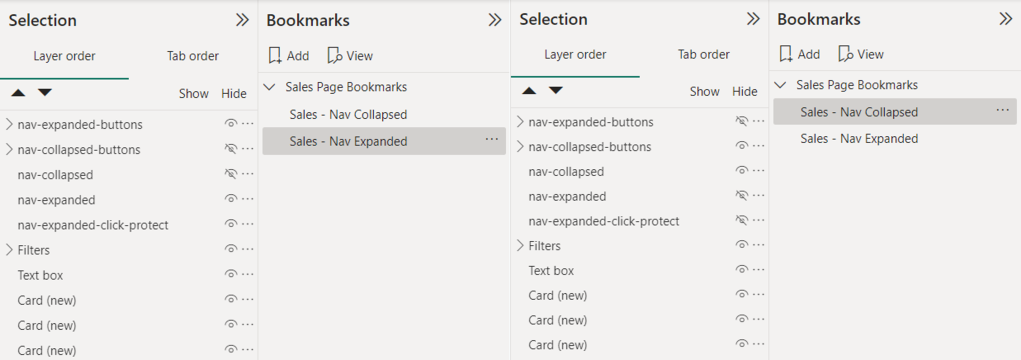
    • Ensure the nav-collapsed-buttons grouping and nav-collapsed images are hidden while their expanded counterparts are visible. Then right-click the expanded bookmark and select update.
    • Select the collapsed bookmark, unhide the collapsed objects, and hide the expanded objects. Right-click the collapsed bookmark and select update.

Now that we have created all the interactivity for our navigation in Power BI for our Sales Analytics page, we can easily copy and move these objects (e.g., the button groupings) to each page in our report. Then, on each page, we will import the 2 Figma navigation designs specific to that page and then size and align them. After this we can add two new bookmarks for that page to store the collapsed and expanded state, using the same process we used in step #9. Finally, update the current page button to toggle off the styling fill and toggle on styling fill for the sales icon buttons (See step #4).

By blending Figma’s design capabilities with Power BI’s interactive features, we can create a navigation experience that elevates the appearance of our report and feels intuitive and engaging. This approach ensures our reports are not just viewed but interacted with, providing deep insights and a more enjoyable user experience.

Bringing It All Together: A Complete Navigation Experience


After creating our navigation visual elements in Figma and integrating them with the interactive powers of Power BI buttons and bookmarks, it’s time to bring it all together and see it in action.
Testing and Refining the Navigation

The key to a successful navigation experience for our users lies in its usability. It is important to conduct user testing sessions to gather feedback on the intuitiveness of the navigation. During these sessions, we can note areas where users hesitate or get lost. Then, using this feedback, we can further refine our navigation, making adjustments to ensure users can effortlessly find the information they need within our reports.

User Experience (UX) Tips for Power BI Reports

Well-designed navigation is just one piece of the UX puzzle. To further enhance our Power BI reports, we should also consider the following.

  • Clarity: ensure our reports are clear and easy to understand at a glance. We should use consistent labeling and avoid cluttering a page with too much information.
  • Consistency: apply the same navigation layout and style throughout our reports, and perhaps even across different reports. This consistency helps users learn how to navigate our reports more quickly.
  • Feedback: Provide visual and textual feedback when users interact with our report elements. For example, we could set the on hover and on pressed options for our buttons or use tooltips to explain what a button does.

Elevating Power BI Reports

By embracing the fusion of Figma’s design capabilities, UX tips, and Power BI’s interaction and analytical power, we can unlock new potential in our reports and user engagement. This journey from design to functionality has enhanced the aesthetic appeal, usability, and functionality of our report. Remember the goal of our reports is to tell the data’s story in an insightful and engaging way. Let’s continue to explore, iterate, and enhance our reports as we work towards achieving this goal while crafting reports that are beyond just tools for analysis but experiences that inform, engage, and fuel data-driven decisions.

If you found this step-by-step guide useful, check out the quick start on creating interactive navigation solely using Power BI’s built-in tools. It provides details on where and how to get downloadable templates to begin implementing this navigational framework for 2-, 3-, 4-, and 5-page reports!

User-Centric Design: Next level reporting with interactive navigation for an enhanced user experience

Also, check out the latest guide on using Power BI’s page navigator for a streamlined, engaging, and easy-to-maintain navigational experience.

Streamlined report navigation with built-in tools to achieve functional, maintainable, and engaging navigation in Power BI reports.


Thank you for reading! Stay curious, and until next time, happy learning.

And, remember, as Albert Einstein once said, “Anyone who has never made a mistake has never tried anything new.” So, don’t be afraid of making mistakes, practice makes perfect. Continuously experiment, explore, and challenge yourself with real-world scenarios.

If this sparked your curiosity, keep that spark alive and check back frequently. Better yet, be sure not to miss a post by subscribing! With each new post comes an opportunity to learn something new.

DAX Table Manipulation Functions: Transforming Your Data Analysis


Exploring DAX: Table Manipulation Functions

Dive into the world of DAX and discover its critical role in transforming raw data into insightful information. With DAX in Power BI, we are equipped with a powerful tool providing advanced data manipulation and analysis features.

Despite its advanced capabilities, DAX remains approachable, particularly its table manipulations functions. These functions are the building blocks of reshaping, merging, and refining data tables, paving the way for insightful analysis and reporting.

Let’s explore DAX table manipulations functions and unlock their potential to enhance our data analysis. Get ready to dive deep into each function to first understand it and then explore practical examples and applications.

For those of you eager to start experimenting there is a Power BI report pre-loaded with the same data used in this post ready for you. So don’t just read, follow along and get hands-on with DAX in Power BI. Get a copy of the sample data file here:

This dynamic repository is the perfect place to enhance your learning journey.

Here is what the post will cover:

  1. ADDCOLUMNS: Adding More Insights to Your Data
  2. Joining Tables with DAX: CROSSJOIN, NATURALINNERJOIN & NATURALLEFTOUTERJOIN
  3. GROUPBY: The Art of Segmentation
  4. SUMMARIZE & SUMMARIZECOLUMNS: Summary Magic
  5. ROLLUP: Climbing the Aggregation Ladder
  6. SELECTCOLUMNS: Handpicking Your Data
  7. UNION, INTERSECT, EXCEPT: Set Operations in DAX
  8. DISTINCT: Identifying Unique Values
  9. TREATAS: Bridging Data Tables

ADDCOLUMNS: Adding More Insights to Your Data

When it comes to enhancing our data tables in Power BI, ADDCOLUMNS is one of our go-to tools. This expression helps us add new columns to an existing table, which can be incredibly handy for including calculated fields or additional information that was not in the original dataset.

The syntax for ADDCOLUMNS is straightforward.

ADDCOLUMNS(table, name, expression[, name, expression]...)

Here, <table> is an existing table or any DAX expression that returns a table of data, <name> is the name given to the column and needs be enclosed in double quotes, and finally <expression> is any DAX expression that returns a scalar value that is evaluated for each row of <table>.

Let’s take a look how we can create a comprehensive date table using ADDCOLUMNS. We will start with the basics by creating the table using CALENDARAUTO() and then enrich this table by adding several time-related columns.

DateTable = 
ADDCOLUMNS (
    CALENDARAUTO(),
    "Year", YEAR([Date]),
    "YearQuarter", FORMAT([Date], "YYYY \QTR-q"),
    "YearQuarterSort", YEAR([Date]) &amp; QUARTER([Date]),
    "Quarter", QUARTER([Date]),
    "MonthName", FORMAT([Date], "MMMM"),
    "MonthShort", FORMAT([Date], "mmm"),
    "MonthNumber", MONTH([Date]),
    "MonthYear", FORMAT([Date], "mmm YYYY"),
    "MonthYearSort", FORMAT([Date], "YYYYMM"),
    "Day", DAY([Date]),
    "Weekday", WEEKDAY([Date]),
    "WeekdayName", FORMAT([Date], "DDDD"),
    "DateKey", FORMAT([Date], "YYYYMMDD")
)

In this example, we transform a simple date table into a multifaceted one. Each additional column provides a different perspective of the date, from the year and quarter to the month name and day of the week. This enriched table becomes a versatile tool for time-based analysis and reporting in Power BI.

With ADDCOLUMNS, our data tables go beyond just storing data, they become dynamic tools that actively contribute to our data analysis, making our reports richer and more informative.


Joining Tables with DAX: CROSSJOIN, NATURALINNERJOIN & NATURALLEFTOUTERJOIN

In Power BI, combining different datasets effectively can unlock deeper insights. DAX offers powerful functions like CROSSJOIN, NATURALINNERJOIN, and NATURALLEFTOUTERJOIN to merge tables in various ways, each serving a unique purpose in data modeling.

CROSSJOIN: Creating Cartesian Products

CROSSJOIN is our go-to function when we need to combine every row of one table with every row of another table, creating what is known as a Cartesian product. The syntax is simple.

CROSSJOIN(table, table[, table]…)

Here<table> is any DAX expression that returns a table of data. The columns names from the <table> arguments must all be different in all tables. When we use CROSSJOIN the number of rows in the resulting table will be equal to the product of the number of rows from all <table> arguments, and the total number of columns is the sum of all the number of columns in all tables.

We can use CROSSJOIN to create a new table containing every possible combination of products and regions within our dataset.

ProductsRegionsCross = 
CROSSJOIN(Products, Regions)

This formula will create a new table where each product is paired with every region, providing a comprehensive view for various analysis task such as product-region performance assessments.

NATURALINNERJOIN & NATURALLEFTOUTERJOIN: Simplifying Joins

When it comes to joining tables based on common columns, NATURALINNERJOIN and NATURALLEFTOUTERJOIN can be helpful. These functions match and merge tables based on column with the same names and data types.

NATURALINNERJOIN creates a new table containing rows that have matching values in both tables, this function performs an inner join of the tables. Here is the syntax.

NATURALINNERJOIN(left_table, right_table)

The <left_table> argument is a table expression defining the table of the left side of the join, and the <right_table> argument defines the table on the right side of the join. The resulting table will include only the rows where the values in the common columns are present in both tables. This table will have the common columns from the left table and other columns from both tables.

For instance, to see products data and sales data for only products that have sales we could create the following table.

NATURALLEFTOUTJOIN, on the other hand, includes all the rows from the first (left) table and the matched rows from the second (right) table. Unmatched rows in the first table will have null values in columns of the second table. This is useful for scenarios where we need to maintain all records from one table while enriching it with data from another. Its syntax is the same as NATURALINNERJOIN.

NATURALLEFTOUTERJOIN(left_table, right_table)

The resulting table will include only rows from the <right_table> where the values in the common columns specified are also present in the <left_table>.

Let’s explore this and how it differs from NATURALINNERJOIN by creating the same table as above but this time using NATURALLEFTOUTERJOIN.

Here we can see the inclusion of our TV line of products, which have no sales. NATURALLEFTOUTERJOIN provides a list of all products, along with the sales data where it is available for each product. While the previous example shows that NATURALINNERJOIN provides only products and sales where the ProductID is matched between these two tables.

Each of these functions serves a distinct purpose: CROSSJOIN for comprehensive combination analysis, NATURALINNERJOIN for intersecting data, and NATURALLEFTOUTERJOIN for extending data with optional matching from another table. Understanding when to use each will significantly enhance our data modeling in Power BI.


GROUPBY: The Art of Segmentation

Segmenting data is a cornerstone of data analysis, and in Power BI, the DAX GROUPBY function is a powerful ally for this task. GROUPBY allows you to group a table by one or more columns and performs calculations on each group. It helps us organize our data into manageable clusters, then glean insights from each cluster. The syntax for GROUPBY is as follows.

GROUPBY (table [, groupBy_columnName[, groupBy_columnName[, …]]] [, name, expression [, name, expression [, …]]])

Let’s break this down. The <table> argument is any DAX expression that returns a table of data. The <groupBy_columnName> argument is the name of an existing column in <table> (or a related table) by which the data is to be grouped and cannot be an expression. The <name> argument is the name given to a new column that is being added to the list returned by GROUPBY enclosed in double quotes. Lastly, <expression> is the expression to be evaluated for each group and must be a supported aggregation iterator function.

For details on aggregation iterator functions visit this in-depth post.

A guide to transforming data into meaningful metrics: Explore essential aggregation functions.

Let’s get into some details and examples.

The general use of GROUPBY is to create a table with a new column(s) which contain aggregated results. When using GROUPBY for grouping and aggregation we must be familiar with the related CURRENTGROUP function. The CURRENTGROUP function returns the set of rows from the table argument of the GROUPBY function that belongs to the current row of the GROUPBY results, and the function can only be used within the GROUPBY expression. This function has not argument and is only supported as the first argument to a supported aggregation function, for a list of supported functions see the reference document below.

Learn more about: CURRENTGROUP

We will start with a basic use of GROUPBY to analyze our sales by product. We can try to create a new table using the following expression.

Sales by Product = 
GROUPBY(
    Sales,
    Products[Product],
    "Total Sales", SUM(Sales[Amount])
    "Average Sales", AVERAGE(Sales[Amount)
)

However, we will see this returns an error stating:

Function 'GROUPBY' scalar expression have to be Aggregation functions over CurrentGroup(). The expression of each Aggregation has to be either a constant or directly reference the column in CurrentGroup().

We can correct this and get our expected results but updating our expression to:

Sales by Product = 
GROUPBY(
    Sales,
    Products[Product],
    "Total Sales", SUMX(CURRENTGROUP(), Sales[Amount]),
    "Average Sales", AVERAGEX(CURRENTGROUP(), Sales[Amount])
)

Although we can use GROUPBY to create the above summary table, for efficient aggregations over physical tables in our data model such as our Sales table we should conder using the functions SUMMARIZECOLUMNS or SUMMARIZE. We will explore these functions later in this post. The true power of GROUPBY is to perform aggregations over intermediate results from DAX table expressions.

We will leverage this use case by creating a new measure that calculates the total sales amount for each product category, but only for the categories where the average sales amount per transaction exceeds a threshold. Here is how we can use GROUPBY and a virtual table to define the Total Sales by High Performing Categories measure.

Total Sales by High Performing Categories = 
VAR ThresholdAverage = 3500
VAR IntermediateTable = GROUPBY(
    Sales,
    Products[Product],
    "Total Sales", SUMX(CURRENTGROUP(), Sales[Amount]),
    "Average Sales", AVERAGEX(CURRENTGROUP(), Sales[Amount])
)
VAR FilteredTable = FILTER(
    IntermediateTable,
    [Average Sales] &gt; ThresholdAverage
)
RETURN
SUMX(FilteredTable, [Total Sales])

In this measure we first define the threshold average as $3,500. Then using GROUPBY we create an intermediate table that groups our sales by product and calculates the total sales and average for each product, this is the same expression we used in the above example. We then create another table by filtering the intermediate table to include only the product groups where the average sales exceed the defined threshold. Then we use SUMX to sum up the total sales from the filtered tabled.

We can see the measure returns a total sales value of $267,000 which from the previous example we can see is the sum of our total sales for our Laptop and Tablet product categories, leaving out the Smartphone category which has an average of $3,379 and is below the threshold. This measure effectively uses GROUPBY to segment and analyze our data in a sophisticated manner, tailoring the calculation to specific business requirements.

Using GROUPBY in measures provides immense flexibility in Power BI, enabling us to perform complex aggregations and calculations that are directly reflected in our report visuals.


SUMMARIZE & SUMMARIZECOLUMNS: Summary Magic

In Power BI, creating summary tables is a common requirement, and DAX offers us two powerful functions for this purpose: SUMMARIZE and SUMMARIZECOLUMNS. These functions are designed to simplify the process of aggregating and summarizing data, making it easier to create our reports and dashboards.

SUMMARIZE: The Classic Aggregator

SUMMARIZE allows us to create a summary table by specifying the columns we want to group by and the aggregations we want to perform. It is particularly useful for creating customized groupings and calculations. Here is its syntax.

SUMMARIZE (table, groupBy_columnName[, groupBy_columnName]…[, name, expression]…)

Here, <table> can be any DAX expression that returns a table of data, <groupBy_columnName> is optional and is the name of an existing column used to create summary groups, <name> is the name given to a summarized column enclosed in double quotes, and <expression> is any DAX expression that returns a single scalar value.

Let’s see how we can more effectively create our Sales by Product summary table. We will create a Sales by Product SUMMARIZE table using the following:

Sales by Product SUMMARIZE = 
SUMMARIZE(
    Sales,
    Products[Product],
    "Total Sales", SUM(Sales[Amount]),
    "Average Sales", AVERAGE(Sales[Amount])
)

A key difference to note is the use of SUM and AVERAGE compared to the use of SUMX and AVERAGEX that were required when we used GROUPBY. Unlike GROUPBY the SUMMARIZE function has an implied CALCULATE providing the required context to aggregate our values.

SUMMARIZECOLUMNS: Enhanced Efficiency and Flexibility

SUMMARIZECOLUMNS offers enhanced efficiency and flexibility, especially in handling complex filter contexts. It may be preferred over SUMMARIZE for its performance benefits and ease of use with measures. The syntax is:

SUMMARIZECOLUMNS(groupBy_columnName[, groupBy_columnName]…, [filter_table]…[, name, expression]…)

The <groupBy_columnName> argument is a column reference to a table within our data model, the <filterTable> is a table expression which is added to the filter context of all columns specified by <groupBy_columnName>, <name> specifies the column name, and the <expression> is any DAX expression that returns a single value.

We are interested in calculating the total and average sales by product and region, but only for the previous year. This is a common scenario in business analysis, where understanding historical performance is key. We can use SUMMARIZECOLUMNS to help us achieve this.

We will create a new Last Year Sales by Product and Region table using the following:

Last Year Sales by Product and Region = 
SUMMARIZECOLUMNS(
    Regions[Region],
    Products[Product],
    Filter(Sales, Year(Sales[SalesDate]) = Year(TODAY())-1),
    "Total Sales", SUM(Sales[Amount]),
    "Average Sales", AVERAGE(Sales[Amount])
)

Here we begin with defining the dimension for group with Regions[Region] and Products[Product], this means our resulting summary will include these two levels of data granularity. The FILTER function is applied to the Sales table to include only sales records from the last year. This is achieved by comparing the year of the SalesDate to the previous year (YEAR(TODAY()) - 1). We then define two new columns in our summary: Total Sales, which sums up the amount for each product-region combination, and Average Sales, which calculates the average sales amount.

This example highlights SUMMARIZECOLUMNS and its strength in handling complex data relationships and filters. By seamlessly integrating time-based filtering and multi-dimensional grouping, it enables the creation of insightful, context-rich summary tables, pivotal for time-sensitive business analysis.

In summary, while SUMMARIZE is great for basic aggregation tasks, SUMMARIZECOLUMNS is the go-to function for more complex scenarios, offing better performance and handling of filter context in Power BI.


ROLLUP: Climbing the Aggregation Ladder

The ROLLUP function in DAX is a robust tool in Power BI for creating layered aggregations, especially useful in multi-level data analysis. It facilitates the generation of subtotals and grand totals within a single query, offering a detailed yet consolidated view of your data. ROLLUP modifies the behavior of the SUMMARIZE function by adding rollup rows to the results on columns defined by the <groupBy_columnName> argument.

Understanding the syntax and functionality of ROLLUP is key to leveraging its full potential. The basic syntax of ROLLUP is as follows:

ROLLUP (groupBy_columnName [, groupBy_columnName [, … ]])

The <groupBy_columnName> argument is a name of an existing column or ROLLUPGROUP function to be used to create summary groups.

To better understand our resulting summary table when using ROLLUP we can incorporate another helpful function: ISSUBTOTAL. We can use ISSUBTOTAL to create another column within our SUMMARIZE expression that returns true if the row contains a subtotal value for the column passed to ISSUBTOTAL as an argument.

Let’s explore an example. Suppose we want to analyze sales data and see subtotals at different levels: by region, then by product within each region, and finally a grand total across all regions and products. Here is how ROLLUP and ISSUBTOTAL can help.

Sales by Region and Production Rollup = 
SUMMARIZE(
    Sales,
    Regions[Region],
    ROLLUP(Products[Product]),
    "Total Sales", SUM(Sales[Amount]),
    "Product SubTotal", ISSUBTOTAL(Products[Product])
)

This example uses SUMMARIZE and groups our Sales data by Region. Then using ROLLUP it generates subtotals first at the product level within each region, followed by region-level subtotals. Total Sales calculates the sum of sales amounts for each group. Product SubTotals, through ISSUBTOTAL indicates whether a row is a subtotal for a product, enhancing the analysis by clearly marking these subtotal rows.

This approach, using ROLLUP with SUMMARIZE is highly effective for multi-layered data analysis. It allows for an intricate breakdown of data, showcasing how individual segments (in the example, products within regions) cumulatively contribute to broader totals. Such a perspective is critical for in-depth data analysis and informed decision-making.


SELECTCOLUMNS: Handpicking Your Data

In Power BI, tailoring our dataset to include just the right columns is often essential for efficient and focused analysis. This is where the SELECTCOLUMNS function in DAX becomes invaluable. SELECTCOLUMNS allows us to create a new table by selecting specific columns from an existing table. The syntax for SELECTCOLUMNS is straightforward:

SELECTCOLUMNS(table, [name], expression, name], …)

The arguments of this function are <table> which is any DAX expression that returns a table, <name> is the name given to the column, and <expression> is any expression that returns a scalar value.

Let’s use SELECTCOLUMNS to create a simplified table from our dataset, focusing on product sales and the corresponding sales date.

Simplified Product Sales = 
SELECTCOLUMNS(
    Sales,
    "Product Name", RELATED(Products[Product]),
    "Sales Amount", Sales[Amount],
    "Date of Sale", Sales[SalesDate]
)

UNION, INTERSECT, EXCEPT: Set Operations in DAX

Set operations in DAX including UNION, INTERSECT, and EXCEPT are fundamental in Power BI for efficiently managing and manipulating data sets. Each operation serves a unique purpose in data analysis, allowing for combining, intersecting, and differentiating data sets.

UNION: Merging Data Sets

UNION is used to combine two or more tables by appending rows from one table to another. The tables must have the same number of columns, and corresponding columns must have compatible data types. Here is its syntax.

UNION(table_expression1, table_expression2[,table_expression]…)

The <table_expression> arguments are any DAX expression that returns a table.

In our data model we have our products table and a new table containing other products, we can use UNION to merge these two product tables.

INTERSECT: Finding Common Elements

INTERSECT returns the common rows between two tables. This function is useful when we need to identify overlapping data. It’s syntax is simple.

INTERSECT(table_expression1, table_expression2)

The <table_expression> arguments are any DAX expression that returns a table. Duplicated rows are retained. The column names in the resulting table will match the column names in <table_expression1>. The table returned by INTERSECT has lineage based on the column in <table_expression1> regardless of the lineage of the columns in the second table.

Let’s use our new All Products table and INTERSECT to examine what products have sales.

Product IDs with Sales INTERSECT = 
INTERSECT(
   SELECTCOLUMNS(
      'All Products', 
      "ProdictID", 
      'All Products'[ProductID]
   ), 
   SELECTCOLUMNS(
      Sales, 
      "ProductID", 
      Sales[ProductID]
   )
)

EXCEPT: Identifying Differences

EXCEPT takes two tables and returns the rows from the first table that are not found in the second table. This is useful for finding discrepancies or exclusions between datasets.

The syntax for EXCEPT will look familiar.

EXCEPT(table_expression1, table_expression2)

Where <table_expression> can be any DAX expression that returns a table.

Let’s look at the list of ProductIDs that do not have sales, by modifying the above example using EXCEPT.

Understanding and utilizing UNION for merging data, INTERSECT for finding common data, and EXCEPT for identifying unique data helps enhance our data manipulation and analysis capabilities in Power BI.


DISTINCT: Identifying Unique Values

Identifying unique values in a data set is a common requirement, and the DISTINCT function in DAX provides a straightforward solution. DISTINCT is used to return table that contains the distinct values from a specified column or table. This function can help remove duplicate values and obtain a list of unique entries for further analysis.

The syntax for DISTINCT is simple.

DISTINCT(column)

Here, <column> is the column from which distinct values are to be returned, or an expression that returns a column. When we are using DISTINCT it is important to be aware that the results of this function are affected by the current filter context. For example, if we use DISTINCT to create a measure of the distinct products from our sales table, the result of this measure would change whenever our Sales table was filtered by date or region for example.

Using DISTINCT on a Column

When applied to a column, DISTINCT generates a one column table of unique values from the specified column. For example, we want to create a measure that returns the column of employees that have a sale. For this we can use DISTINCT to get a list of the distinct employee Ids from our Sales table and pass the list to the COUNTROWS functions to produce the count. Here is the expression.

Count of Employee with Sales = 
COUNTROWS(
   DISTINCT(
      Sales[EmployeeID]
   )
)

Using DISTINCT on a Table

When used on a table, DISTINCT returns a table with unique rows, effectively removing any duplicated rows. We can use this to examine our Sale table to identify if there are any duplicated sales records. We will create two measures, the first to return the count of rows in our Sales table and the second to return the count of rows of our Sales table using DISTINCT.

Our Count of Sales DISTINCT measure produced a count of our Sales table where each row is unique across all columns in the table. With this compared to our count of Sales we can identify our Sales table has a duplicated record.


TREATAS: Bridging Data Tables

A common challenge we may encounter is linking data from different tables that do not have a direct relationship in the data model. TREATAS in DAX is a powerful function designed to address this issue. It applies the values from one table as filters to another unrelated table. This can be especially useful when we are working with complex models where establishing direct relationships may not be feasible or optimal.

The syntax for TREATAS is as follows:

TREATAS(table_expression, column[, column[, column[,…]]]} )

The arguments of TREATAS are the <table_expression> which is an expression that results in a table, and <column> which is one or more existing columns, it cannot be an expression. The table returned by TREATAS contains all the rows in <column(s)> that are also in <table_expression>. When using TREATAS the number of columns specified must match the number of columns in <table_expression> and they must be in the same order. TREATAS is best used when a relationship does not exist between the tables, if there are multiple relationships between the tables, we should consider using USERELATIONSHIP to specify what relationship to use.

Previously, using SUMMARIZECOLUMNS we created a summary table of sales for the previous year. We now wish to visualize the total sales of this table utilizing a measure that allows the user to filter the value by a selected region.

Let’s start by adding a table to visualize our Last Year Sales by Product and Region table, a card visual to visualize the default aggregation of the Total Sales field in this table, and a slicer to allow for selection of a region.

When we select a region in our slicer, an issue becomes clear. The table and Total Sales card visual are not filtered. This is because there is no direct relationship between our Regions table and our Last Year Sales by Product and Region table. Here is how we can create a measure using TREATAS to help solve this issue.

Last Year Sales by Region = 
CALCULATE(
    SUM('Last Year Sales by Product and Region'[Total Sales]), 
    TREATAS(
        VALUES(Regions[Region]),
        'Last Year Sales by Product and Region'[Region]
    )
)

Adding a new card visual to visualize this measure we can see now that the total sales value is filtered by our Region slicer as expected.

By using TREATAS, we can dynamically filter and aggregate data across tables without the need for a physical relationship in the data model. This function is invaluable for creating flexible, context-specific calculations in Power BI.


Wrapping Up: Harnessing the Full Potential of Table Manipulation in DAX

As we wrap up our exploration of table manipulation functions in DAX, it is clear that these tools offer a wealth of possibilities for transforming and understanding our data. The functions we discussed here and many others found in the DAX Reference Guide each serve unique purposes and can be combined in various ways to unlock deeper insights.

Learn more about: Table manipulation functions.

These functions offer flexibility in data manipulation, enabling custom analyses and efficient data modeling. Mastering these functions enhances the power of our reports, making them more insightful and interactive. However, as always, it is important to balance complexity with efficiency to maintain sufficient performance.


Thank you for reading! Stay curious, and until next time, happy learning.

And, remember, as Albert Einstein once said, “Anyone who has never made a mistake has never tried anything new.” So, don’t be afraid of making mistakes, practice makes perfect. Continuously experiment and explore new DAX functions, and challenge yourself with real-world data scenarios.

If this sparked your curiosity, keep that spark alive and check back frequently. Better yet, be sure not to miss a post by subscribing! With each new post comes an opportunity to learn something new.

Power Apps Tips: Visually Distinguishing Your App’s Environment


Are you tired of the confusion and mix-ups that come with managing Power Apps across multiple environments? We have all been there – one minute we are confidently testing a new feature, and the next, we are lost in a world of confusion until we realize we are in the production environment, not our development or testing environment. It can be both surprising, confusing, and disorienting.

But what if there was a way to make our apps and more importantly our users more environmentally aware. Imagine an app that clearly shows whether it is in development, testing, or production. This isn’t just a dream; it is entirely possible, and we are going to explore how. With a combination of environment variables, labels, and color properties, we can transform our apps and adjust their appearance all based on the environment they are in.

In this guide we will go from apps that are indistinguishable between environments.

To apps that are informative and allow us to develop, test, and use our apps with confidence.

Dive in and explore as we start with the basics of environment variables and then move to advanced techniques for dynamic configuration. By the end of the guide, we will not only learn how to do this, but it will become clear as to why this is helpful when managing Power Apps across different environments.

Here is what this guide will cover:

  1. Understanding Power Apps Environments and Environment Variables
    1. Introduction to Power Apps Environments
    2. The Role of Different Environments
    3. The Importance of Power Apps ALM
  2. The Significance of Environmental Awareness in Power Apps
    1. Common Challenges in Multi-Environment Scenarios
    2. Importance of Identifying the Current Environment
  3. Building The App
    1. Setting the Stage
    2. Creating the App in the Development Environment
    3. Extracting Environment Information
      1. Building the Power Automate Workflow
    4. Call the Workflow and Store the Outputs
  4. Adding the Environmental Visual Cues
    1. Adding Text Labels
    2. Environmental Specific Color Themes
    3. Deploying to Different Environments
  5. Wrapping Up: Ensuring Clarity and Efficiency in Your Power Apps

Understanding Power Apps Environments and Environment Variables

Power Apps is a fantastic and powerful platform that allows us to create custom business applications with ease. However, as our projects and solutions grow, we begin to dive into the realm of application development, and we encounter the need for efficient management. This is precisely where Power Apps environments step in to save the day.

Introduction to Power Apps Environments

Environments act as unique containers helping facilitate and guide us through the entire app development journey. Each environment is a self-contained unit, ensuring that our data, apps, and workflow are neatly compartmentalized and organized. This structure is particularly beneficial when managing multiple projects or collaborating with a team. Environments are like distinct workspaces, each tailored for specific stages of your app development journey.

These environments let use build, test, and deploy our applications with precision and control, ensuring that chaos never gets in the way of our creativity while crafting our Power Apps applications.

The Role of Different Environments

Let’s shed some light on the roles played by different environments. Environments can be used to target different audiences or for different purposes such as development, testing, and production. Here we will focus on staged environments (dev/test/prod) an environment strategy that helps ensure that changes during development do not break the app users’ access in our production environment.

First up is the development environment – the birthplace of our app ideas. It is where we sketch out our vision, experiment with various features and lay the foundation for our apps.

Next is the testing or QA environment which takes on the role of the quality assurance center. In this environment we examine our app, validate its functionality and user experience, and ensure everything works seamlessly and as expected before it reaches our final end users.

Lastly, we have our production environment, where our apps go live. It is the real-world stage where our apps become accessible to its intended users, interacts with live data, and requires stability and reliability.

The Importance of Power Apps ALM

We cannot get too far into exploring Power Apps environments, and environment strategies without mentioning Application Lifecycle Management (ALM). ALM is a pivotal aspect of successful software development, and our Power Apps are no exception. ALM within Power Apps helps ensure a smooth transition between the development, testing, and production phases of our projects. It encompasses maintaining version control, preventing disruptions, and streamlining the deployment process.

If you are curious to learn more about Power Apps ALM, I encourage you to visit the post below that discusses its different aspects including how to implement ALM, where Power Apps solutions fit into the picture, version control, change management, and much more.

Explore how ALM can enhance collaboration, improve performance, and streamline development in Power Platform solution. 


The Significance of Environmental Awareness in Power Apps

Common Challenges in Multi-Environment Scenarios

Navigating through multiple environments in Power Apps can sometimes feel like a tightrope walk. One common challenge is keeping track of which environment we are working in and what environment app we are accessing in our browser. It can be easy to lose track especially when we are deep in development and testing.

Image a scenario where we created a new feature in development, and as the developer we wish to verify this change before deploying the update to our testing environment. But as often happens, something comes up and we cannot check the functionality right away. When we come back later, we launch the app using the web link url, and we don’t see our expected update. Was it an issue how we developed the change, are we viewing the development app, are we viewing the testing app? All can lead us to more questions and confusion, that could be solved if our app clearly indicates the environment it resides in no matter how we access the ap.

Importance of Identifying the Current Environment

Informing us and other app users, especially those that may use the app across different environments, about the current environment is focused on providing control and safety. Being aware of our environment ensures that we are in the correct environment to carry out our tasks.

Identifying the environment is crucial for effective testing of our apps. By knowing we are in the right testing environment, we can experiment and troubleshoot without the fear of affecting the live application or data.

Moreover, it aids in communication within our teams. When everyone is on the same page about the environment they should be working in for specific tasks, collaboration becomes smoother, and we can minimize the chances of errors. The goal is to create a shared understanding and a common approach among team members.


Building The App

Setting the Stage

For our app we will be using a SharePoint List as the data source. Each environment will use its own specific list, so we have 3 different lists that are on different SharePoint sites. Once the lists are created, we can begin building our solution and app.

The first step to creating our Power App that we can easily move between environments is creating a solution to contain our app. In addition to the canvas app the solution will also contain the various other components we require, including a Power Automate workflow and environment variables.

To do this we navigate to our development environment and then select Solutions in the left-hand menu. On the top menu select New solution and provide the solution a name and specify the publisher. For additional details visit this article.

Learn how to create a solution in Power Apps

After creating our solution, we will first create our environment variables that will define the app’s data source. Since the SharePoint site and list will be changing as we progress our app from development to test to production, we will create two environment variables. The first to specify the SharePoint Site, and the second to specify the SharePoint List on the site. For details on environment variables and how they can be modified when importing a solution to another environment visit this article.

Use environment variables to migrate application configuration data in solutions

Here we will manually create the environment variables, so we have control over naming, but there is also the option to automatically create the environment variables from within our app. In the canvas app editor on the top menu select Settings. Within the General section locate the Automatically create environment variables when adding data sources, and toggle to the desired value.

To manually add environment variables to our solution, select New on the top menu, under more we will find Environment variables. Provide the environment variable a name and under Data Type select Data source. In the connector drop down select SharePoint and a valid SharePoint connection in the Connection drop down. For the first variable under Parameter Type select Site and then New site value and select the required SharePoint site or provide the site url. For the second environment variable select List for the Parameter Type, then for the Site select the newly created environment variable, and then New list value, and select the required SharePoint List.

Creating the App in the Development Environment

Our app starts to come to life in our development environment. First, we focus on creating the app’s core features and functionalities. This is where our creativity and technical skills come into play. We can experiment with different designs, workflows, and integrations, all within the safe confines of the development environment. Its a bit like being in a laboratory, where we can test hypotheses and make discoveries without worrying about breaking the version of the app our end user might be actively using.

First, we will connect to our data source using our environment variables. In the left side menu select the data menu, then add new data, and search for SharePoint. After selecting the SharePoint data source and connection, in the Connect to a SharePoint site pane select the Advanced tab and select the environment variable we created previously, and then do the same to select the list environment variable.

If we opted to not create the environment variables first, and ensured the automatically create environment variables when adding data source setting is turned on, we can provide a site URL and select a list. We will then be prompted that an environment variable will be automatically generated to store information about this data source.

Once connected to our data source we will build out the basic functionality of our app. For this simplified app this includes a vertical navigation component and a gallery element to display the list items. Here is the base app that will be our launching point to build a more informative and dynamic app.

Extracting Environment Information

As we deploy our app to different environments, we will update the SharePoint site and list environment variables. Since the values of these environment variables will be distinct and specific to the environment, we can leverage this to help determine and show what environment the app is in.

Now, if we search the data sources that we can add to our app for “environment”, we will find an environment variable values dataverse source. The data source can be used to extract the values of our environment variables however, this will give our app a Premium licenses designation. Premium licensing may not always be suitable or available, so we will explore an alternative method, using a Power Automate workflow and our App.OnStart property.

Building the Power Automate Workflow

In the left side menu, select the Power Automate menu option, then create new workflow.

To extract and return the information we need to our app we will create a simple flow, consisting only of the trigger and the Respond to a PowerApp or flow action. Selecting the Create new flow button will create a Power Automate workflow with a PowerApps (V2) trigger. For this workflow we will not need to add any inputs to this trigger action.

In the workflow designer, select New action and search for Respond to a PowerApp or flow, and add the action to the workflow. Here we will add two outputs, the first to return the value of the SharePoint site environment variable and the second to return the value of the SharePoint list environment variable. Depending on our requirements, we may only need one of these values to determine the appropriate environment information. For the output value we can find our environment variables listed in the dynamic content.

The final workflow is shown below. Once created give the workflow an informative name, then save and close the workflow.

Call the Workflow and Store the Outputs

On the start of our app, we will run our workflow and store the output values, which are the values of our environment variables, in a global variable within our app scope. We do this by using the App.OnStart property and setting a variable to store the outputs. We will add the following to the App.OnStart property.

Set(gblEnvironmentDetails, .Run())

Here, we create the gblEnvironmentDetails global variable which will store the outputs of our workflow. This variable has a record data type with values for both our sourcesiteurl and sourcelistid outputs.

The App.OnStart event, becomes crucial as it sets the stage for the entire app session. Now, each time our app starts are workflow will return the environment values we require ensuring this information is always available from the moment our app is launched.

We can visual these values, and how they change between our environments by adding labels to our app. We will add various environment detail labels. The first we will add will display out SharePoint site environment variable value, set the text property of the label to the following.

"SharePoint Site Environment Variable: " &amp; gblEnvironmentDetails.sourcesiteurl

We will make this value a bit easier to work with and evaluate, by extracting the site name from the site url. We add another label to display the site name, and set the text property of the label to the following.

"SharePoint Site : " &amp; Last(Split(gblEnvironmentDetails.sourcesiteurl, "/sites/")).Value

This expression splits the site url by the text “/sites/” and then returns all the text that follows it which is the site name.

Lastly, we add a text label to display the value stored in our SharePoint List environment variable by adding a new label and setting the text property to the following.

"SharePoint List Id : " &amp; gblEnvironmentDetails.sourcelistid

Adding the Environmental Visual Cues

To make the environment distinction clear we will add environment-specific colors and text labels in our app’s design.

Adding Text Labels

We will start by adding an environment label in the header, that will be placed opposite of our app name. To do this we first create a named formula and then use this to set the text property of the new label in our header element. In the App.Formulas property add the following.

nfmEnvironment = Switch(
    Last(Split(gblEnvironmentDetails.sourcesiteurl, "/sites/")).Value,
    "PowerAppsDevSource", "DEV",
    "PowerAppsTestSource", "TEST",
    "SalesandMarketing", "PROD",
    "UNKNOWN"
);

This expression creates a new named formula nfmEnvironment and we use the switch function to evaluate the site name of our SharePoint site environment variable using the same formula we used above and return our environment label. For our app if our SharePoint site environment variable is for the Power Apps Dev Source site the named formula nfmEnvironment will return a value of DEV, when set to Power Apps Test Source it will return TEST and when set to our Sales and Marketing site it will return PROD. The formula also includes a default value of UNKNKOWN, if none of the above conditions are true, this will help identify a potential error or our app data source set to an unexpected site.

We then add a new label to our header element and set the text property to nfmEnvironment. Additionally, the navigational component used in our app has a text input to display the environment label near the bottom under the user profile image. We will set the input value also to nfmEnvironment.

Environmental Specific Color Themes

Next, we will elevate our awareness when working with our apps across different environments by moving beyond just labels. We will now leverage different visual cues and color themes between the different environments. In our development environment the navigation component and header will be green, when in our testing environment these elements will be gray, and finally in production they will be blue.

The first step to include this functionality is to define our color theme that we can then use to set the color of our different elements depending on the value of nfmEnvironment. To create our color theme, we will create a new named formula. In the App.Formulas property we will add the following to create a named formula containing the basics of a color theme used within our app.

nfmThemeColor =
{
    primary: "#004F6B",
    onPrimary: "#FFFFFF",
    primaryFixed: "#9DC8EB",
    onPrimaryFixed: "#004D67",
    secondary: "#005C3F",
    onSecondary: "#FFFFFF",
    secondaryFixed: "#78CDA7",
    onSecondaryFixed: "#005138",
    tertiary: "#394C57",
    onTertiary: "#FFFFFF",
    tertiaryFixed: "#D0DDE4",
    onTertiaryFixed: "#364954",
    background: "#F6FAFE",
    onBackground: "#171C1F",
    surface: "#F6FAFE",
    onSurface: "#171C1F",
    surfaceContainerLowest: "#FFFFFF",
    surfaceContainerLow: "#F0F4F8",
    surfaceContainer: "#EAEEF2",
    surfaceContainerHigh: "#E5E9ED",
    surfaceContainerHighest: "#DFE3E7"
};

This named formula now stores our different color values and we can use it and our nfmEnvironment formula to dynamically color our apps elements.

We will start with setting the fill of the header. The header is a responsive horizontal container containing our two text labels. The fill property of the container we will set to the following expression.

Switch(
    nfmEnvironment,
    "DEV", ColorValue(nfmThemeColor.secondary),
    "TEST", ColorValue(nfmThemeColor.tertiary),
    "PROD", ColorValue(nfmThemeColor.primary),
    Color.Black
)

Adding the color cues will following a similar pattern that we used to set the environment label text property. We use the Switch function to evaluate our nfmEnvironment value and depending on the value set the color to the secondary color (green), tertiary color (gray), primary color (blue), or if a condition is not met the header will be set to black.

We then use the same expression for the vertical selection indicator bar and next arrow icon in our app’s gallery element. Next we incorporate the same expression pattern to color the different aspects of the navigation element using the expressions below.

//Navigation Background
Switch(
    nfmEnvironment,
    "DEV", ColorValue(nfmThemeColor.secondaryFixed),
    "TEST", ColorValue(nfmThemeColor.tertiaryFixed),
    "PROD", ColorValue(nfmThemeColor.primaryFixed),
    Color.Black
)

//Selected Item Background
Switch(
    nfmEnvironment,
    "DEV", ColorValue(nfmThemeColor.onSecondaryFixed),
    "TEST", ColorValue(nfmThemeColor.onPrimaryFixed),
    "PROD", ColorValue(nfmThemeColor.onTertiaryFixed),
    Color.Black
)

//Base Icon Color
Switch(
    nfmEnvironment,
    "DEV", ColorValue(nfmThemeColor.onSecondaryFixed),
    "TEST", ColorValue(nfmThemeColor.onPrimaryFixed),
    "PROD", ColorValue(nfmThemeColor.onTertiaryFixed),
    Color.Black
)

After adding the dynamic color themes to our navigation our environment aware app is complete.

We now have a clear and informative app that instantly informs users about the app’s current environment. Using text labels and visual cues are simple yet effective ways to avoid confusion and ensure that everyone knows which version of the app they are interacting with.

Deploying to Different Environments

Now that our app is complete, we save and publish our version of the app and begin the process of deploying the app to the testing environment. First, we will edit each environment variables within out solution and remove the current site and current list from our solution. This will help ensure the values we set for these variables in our development environment don’t carry with our solution when we import it to different environments.

Then export the solution and download the exported .zip file. Next, we switch to our test environment, and import the solution. During the import process we are prompted to set our two environment variables, which help set our dynamic and environment specific visual cues in our app. We set the values and finish importing the app to our test environment to view our app in the test environment.

We can then also repeat the process, to see our app in the production environment.

Wrapping Up: Ensuring Clarity and Efficiency in Your Power Apps

As we wrap up our exploration of visually distinguishing environments in Power Apps, remember that the key to a successful app lies in its clarity and user-friendliness. By implement the techniques we have discussed, from color-coding elements of our app and labeling to using dynamic UI elements, we can significantly enhance the user experience. These strategies not only prevent confusion but also streamline our workflow across development, testing, and production environments. When we embrace these tips, we can make our Power Apps intuitive and efficient, ensuring that users always know exactly where they are and what they are working with.


Thank you for reading! Stay curious, and until next time, happy learning.

And, remember, as Albert Einstein once said, “Anyone who has never made a mistake has never tried anything new.” So, don’t be afraid of making mistakes, practice makes perfect. Continuously experiment, explore, and challenge yourself with real-world scenarios.

If this sparked your curiosity, keep that spark alive and check back frequently. Better yet, be sure not to miss a post by subscribing! With each new post comes an opportunity to learn something new.

Dive Into DAX: Data Aggregation Made Easy


Welcome to another insightful journey of data analysis with Power BI. This guide is crafted to assist you in enhancing your skills no matter where you are in your DAX and Power BI journey through practical DAX function examples.

As you explore this content, you will discover valuable insights into effective Power BI reporting and develop strategies that optimize your data analysis processes. So, prepare to dive into the realm of DAX Aggregation functions.

  1. Unraveling the Mystery of Aggregation in DAX
  2. SUMming It Up: The Power of Basic Aggregations
    1. SUM
  3. Understanding DAX Iterators: The X Factor in Aggregations
  4. AVERAGEx Marks the Spot: Advanced Insights with Average Functions
    1. AVERAGEX
  5. COUNTing on Data: The Role of Count Functions in DAX
    1. COUNT
    2. COUNTA
    3. COUNTROWS
    4. DISTINCTCOUNT
  6. MAXimum Impact: Extracting Peak Value with MAX and MAXX
    1. MAX
    2. MAXX
  7. MINing for Gold: Uncovering Minimum Values with DAX
    1. MIN
    2. MINX
  8. Blending Aggregates and Filters: The Power Duo
  9. Navigating Pitfalls: Common Mistakes and How to Avoid Them
  10. Mastering Aggregation for Impactful Analysis

Unraveling the Mystery of Aggregation in DAX

Aggregation functions in DAX are essential tools for data analysis. They allow us to summarize and interpret large amounts of data efficiently. Let’s start by first defining what we mean when we talk about aggregation.

Aggregation is the process of combining multiple values to yield a single summarizing result. In the realms of data analysis, this typically involves calculating sums, averages, counts, and more to extract meaningful patterns and trends from our data.

Why is aggregation so important? The goal of our analysis and repots is to facilitate data-driven decision-making and quick and accurate data summarization is key. Whether we are analyzing sales data, customer behavior, or employee productivity, aggregation functions in DAX provide us a streamlined path to the insights we require. These functions enable us to distil complex datasets into actionable information, enhancing the effectiveness of our analysis.

As we explore various aggregation functions in DAX throughout this post, we will discover how to leverage these tools to transform data into knowledge. Get ready to dive deep into each function to first understand it and then explore practical examples and applications.

For those of you eager to start experimenting there is a Power BI report-preloaded with the same data used in this post ready for you. So don’t just read, follow along and get hands-on with DAX in Power BI. Get a copy of the sample data file here:

This dynamic repository is the perfect place to enhance your learning journey.


SUMming It Up: The Power of Basic Aggregations

SUM

When it comes to aggregation functions, SUM is the foundational member. It is straightforward and common but don’t underestimate its power. The SUM function syntax is simple as well.

SUM(column)

The argument column is the column of values that we want to sum.

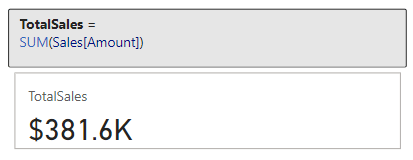
Let’s put this function to work with our sample dataset. Suppose we need to know the total sales amount. We can use the SUM function and the Amount column within our Sales Table to create a new TotalSales measure.

TotalSales = 
SUM(Sales[Amount])

This measure quickly calculates the total sales across the entire dataset.

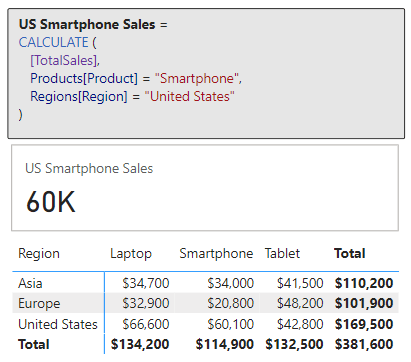
However, the utility of SUM goes beyond just tallying totals. It can be instrumental in uncovering deeper insights within our data. For a more advanced application, let’s analyze the total sales for a specific product category in a specific sales region. We can do this by combining SUM with the CALCULATE function, here is how the measure would look.

US Smartphone Sales = 
CALCULATE (
   [TotalSales],
   Products[Product] = "Smartphone",
   Regions[Region] = "United States"
)

The measure sums up sales amounts exclusively for smartphones in the United Sales. For additional and more complex practical applications of SUM, for example calculating cumulative sales over time, continue your exploration with the examples in the following posts.

Demystifying CALCULATE: An exploration of advanced data manipulation. 

Discover how to effortlessly navigate through intricate data landscapes using DAX Filter Functions in Power BI.

The beauty and power of SUM lies in its simplicity and versatility. It is a starting point for deeper analysis, and commonly serves as a steppingstone towards more complex functions and insights. As we get more comfortable with SUM we will soon find it to be an indispensable part of our analytical approach in Power BI.


Understanding DAX Iterators: The X Factor in Aggregations

Before we continue diving deeper, if we review the aggregation function reference, we will notice several aggregation functions ending with X.

Learn more about: Aggregation Functions

These are examples of iterator functions in DAX and include functions such as SUMX, AVERAGEX, MAXX, MINX, and COUNTX. Understanding the distinction between these functions and their non-iterative counterparts like SUM is crucial for advanced data analysis.

Iterator functions are designed to perform row-by-row computations over a table (i.e. iterate over the table). In contrast to standard aggregations that operate on a column, iterators apply a specific calculation to each row, making them more flexible and powerful in certain scenarios.

In other words, SUM will provide us the total of a column while SUMX provides the total of an expression evaluated for each row. This distinction is key in scenarios where each row’s data needs individual consideration before aggregating to a final result.

For more in-depth insights into the powerful capabilities of DAX iterator functions, explore this in-depth post.

Iterator Functions — What they are and What they do


AVERAGEx Marks the Spot: Advanced Insights with Average Functions

AVERAGEX

Let’s explore an aggregation iterator function with AVERAGEX. This function is a step up from our basic average. As mentioned above, since it is an iterator function it calculates an expression for each row in a table and then calculates the average (arithmetic mean) of these results. The syntax for AVERAGEX is as follows:

AVERAGEX(table, expression)  

Here, table is the table or an expression that specifies the table over which the aggregation is performed. The expression argument is the expression which will be evaluated for each row of the table. When there are no rows in the table, AVERAGEX will return a blank value, while when there are rows but non meet the specified criteria, the function returns a value of 0.

Time to see it in action with an example. We are interested in finding the average sales made by each employee. We can create the following measure to display this information.

Employee Average Total Sales = 
AVERAGEX(
   Employee, 
   [TotalSales]
)

This measure evaluates our TotalSales measure for each employee. The sales table is filtered by the EmployeeID, the employee’s total sales is calculated, then finally after all the employees totals sales are calculated the expression calculates the average.

In this above example, we can see the difference between AVERAGE and AVERAGEX. When we use the AVERAGE function this calculates the average of all the individual sale values for each employee, which is $3,855. The Employee Average Total Sales measure uses AVERAGEX and first calculates the total sales for each employee (Sum of Amount column), and then averages these total sales values returning an average total sales amount of $95,400.

What makes AVERAGEX particularly useful is its ability to handle complex calculations within the averaging process. It helps us understand the average result of a specific calculation for each row in our data. This can reveal patterns and insights that might be missed with basic averaging methods. AVERAGEX, and other iterators, are powerful tools in our DAX toolkit, offering nuanced insights into our data.


COUNTing on Data: The Role of Count Functions in DAX

The COUNT functions in DAX, such as COUNT, COUNTA, and DISTINCTCOUNT, are indispensable when it comes to understanding the frequency and occurrence of data in our dataset. These functions provide various ways to count items, helping us to quantify our data effectively.

COUNT

For our exploration of DAX counting functions, we will start with COUNT. As the name suggests, this function counts the number of non-blank values within the specified column. To count the number of blank values in a column check out the reference document for COUNTBLANK. The syntax for COUNT is shown below, where column is the column that contains the values to be counted.

COUNT(column)

If we want to get a count of how many sales transactions are recorded, we can create a measure with the expression below.

Sale Transaction Count = 
COUNT(Sales[SalesID])

This new measure will provide the total number of sales transactions that have a sales id recorded (i.e. not blank).

The COUNT function counts rows that contain numbers, dates, or strings and when there are no rows to count the function will return a blank. COUNT does not support true/false data type columns, if this is required, we should use COUNTA instead.

When our goal is to count the rows in a table, it is typically better and clearer to use COUNTROWS. Keep reading to explore and learn more about COUNTA and COUNTROWS.

COUNTA

COUNTA expands on COUNT by counting all non-blank values in a column regardless of datatype. This DAX expression follows the same syntax as COUNT shown above.

In our Employee tables there is a true/false value indicating if the employee is a current or active employee. We need to get a count of this column, and if we use COUNT we will see the following error when we try to visual the Employee Active Column Count measure.

Employee Active Column Count = 
COUNT(Employee[Active])

Since the Active column contains true/false values (i.e. boolean data type) we must use COUNTA to get a count of non-blank values in this column.

Employee Active Column Count = 
COUNTA(Employee[Active])

Building on this measure we can use COUNTAX to get a current count of our active employees. We will create a new measure shown here.

Active Employee Count = 
COUNTAX(
   FILTER(
      Employee, 
      Employee[Active]=TRUE()
   ), 
   Employee[Active]
)

Here we use COUNTAX, and for the table argument we use the FILTER function to filter the Employee table to only include employees whose Active status is true.

COUNTROWS

Next, we will look at COUNTROWS, which counts the number of rows in a table or table expression. The syntax is:

COUNTROWS([table])

Here, table is the table that contains the rows to be counted or an expression that returns a table. This argument is optional, and when it is not provided the default value is the home table of the current expression.

It is typically best to use COUNT when we are specifically interested in the count of values in the specified column, when it is our intention to count the rows of a table, we can use COUNTROWS. This function is more efficient and indicates the intention of the measure in a clearer manner.

A common use of COUNTROWS is to count the number of rows that result from filtering a table or applying context to a table. Let’s use this to improve our Active Employee Count measure.

Active Employee CountRows = 
COUNTROWS(
   FILTER(
      Employee, 
      Employee[Active]=TRUE()
   )
)

In this example it is recommended to use COUNTROWS because we are not specifically interested in the count of values in the Active column. Rather, we are interested in the number of rows in the Employee table when we filter the table to only include Active=true employees.

DISTINCTCOUNT

Adding to these, DISTINCTCOUNT is particularly useful for identifying the number of unique values in a column, with the following syntax.

DISTINCTCOUNT(column)

In our report we would like to examine the number of unique products sold within our dataset. To do this we create a new measure.

Unique Products Sold = 
DISTINCTCOUNT(Sales[ProductID])

We can then use this to visual the number of unique Product Ids within our Sales table, and we can use this new measure to further examine the unique products sold broken down by year and quarter.

Together, DAX count functions provide a comprehensive toolkit for measuring and understanding the dimensions of our data in various ways.


MAXimum Impact: Extracting Peak Value with MAX and MAXX

In DAX, the MAX and MAXX functions are the tools to use for pinpointing peak performances, maximum sales, or any other type of highest value within in our dataset.

MAX

The MAX function is simple to use. It finds the highest numeric value in a specified column.

MAX(column)

The column argument is the column in which we want to find the largest value. The MAX function can also be used to return the largest value between to scalar expressions.

MAX(expression1, expression2)

Each expression argument is a DAX expression which returns a single value. When we are using MAX to compare two expressions, a blank value is treated as 0, and if both expressions return a blank value, MAX will also return a blank value. Similar to COUNT, true/false data types are not supported, and if we need to evaluate a column of true/false values we should use MAXA.

Let’s use MAX to find our highest sale amount.

Max Sale Amount = 
MAX(Sales[Amount])

This new measures scans through the Amount column in our Sales table and returns the maximum value.

MAXX

MAXX builds on the functionality of MAX and offers more flexibility. It calculates the maximum value of an expression evaluated for each row in a table. The syntax follows the similar pattern as the other aggregation iterators.

MAXX(table, expression, [variant])

The table and expression arguments are the table containing the rows for which the expression will be evaluated, and the expression specifies what will be evaluated. The optional argument variant can be used when the expression has a variant or mixed value type, by default MAXX will only consider numbers. If variant is set to true, the highest value is based on ordering the column in descending order.

Let’s add some more insight to our Max Sale Amount measure. We will use MAXX to find the highest sales amount per product across all sales regions.

Max Product Total Sales = 
MAXX(
   Products, 
   [TotalSales]
)

This measure iterates over each product and calculates the totals sales amount for that product by evaluating our previously created TotalSales measure. After the total sales for each product is calculated the measure returns the highest total found across all products.

These functions provide us the tools to explore the maximum value within specific columns and also across different segments and criteria, enabling a more detailed and insightful understanding of our data’s maximum values.


MINing for Gold: Uncovering Minimum Values with DAX

The MIN and MINX functions help us discover the minimums in various scenarios, whether we are looking for the smallest sale or quantity, or any other type of lowest value.

MIN

MIN is straightforward, it finds the smallest numeric value in a column or, similar to MAX, the smallest value between two scalar expressions.

MIN(column)
MIN(expression1, expression2)

When comparing expressions, a blank value is handled the same as how the MAX function handles a blank value.

We have already identified the highest sale value, let’s use MIN to find our lowest sale amount.

Min Sale Amount = 
MIN(Sales[Amount])

This measure checks all the values in the Amount column of the Sales table and returns the smallest value.

MINX

MINX, on the other hand, offers more complex analysis capabilities. It calculates the minimum value of an expression evaluated for each row in a table. Its syntax will look familiar and follows the same pattern as MAXX.

MINX(table, expression, [variant])

The arguments to MINX are the same as MAXX, see the previous section for details on each argument.

We used MAXX to find the maximum total product sales, in a similar manner let’s use MINX to find the lowest total sales by region.

Min Region Total Sales = 
MINX(
   Regions, 
   [TotalSales]
)

The Min Region Total Sales measure iterates over each region and calculates its total sales, then it identifies and returns the lowest totals sales value.

These functions are powerful and prove to be helpful in our data analysis. They allow us to find minimum values and explore these values across various segments and conditions. This helps us better understand the lower-end spectrum of our data.


Blending Aggregates and Filters: The Power Duo

Blending aggregation functions with filters in DAX allows for more targeted and nuanced data analysis. The combination of functions like CALCULATE and FILTER can provide a deeper understanding of specific subsets in our data.

CALCULATE is a transformative function in DAX that modifies the filter context of a calculation, making it possible to perform aggregated calculations over a filtered subset of data. CALCULATE is crucial to understand and proves to be helpful in many data analysis scenarios. For details on this function and plenty of examples blending aggregations functions with CALCULATE take a look at this in-depth post focused solely on this essential function.

Demystifying CALCULATE: An exploration of advanced data manipulation. 

FILTER is another critical function that allows us to filter a table based on a given conditions. We used this function along with COUNTROWS to count the number of active employees. For additional examples and more details on FILTER and other filter functions see the post below.

Discover how to effortlessly navigate through intricate data landscapes using DAX Filter Functions in Power BI.


Working with DAX in Power BI can be incredibly powerful, but it is not without its pitfalls. Being aware of common mistakes and understanding how to avoid them can save us time and help ensure our data analysis is as accurate and effective as possible.

One frequent mistake is misunderstanding context in DAX calculations. Remember, DAX functions operate within a specific context, which could be row context or filter context. Misinterpreting or not accounting for this can lead to incorrect results. For instance, using an aggregate function without proper consideration of the filter context can yield misleading totals or averages.

Another common issue is overlooking the differences between similar functions. For example, SUM and SUMX might seem interchangeable, but they operate quite differently. SUM aggregates values in a column, while SUMX performs row-by-row calculations before aggregating. Understanding these subtleties is crucial for accurate data analysis.

Lastly, we should always beware of performance issues with our reports. As our datasets grow, complex DAX expression can slow down our reports. We should look to optimize our DAX expressions by using appropriate functions and minimizing the use of iterative functions (like aggregations functions ending in X) when a simpler aggregation function would suffice.


Mastering Aggregation for Impactful Analysis

As we reach the conclusion of our exploration into DAX aggregation functions, it’s clear that mastering these tools is essential for impactful data analysis in Power BI. Aggregation functions can be the key to unlocking meaningful insights and making informed decisions.

Remember, the journey from raw data to actionable insights involves understanding not just the functions themselves, but also the context in which they are used. From the basic SUM to the more complex SUMX, each function has its place and purpose. The versatility of AVERAGEX and the precision of COUNT functions demonstrate the depth and flexibility of DAX.

Incorporating MAX and MIN functions helps us identify extremes in our datasets. Blending aggregations with the power of CALCULATE and FILTER shows the potential of context-driven analysis, enabling targeted investigations within our data.

The journey through DAX aggregation functions is one of continuous learning and application. As we become more comfortable with these tools, we will find ourselves able to handle increasingly complex data scenarios, making our insights all the more powerful and our decisions more data driven. Continue exploring DAX aggregation functions with the DAX Reference.

Learn more about: Aggregation Functions


Thank you for reading! Stay curious, and until next time, happy learning.

And, remember, as Albert Einstein once said, “Anyone who has never made a mistake has never tried anything new.” So, don’t be afraid of making mistakes, practice makes perfect. Continuously experiment and explore new DAX functions, and challenge yourself with real-world data scenarios.

If this sparked your curiosity, keep that spark alive and check back frequently. Better yet, be sure not to miss a post by subscribing! With each new post comes an opportunity to learn something new.

Power Apps Dynamic Design: Explore Dynamic UI Strategies


Setting the Stage for Dynamic Interfaces

If you are new to the world of Power Apps, it is where we blend our creativity with technology to build some seriously powerful and helpful applications. In this particular exploration we will be diving into an inventory management application for Dusty Bottle Brewery.

Our focus? Dynamic user interfaces (UI). It is all about making an app that is not only functional but also engaging and intuitive. Imagine an inventory app that adapts in real-time, showcasing inventory updates, new arrivals, and even alerts when a popular brew or item is running low. That is the power of dynamic UI in action, it makes our app come alive.

Join me as we explore Power Apps and learn how to transform a standard inventory management application into an interactive and responsive tool. We will dive into leveraging visible properties, integrating role-based elements, and much more. Whether you are an expert or just starting, come along on this exciting journey to create a dynamic and vibrant app.


The Magic of Visible: More Than Meets the Eye

The Visible property in Power Apps is crucial for creating a dynamic app at Dusty Bottle Brewery and forms the cornerstone of creating an engaging user experience. Using this property effectively is focused on displaying the right information at the right time for a sleek yet informative interface.

Here’s how it works in action: when we open our Inventory App, we are brought to a dashboard showing current stock levels. This main dashboard uses the visible property of various elements to dynamically show additional information for each item.

For example, each item shows a stock status badge indicating if the stock level is good, average, low, or extremely low. This is all made possible leveraging the visible property of these objects. It’s more than just hiding and showing object, we are creating a responsive experience that adapts to user interactions.

Let’s dive into the information (i) icon and the details it has to offer. By selecting the i icon for a product, we reveal additional information like the recommended order amount, cost per unit, and total cost for the recommended order.

Time to see how it works with some practical expressions. Below is the main dashboard. Notice how the information (i) icon appears on the selected item. This is accomplished by setting the visible property of the icon to ThisItem.IsSelected.

Additionally, by selecting this icon the user can display additional information. This information provides just in time insights. Providing for a responsive experience that displays all the required information at just the right time leaving a clean and simple dashboard with hidden power that is revealed through user interactions.

We use a variable to set the Visible property of the informational items. For the informational icons OnSelect property we use:

UpdateContext({locInfoVisible:!locInfoVisible});

The locInfoVisible variable toggles between true and false, acting as a switch. The pattern of using ! (i.e. not) and a boolean variable is helpful for flipping the variable’s value between true and false.

We are not limited to boolean variables to control our app objects visibility. Any expression that evaluates to true or false will work. An example of this within our app is the stock status badges. Each icon has its own specific condition controlling its visibility.

For each product we calculate the percentage of our target stock count. In the app we store this value in the text label lbl_Main_StockEval.

For example, the Extremely Low icon’s visible property is set to

Value(lbl_Main_StockEval.Text)&lt;=20

This results in the icon showing only when the expression evaluates to true, that is if the item stock is less than or equal to 20% of the target amount.

Effectively pairing expressions with the visible property streamlines our app’s interface, focusing attention on what is most relevant. This elevates our apps from functional to intuitive and powerful.


User Roles and UI Elements: A Match Made in Heaven

Customizing apps based on user roles is crucial for any organization. Although this type of customizing includes things such as access control, it can go way beyond just that. Customizing our apps for different user roles is focused on making our apps more intuitive and user-friendly while recognizing what that means may differ for each individual or for each user role.

Let’s, examine a scenario with our Dusty Bottle Brewery inventory app where personnel should see a simplified dashboard focused on just their area of responsibility. Staff in the Brewing department should only see brewery related inventory, staff in the Sales and Marketing should only see merchandise related inventory, while staff in Logistics and Supply Chain should be able to view all items. This is where the flexibility of Power Apps shines, allowing us to tailor our apps based on the current user.

We first need to add the Office 365 Users data connector which then allows us to set UserProfile to the current user’s profile. In the Formulas property of the App object we add the following Named Formula:

UserProfile = Office365Users.MyProfileV2();

Note: This can also be done with a global variable by adding the following to the OnStart property of the App object.

Set(gblUserProfile, Office365Users.MyProfileV2());

The user profile provides the required information to personalize the user experience for our app. For example, we use UserProfile to welcome the current user in the top right of the app.

Next, we use the user’s department to control the data presented on the dashboard, ensuring relevant information is highlighted.

To add this role-based feature we add the following to the App OnStart property to pre-load the appropriate data.

Switch(
    true,
    UserProfile.department = "Brewing",
    ClearCollect(
        colSpInventory,
        Filter(
            Inventory,
            Category.Value = "Beer"
        )
    ),
    UserProfile.department = "Sales and Marketing",
    ClearCollect(
        colSpInventory,
        Filter(
            Inventory,
            Category.Value = "Merchandise"
        )
    ),
    UserProfile.department = "Logistics and Supply Chain",
    ClearCollect(
        colSpInventory,
        Inventory
    )
);

Here we filter the collection of inventory items (colSpInventory) based on the user’s department. This collection is then used in the Items property of the gallery displaying the inventory items. This approach enhances the efficiency and reducing clutter within our app.

For instance, Dusty Bottle’s Lead Brewer, Adele Vance, sees only brewery items, streamlining her experience. This helps Adele identify brewery items that are low in stock and provides all the information she requires without cluttering the dashboard with irrelevant information.

What is the most exciting about this level of control is the possibilities of the personalization aspect.

For example, let’s build on this role-based feature by expanding it beyond the user’s department. Dusty Bottle Brewery has a management team containing members of all departments and the members of this group should be able to see all inventory items. This group of users is defined by a Microsoft 365 group, and we will leverage the group’s membership to add this functionality to our app.

First, we add the Office 365 Group data connector to our app. Similar to Office 365 Users, this allows us to use Office365Group.ListGroupMembers to get all the members of our Management group.

Then we add another Named Formula to the Formulas property of the App.

ManagementMember = !IsBlank(
    LookUp(
        Office365Groups.ListGroupMembers("&lt;group_object_id&quot;).value,
        displayName = UserProfile.displayName
    )
);

Let’s break this down, starting from the inside working out. We provide Office365Groups.ListGroupMembers the object id of the required group, this then provides a record. The record property value contains the membership user information we are looking for. We then use LookUp to see if the current user’s display name is within the group members. If the returned record from LookUp is not (!) blank, then the user is a member of the management group, and ManagementMember returns a value of true, otherwise false.

Finally, we update the OnStart property of our app to the following.

Switch(
    true,
    UserProfile.department = &quot;Brewing&quot;,
    ClearCollect(
        colSpInventory,
        Filter(
            Inventory,
            Category.Value = &quot;Beer&quot;
        )
    ),
    UserProfile.department = &quot;Sales and Marketing&quot;,
    ClearCollect(
        colSpInventory,
        Filter(
            Inventory,
            Category.Value = &quot;Merchandise&quot;
        )
    ),
    ManagementMember || UserProfile.department = &quot;Logistics and Supply Chain&quot;,
    ClearCollect(
        colSpInventory,
        Inventory
    )
);

Providing each user or group a tailored interface that feels like it is made just for them. Using these role-based approaches we can deliver the right tools and information to the right people at the right time.


Input-Driven Interfaces: Reacting in Real-Time

In the dynamic environment of any organization, an input-driven interface can significantly improve the user experience by responding to user actions in real-time. This approach makes the app both intuitive and interactive.

For example, updating inventory involves selecting an item from the main dashboard to access its restocking screen. On the restocking screen the user is provided all the essential information for restocking an item.

This screen shows the cost, stock status indicator, stock count, and the target stock count on the left. On the right, is a dynamic input control and what the stock indicator would be if the input quantity is restocked. The default of this control is the difference between the current stock and the target stock value.

The input-driven interface updates information based on user input, ensuring accuracy and responsiveness. For instance, changing the restock quantity automatically updates the related information (e.g. Restock Total Cost).

What if the user is only able to restock 10 of these baseball caps. After updating the Restock Quantity input, we see the change reflected in the Restock Total Cost.

We achieve this by referencing the restock quantity (txt_Restock_QuantityAdded) in the text label displaying the total cost and the visible property fields of the stock indicator badges. The total cost label’s text property is set to the following.

Text(
    Value(txt_Restock_QuantyAdded.Text * gblSelectedItem.Cost),
    "$#,##0.00"
)

But the possibilities don’t have to end there. The app could integrate sliders or dropdown menus for inventory updates. As the user adjusts these controls, the interface could dynamically show the impact of these changes.

This approach can be extended to handle complex scenarios, like entering a new item, where the app reveals additional fields based on the item category or other properties. This can help keep the interface clean while also guiding the user through data entry in a logical, step-by-step manner.

Harnessing the power of input-driven interfaces transforms our apps into responsive companions, adapting to user needs and simplifying tasks.


Buttons and Actions: Bringing Our Interfaces to Life

Interactive buttons and actions play a pivotal role in bringing the user interface to life. They create engaging and interactive experiences for our users.

Consider our simple action of updating stock levels in our inventory app. Selecting the Restock button updates the stock value and, if successful, presents a success message to the user. This immediate feedback reassures users and enhances their interaction with the app.

Additionally, we can tailor buttons and actions for different user roles. For example, enabling the Restock button only for management staff. Using the ManagementMember named formula created previously, we set the DisplayMode of the Restock button to the following.

If(ManagementMember, DisplayMode.Edit, DisplayMode.Disabled)

By thoughtfully integrating these elements, we turn mundane tasks into engaging interactions, making our apps an integral part of the daily workflow.


Tying It All Together: Crafting a Seamless Navigation Menu

As our apps grow in complexity and expand, easy navigation becomes crucial. A well-crafted navigation menu integrates all the dynamic UI features we have discussed into one cohesive, user-friendly package.

First, the navigation menu’s visibility is a key aspect and is controlled by the Visible property. We can make the navigation menu appear and disappear with a simple button click. This approach keeps the interface clean and uncluttered, allowing users to access the menu when needed and hide it when focusing on other tasks. We us a hamburger menu icon to launch the menu when selected using the following for its OnSelect property.

UpdateContext({locNavigationVisible: true})

Additionally, we will set the Visible property of the hamburger icon to !locNavigationVisible. This will hide the icon after it is selected allowing us to show a cancel icon that when selected will hide the navigation menu. The Cancel icon’s OnSelect property is set to the following.

UpdateContext({locNavigationVisible: false})

While its Visible property is set to locNavigationVisible.

Next, we enrich the navigation with selectable icons and actions that allow users to effortlessly navigate between the different screens of our app. Each icon in the navigation menu is linked to a different screen in the app. Using the Power Apps Navigate function and the OnSelect property of the icons seamlessly transports the users to the desired screen, enhancing the app’s overall usability and flow.

Lastly, we tailor the navigation experience to different user roles. For instance, links to admin-specific screens. Above, we can see the navigation menu includes a button to navigate to the Admin screen. This screen should only be accessible to staff within the Logistics and Supply Chain department. To do this we add the following named formula to our App’s Formulas property.

AdminUser = UserProfile.department = "Logistics and Supply Chain"

We can then set the Visible property of the Admin button within the navigation menu to AdminUser. This will make this navigation button visible if the current user is within the Logistics and Supply Chain department and hide this option for all other staff.

Now, we can see that the Admin navigation icon is visible to Grady, who is within the Logistics and Supply Chain department.

However, when Adele uses this app, who is not in this department, the navigation icon is not shown.

By integrating these elements, the Inventory Management app’s navigation becomes a central hub that intelligently adapts to user needs and roles.


Wrapping Up: The Future of Dynamic UI in Power Apps

As we wrap up our journey through Dusty Bottle Brewer’s Inventory App, it is clear that the future of dynamic UI in Power Apps is here and now. Harnessing the power of features like the Visible property, role-based UI elements, input-driven interfaces, and more, we have seen how an app can transform from a simple tool into an essential part of the organizational ecosystem.

The power of Power Apps lies in its ability to continuously evolve allowing us to iterate on our apps, enhancing their responsiveness and efficiency. This inventory app showcases how technology meets business needs and enhances user experiences.

As we build upon our apps the possibilities are varied and exciting. We can incorporate more advanced integrations, AI-driven functionalities, and even more user-friendly designs. The goal will always remain the same: to create applications that are not just functional, but intuitive, responsive, and easy to use.

Here’s to the future of dynamic UI in Power Apps – a future where technology meets user needs in the most seamless and engaging ways possible. Cheers to that!


Thank you for reading! Stay curious, and until next time, happy learning.

And, remember, as Albert Einstein once said, “Anyone who has never made a mistake has never tried anything new.” So, don’t be afraid of making mistakes, practice makes perfect. Continuously experiment, explore, and challenge yourself with real-world scenarios.

If this sparked your curiosity, keep that spark alive and check back frequently. Better yet, be sure not to miss a post by subscribing! With each new post comes an opportunity to learn something new.